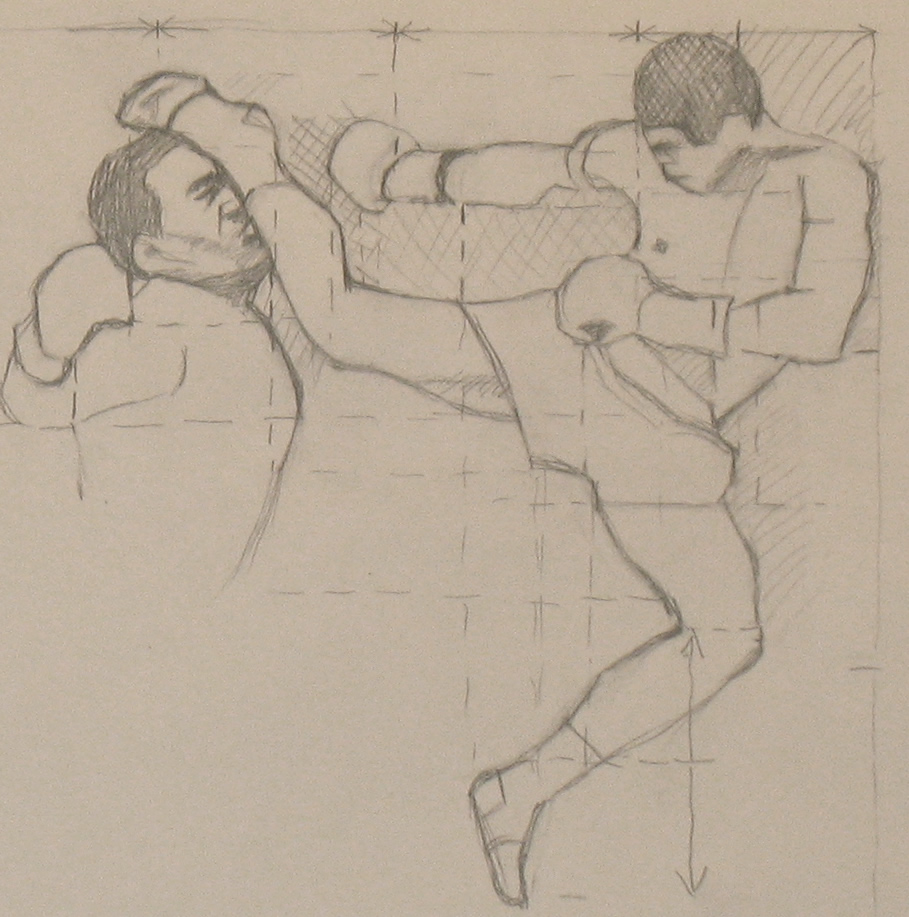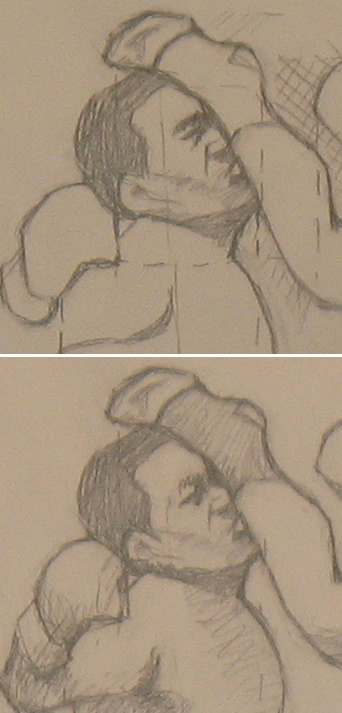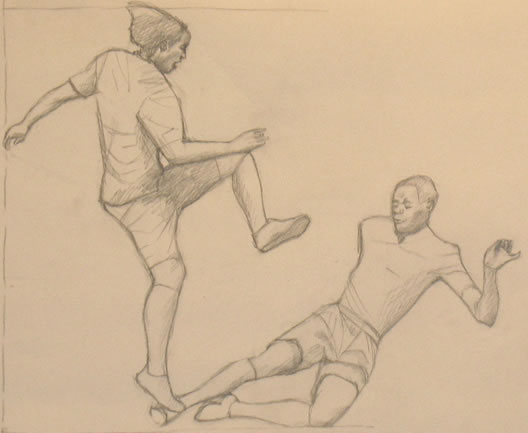






Archive for the ‘Free online drawing lessons’ Category

Why is learning to draw “so hard?”

Thursday, July 29th, 2010

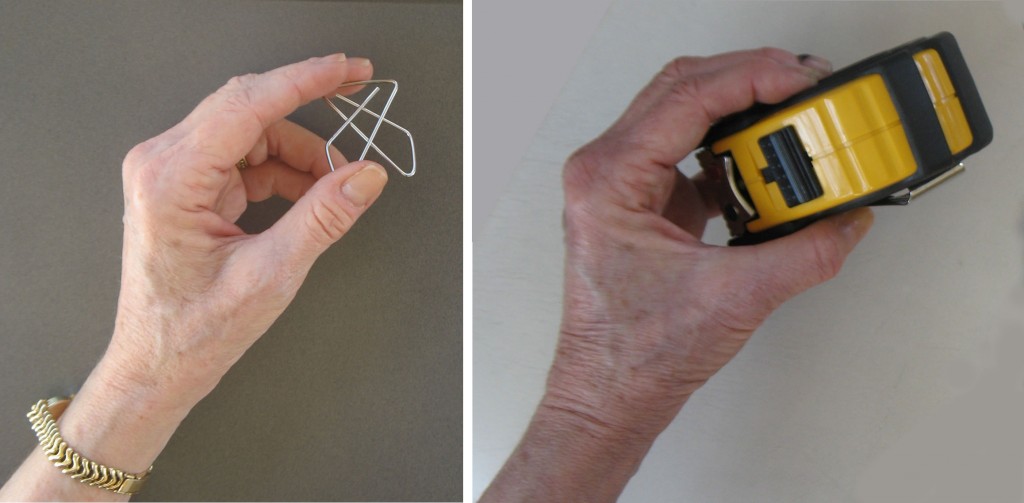
Why do our brains withhold from our conscious grasp a way of seeing that’s so useful?  Why aren’t we able to easily dip into that mode of seeing when we want it to draw?

Centrale Electrique de Zouk (Electric Station of Zouk), by Vanessa Gemeyal

Centrale Electrique de Zouk (Electric Station of Zouk), by Vanessa Gemeyal

When I posted a two-part online drawing lesson a couple of months ago, I received a response that got me wondering.

The response was from a wonderful young Lebanese artist, Vanessa Gemayel (who also happens to be my niece).   Vanessa paints luminously about today’s destruction of the beautiful  traditional architecture that gave Beirut its unique atmosphere, replaced by generic modern architecture that is sadly making Beirut look like every other city in the world.

Vanessa, after trying out my figure-drawing lessons, wrote to me that she found them “very cool and helpful.”  But, she added, “you make it seem a lot easier than it actually is.”  And of course Vanessa is saying outright what many people feel about drawing instruction.

That got me wondering what in the human brain makes drawing from life so not-easy to learn.

All jobs involve a learning curve, often long and hard to get through.  Drawing from life is in that sense no different from any other expertise.  Many skills, for example, require years of study before mastering them.  Others need endless practice.

I believe that the most important element of learning to draw, though, is an “aha moment” – or maybe a small series of such moments.  In those few moments, you suddenly start being able to see in a different way which enables you to draw realistically.  This alternate way of seeing is for me, and for many who draw, the single most basic and important tool we use.

True, endless practice must follow the aha.  But the practice isn’t what blocks most people who really want to learn to draw.

In learning to draw, I think what is elusive to many people is the “aha moment” when they begin to see in that all-important alternate way.

With that aha, you will be able to learn to draw easily.

What is the aha moment in learning to draw?

In my drawing-lesson posts, “Learning to Draw by Playing the Angle Abstraction Game,” I called the technique of seeing differently “angle abstraction.”  The artist is able to see what they’re drawing as a series of angles and shapes that are much easier to draw than when their subject is seen “normally.”

Other artists have given other names to their alternate way of seeing.  Betty Edwards has written two groundbreaking books in which she calls it “right-brain mode,” or “R-mode” (as distinct from left-brain mode, or L-mode).

L-mode is how we consciously think in our everyday lives.  It’s language-based.

R-mode – the one that enables us to draw – is non-verbal and does its work mostly outside our conscious awareness.

The “aha moment” happens when you are suddenly able to consciously access and use R-mode to see differently and draw.

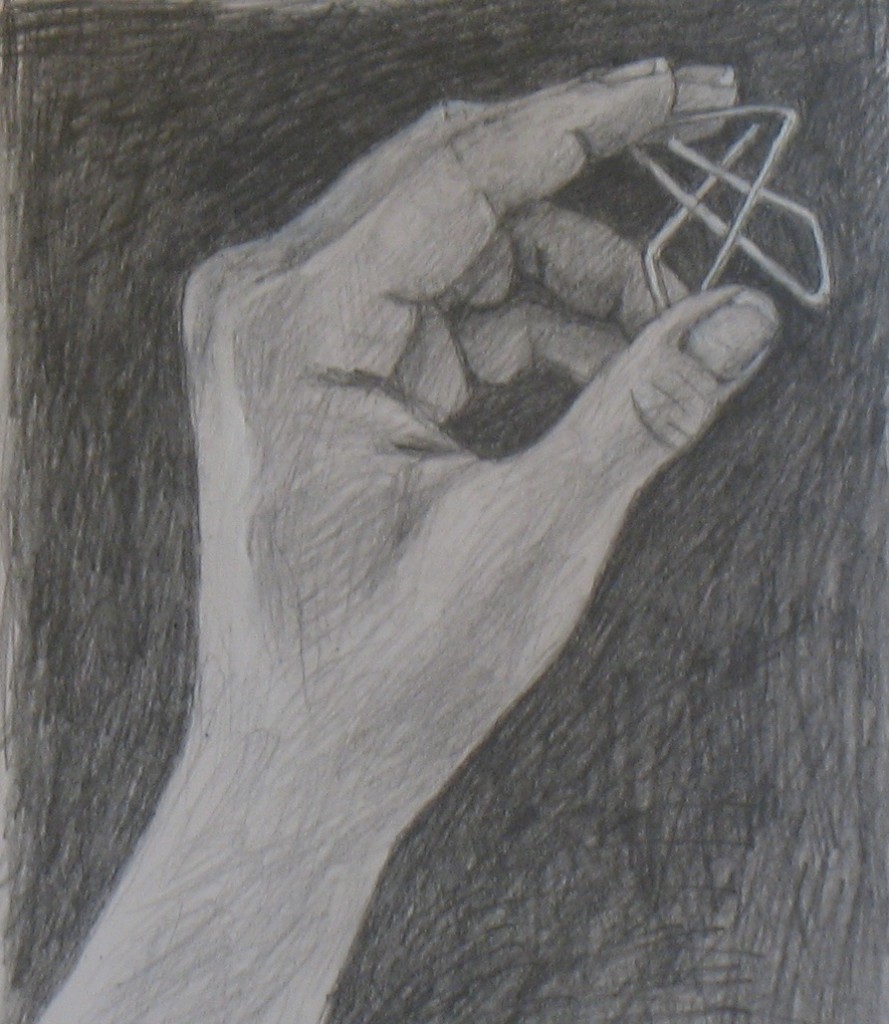
One frame from my free online drawing lesson, "Learning to Draw by Playing the Angle Abstraction Game"

One frame from my free online drawing lesson, "Learning to Draw by Playing the Angle Abstraction Game"

But why would our brains withhold from our conscious grasp a way of seeing that can be so useful?  Why shouldn’t we all be able to easily dip into that mode of thinking when we want it to draw?

Why do our brains block our aha moments?

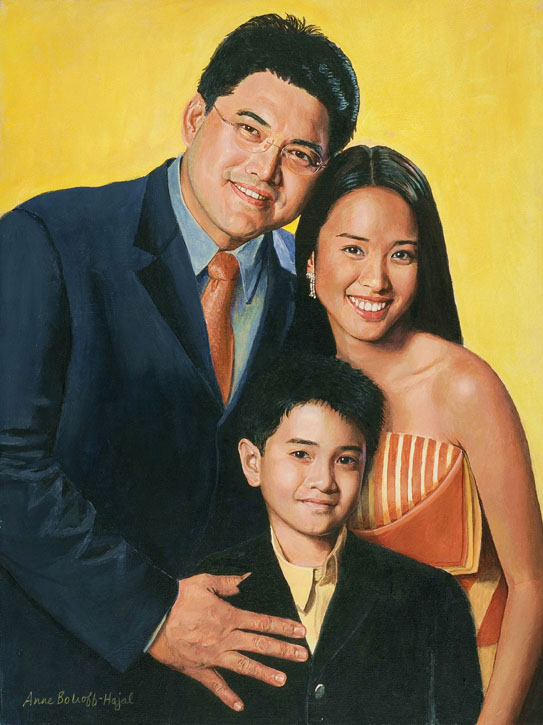
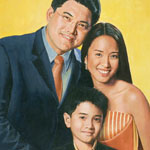
Portrait of the Steinbergs, by Anne Bobroff-Hajal.  Notice how different each of the hands looks.

Portrait of the Steinbergs, by Anne Bobroff-Hajal. Notice how different each of the hands looks.

I was pondering this question when I recently ran into a wonderful answer in one of Betty Edwards’ books, Drawing on the Artist Within (p. 208).

One way of conveying  Edwards’ explanation here  is through a group portrait I painted (right) of Bob and Gail Steinberg with their grandchildren, Riley and Alex.  This portrait illustrates one of the classic problems of drawing: how to draw parts of the human body when they are foreshortened – that is when they are coming straight at us, so they look very different from what we usually think of as an arm, a leg, a hand.

The most obvious foreshortened body part in this portrait is the hand of the Steinbergs’ grandson Alex, who is pointing directly at the viewer.  Everyone who sees this painting knows exactly what that hand is doing.  But in fact, it bears little resemblance to our standard concept of what a hand looks like.  Our conscious, rational L-mode brain typically thinks of a hand as something more like the father’s hand in another portrait (below).

Detail of Edwin Ermita and Two of His Children, by Anne Bobroff-Hajal

Detail of Edwin Ermita and Two of His Children, by Anne Bobroff-Hajal

That little pointing finger

Alex’s pointing finger appears on the canvas as a small circle, not the long tube shape we associate with fingers.  That’s strange enough.  But beyond that, the thumb seems bigger than the other fingers.  And it stretches out at an angle that we rarely think of thumbs taking on.  That thumb seemed so odd to me while I was painting it that I rechecked it multiple times to be sure I had it right.

In fact, it’s exactly because I allowed each finger to take on its actual shape – rather than what I might have consciously thought it should look like – that makes it possible for everyone who looks at the painting to know exactly what that strange conglomeration of flesh-colored blobs is.

Now for the other hands….

In addition to the little pointing finger, we can look at the other hands in the Steinberg portrait.  When we really study them, none of them is shaped like our standard concept of a hand.

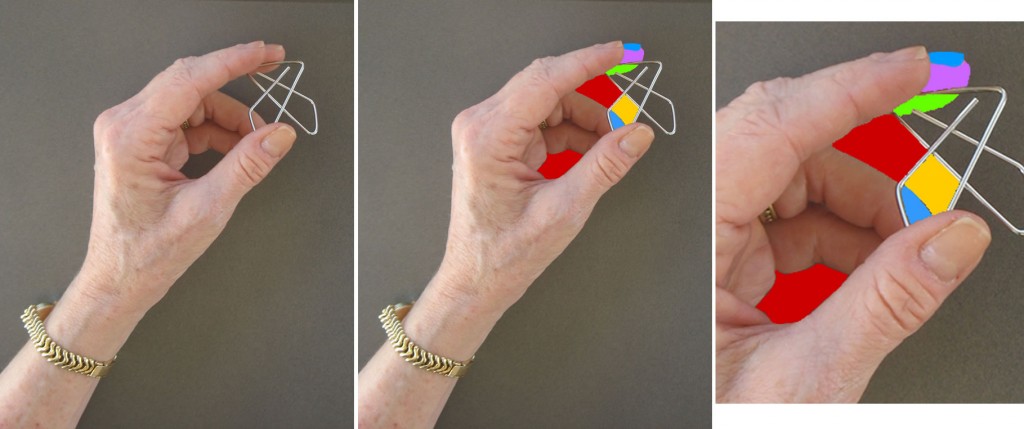
Detail of Steinbergs' hands along with tracing

Detail of Steinberg portrait hands, along with black ink outline of each

Bob Steinberg’s hand appears almost triangular, with only parts of four fingers visible.

Little Alex’s right hand is visible as only a thumb and two fingers.  And the index finger looks like it’s separated from the thumb by an interloping finger which in reality is farther away from the thumb.

Gail Steinberg’s fingers conform fairly well to our standard image of a hand.  But what about the back of the palm area?  It looks much smaller and less rectangular than it “should.”

It’s fine for us to view these shapes as being all different when we’re drawing.  But it’s also crucial for our daily functioning that we recognize all of them as the same – as hands.  It’s the job of our efficient, everyday L-mode, says Edwards, to quickly classify all these odd shapes under the general verbal rubric of “hand.”  And that verbal rubric is envisioned as in Edwin Ermita’s hand above, stretched flat, with five fingers roughly the same length as the palm.

If our brains had to go through a conscious, verbal process of debating whether each of a group of very dissimilar objects is or is not a hand from a different angle, we’d never get through our day.  We’d be mired in endless debating: “I see three of what look like fingers, two from the side and the third, a thumb, from more of a straight-on view.  But if they are fingers, why aren’t there five of them, and why aren’t they attached to a hand?  Is the hand out of my sight, or ….”

Our unconscious interpreter

It’s R-mode, says Edwards, that takes in all the differences in shape and size, and, with lightning speed, calculates from them where things are in space, what they are, and so on.  R-mode sees, for example, that the back of Gail Steinberg’s hand appears to be getting smaller not because it is smaller, but because it’s receding back from her fingers, curving around Alex’s body.  “It’s a hand, all right,” says R-mode, “it’s just shaped differently from a “standard” one because its wrist is farther away from us than its fingers.”

Edwards wrote (p. 178),

“R-mode apparently computes instantaneously and nonverbally….  This computation – and the size-change information that hits the retina – is somehow kept ‘secret’ from conscious awareness, perhaps in order not to interfere with or complicate the language system.”

I suspect this instantaneous computation is also “kept secret from conscious awareness” because language – the currency of L-mode – would slow down its lightning speed.  The rapidity with which our R-mode calculates that a flesh-colored circle is a finger pointing at us happens far faster than we could ever describe in words.

An analogy that might make this clearer is of an athlete hitting a ball.  The athlete’s R-mode brain is making calculations at phenomenal speed about how far away the ball is, how fast its moving, where its moving, and about how the athlete him/herself must move and react to all that information in order to successfully connect with the ball.  If the athlete had to bring all of this to consciousness and calculate it verbally – “the ball is now curving right and I can see it will bounce in this particular way, so I calculate that I should move this way – no, I now see that it had spin on it, so I need to redo my computations…”  – the athlete would never be able to hit the ball before it went whizzing past.

Bringing the aha to more readers

When artists draw, I believe they are making judgments and decisions at that same lightning speed as the athlete hitting a ball.  Their thought process has to be non-verbal because of the countless calculations made in a split-second’s time.

I think this is why it’s so difficult to convey drawing instruction in words.  The artist’s observations, judgments, and decisions happen in a split second of often-exciting non-verbal discovery.  But to convey to a reader that same thought process takes long paragraphs of verbiage.  That’s why I’m hoping to be able to get more video drawing demos up on this blog in future – along with text that tries to convey a small fraction of the artist’s split-second decision-making as he or she works.

We need language to communicate the artist’s process to other people.  But language is slower and more reductionist than some other processes in our brains.  Hopefully a combination of images, video, and language will bring the aha moment to more readers of this blog in the future.

Video drawing demo by artist Jonathan Linton

Tuesday, July 6th, 2010
Stuart, by Jonathan Linton

Stuart, by Jonathan Linton

This is the first of what I hope will be a series of posts featuring video demonstrations of artists drawing, together with their commentary about specific choices they make as they work.  My goal in these posts is to provide insight into the moment-by-moment decisions made by artists during the flow of creating their art.

Drawing at its best is profoundly right-brained – which is to say non-verbal. So trying to translate the drawing process into words often ends up being deadly to read.  What is experienced by the artist as highly pleasurable and out-of-time appears in print as tedious and endless.

So I’m beginning to explore how to convey the artist’s process in a way that’s both fun and helpful to readers wanting to learn more about what’s going on in artists’ minds as they work.

Jonathan Linton is a wonderful portrait artist who I’ve written about before.  Two of my favorites among his portraits are Chad and Stuart (above).  The boy’s facial expression in each of these portraits conveys his very soul.  There’s no vacuous staring into the middle distance here.  Each of the two boys is fully engaged with the viewer in a way that communicates multi-faceted expectations vis-à-vis the world he is growing into.  And each painting is exquisitely rendered from a purely technical point of view.

Jonathan has put some painting and drawing demos on YouTube.  For my present post, he’s now written commentary, keyed to specific moments in his drawing video of Meg.  He’s going to take us through how he moved from reference photo of Meg (below left) to his lovely, complex finished drawing (below right).

Reference photo and final drawing by Jonathan Linton

Reference photo and final drawing of Meg, by Jonathan Linton

Drawing materials used by Jonathan Linton in his drawing demo of "Meg"

Drawing materials used by Jonathan Linton in his drawing demo of "Meg"

Jonathan used a number of materials to create this drawing: vine charcoal, charcoal pencil, paint brush, three different types of erasers, a paint brush, and paper towels (for his complete list, see bottom of this post).  You can trace Jonathan’s use of each during the video by referring to the photo (left) of materials he sent me.  In the video, it’s especially easy to spot the red charcoal pencil and the silver eraser-pencil.  The fat, rectangular Factis eraser is also distinctive.

I’ve embedded Jonathan’s video in this post.  But an easier way to follow through his text explanation may be for you to open the YouTube video in a second window.  Then scroll down to Jonathan’s text in my post below.  Place it next to the YouTube video, and go through the two simultaneously side by side.

It’s fun to go through the video and commentary more than once, because you’ll pick up more of what Jonathan’s actually doing as you become more familiar with both text and video.

One interesting technique Jonathan used was frequent “wiping down” of the powdery-charcoal drawing.  It may seem counter-intuitive to non-artists to repeatedly wipe out an entire drawing as you’re working, so we’ll talk a bit more about that later.

Jonathan began with watercolor-toned paper.  This means that the paper has been covered with a layer of paint to provide color and texture to the background, and as the bottom-most layer of the drawing.

The first drawing implement Jonathan uses is vine charcoal, which is a very soft, light charcoal, easily erased or wiped nearly clean.

Jonathan Linton’s text commentary for YouTube video of drawing “Meg:”

Vine charcoal was used to place the face, mark the axis of the eyes and apply an initial tone.

0:18            In order to give a softer tone to the drawing, I often wiped the drawing with paper towels.  I wasn’t worried about the awkward scribbles showing through to the final layers since the vine charcoal spreads easily.

After placing these rough indications with the vine charcoal, I used a charcoal pencil to feel out the shapes with more specificity.  Since the charcoal pencil’s marks have a lot more sticking power than the vine charcoal, I tried to keep the lines interesting by varying their weight.

0:43            Cross hatching followed the turn of the form.  The idea is that the drawing will end up having some texture in the shadow areas and I wanted that texture to give info as well as to provide interest.

1:15            Everything was wiped down to soften the drawing and unify the tones.

1:18            Back to the charcoal pencil – refining edges and adding tones.

1:50            Another wipe down.

1:52            The erasers lifted the rubbed charcoal off the lighter areas easily.  (The Faber-Castell Perfection 7056 is a great tool, because you use it like a pencil – even to the point of cross-hatching.)

2:10            Back to the charcoal pencil for further restatement.

2:39            Another wipe down – then charcoal pencil.

2:46            Using the white Factis eraser, I made horizontal strokes across the drawing for macro texture.

After this I used the charcoal pencil, the pencil eraser and the paper towels in quick succession – attempting to refine the shapes and nail the tonal variations – trying to keep the lines interesting and decorating with final details.

Now back to me:

Jonathan uses two techniques in the video which involve removing charcoal rather than adding it.  One of these techniques is erasing parts of the drawing in order to create highlights: the areas of the face and hair on which most light falls.

The second removal technique is wiping over with a paper towel the entire drawing he’s created to that point.  The basis of this technique is that the charcoal is only partly erased by the paper towel, leaving a “ghost” image behind.  The ghosts can pile up on top of each other, adding depth and texture to the drawing intermingled with more defined marks.

I recently ran into a description of this wiping technique on the very quirky and entertaining website of a wonderful artist, the 70-year-old Jack Spiegelman.  Spiegelman wrote his description in the fictionalized voice of Otto Dix, the famous German painter.  I’m including it here because there’s something in Spiegelman’s writing that captures the rhythm and highly-focused momentum of an artist’s process.  As I said above, it’s very difficult to write about drawing in a way that captures – well, maybe a tad dramatically at the end of the quote below – the non-verbal state an artist can get into while working.  So, in the “voice of Otto Dix” by Spiegelman:

“I draw and wipe out, draw and wipe out, draw and wipe out. Everything goes on the one piece of paper. The results can be interesting. An energy is produced in this way. Each sketch in some way evolves or is driven by the image that has preceded it.  The erased images remain present as ghost images….

“I draw and wipe out, draw and wipe out, draw and wipe out. Once the drawing begins to happen you switch to a pencil with a  harder lead and work in a little detail.  I draw and erase and draw and erase. Its starting to happen. There is some energy.  I slash away.  I go back and forth from the soft stick to the hard pencil.  I slash away.  The charcoal is flying.  I love this paper!”

Speaking of paper, for Meg Jonathan used Arches Hot Press.

And that brings us last but not least to Jonathan Linton’s materials list:  Bounty paper towels, pencil sharpener, kneaded eraser, Factis eraser, Faber-Castell Perfection 7056 Eraser, vine charcoal, charcoal pencil, and paint brush.

Nicole Mone on the importance of drawing from life

Thursday, July 1st, 2010

This is part of a series of posts about drawing and how artists use drawing.  Others in this thread are here.

________________

Great works are not created with technical ability alone, but it is the starting line.  I like the quote from William Morris Hunt, “Imagination comes in after we have experience.”

- Nicole Moné on why she believes constant sketching from life is important.

Maia (left) and Outdoorsman (right), by Nicole Moné

Maia in Profile (left) and Outdoorsman, Potrait of the Artist's Father (right), by Nicole Moné


Nicole Mone's sketch of a boy on a Metronorth train

Nicole Moné's sketchbook: Drawing of a boy on a Metronorth train.

Nicole Moné almost always carries a sketchbook – usually a Moleskine – with her, to record her impressions of sights she sees in her travels both exotic and routine.  “In my opinion,” Nicole says, “you can never draw and sketch enough, nor will you ever reach a point where you no longer need to.  Continuous observation is essential” for artists.

For those wanting to draw the human figure, Nicole feels,

“a very important exercise is people-watching.  Studying people and the way they move, observing how arms relate to shoulders, how the back arches, how the pelvis tilts when legs move a certain way… When you train yourself to notice these things, you can more effectively translate your observations into your artwork.”

Nicole uses her sketches to record ideas for paintings or sculptures, and as studies for finished works.  Along with her sketchbook, her constant traveling companions include a camera.  “I always have a camera with me as well, and often use the photos in conjunction with my sketches to create a painting back in the studio….”

But if Nicole takes photos of something, you might ask, why bother sketching the same thing?  Nicole responds that drawing

“is important to me because, while sketching, even very quickly, I am more present in the moment than when I snap a photo and move on. Sketching teaches you to see better and remember more. You absorb so much more of your surroundings while sketching and you are listening, smelling & hearing the world around you in that moment….  Sometimes I only have a few minutes, or less, to capture a gesture or some intangible that I want to remember.  There is very limited information but I’ve gotten what I wanted.”

Nicole Mone's sketchbook: ink drawings of Key West

Nicole Moné's sketchbook: ink drawings of Key West

Nicole Moné's sketch of Aaron Shikler

Let’s look at a painting Nicole created based on one of her sketches.  At the time she made the sketch (left), Nicole herself was being painted by portraitist Aaron Shikler.  Sitting for him gave her time to study him from a unique angle.  Being simultaneously a model and an artist, Nicole was able to create an unusual work of art, “The Model’s Perspective #2″ (below).

I love the way Nicole’s finished painting of Shikler captures the contemplative, right-brained state that artists often enter while working “in the zone.”  As an artist, I deeply resonate with the mood of this painting.  And apparently a lot of other people are affected by it, also: The Model’s Perspective #2 has been selected for the “Inspiring Figures” Exhibition and Competition through the Portrait Society of America, hosted by the Butler Institute of American Art, following a New York showing this summer in the Salmagundi Club’s Painting and Sculpture Exhibition for Non-Members.

The Model's Perspective #2, by Nicole Moné

The Model's Perspective #2, by Nicole Moné

Nicole described her process of sketching Shikler, which ultimately resulted in her evocative painting of this mood:

“While I was sitting for a painting for my friend and mentor, Aaron Shikler, I was intrigued by the way he was silhouetted against the windows of his studio and the look of the pipe smoke in the light.  I had plenty of time to observe him as he painted.  I made the sketch to work in conjunction with a few photos that I took with my camera phone.

“As you can see, the sketch didn’t end up being the exact pose I used in the final painting, but it provided me with the memory of the scene as I wished to convey it.”

Nicole’s initial sketch is a lovely example of a drawing that stands on its own, independent of the painting for which it was made.  She used lines and shading based on artistic choice rather than strict realism.  While the sketched lines of Shikler’s body capture his position perfectly, the shaded area draws our attention to the lines of his head as he turns away to focus on filling his brush with paint from his (out-of-sight) palette.
.
This sketch also provides an excellent example of how an artist makes decisions about how to compose a final painting.  For the painting, Nicole made a major departure from her initial drawing.  She decided to paint Shikler in 3/4 view instead of the profile she had first sketched.  And Shikler’s hand is central in the final composition, not hidden as in the sketch.  Nicole made these choices because she wanted to show Shikler
“directly engaged with his work, instead of reaching past the easel to an unseen palette….  The 3/4 view also allowed me to convey some space and ‘air’ around the subject by playing with the smoke lingering between the pipe and his far shoulder.”

She began to make these decisions immediately after creating the sketch – while he was still painting her.

For comparison: The Model's Perspective #1 (left) and The Model's Perspective #2 (right), by Nicole Moné

For comparison: The Model's Perspective #1 (left) and The Model's Perspective #2 (right), by Nicole Moné

After Nicole returned to her own easel, in her first painted study (above), she began to experiment with the position of Shikler’s hand, the turn of his face, and the amount of shadow she wanted him in.

It’s interesting to compare # 1 and #2, in which Shikler is leaning father forward, his head slightly more tilted.  These slight changes in body position in #2 show him at a moment when he is more engaged in the act of painting.  Also in #2, Nicole has shifted her perspective to create less distance between Shikler and his easel: the window no longer separates them.  We see more detail in Shikler’s face, so the backlit lens of his glasses is no longer key.  To me, the first painting, while lovely, is more a study of light and smoke.  The changes Nicole made in #2 make it more about an artist’s process and mood while he paints.

Autumn Leaves - Week 16 of The Skeleton Project, by Nicole Moné

Autumn Leaves - Week 16 of The Skeleton Project, by Nicole Moné

Another of Nicole’s artistic interests is the skeleton, inspiring her to begin the Skeleton Project.  She draws from her own life-sized male skeleton which she bought from a medical supplier.  For animal skulls, she uses friends’ specimen collections and gifts she’s been given of animal bones by friends and Skeleton Project fans.  Nicole wrote,

“I love skeletons; there is something deeply beautiful about the human skeleton. Drawing skeletons gives you a greater understanding for drawing the human figure. When you know the architecture underneath, drawing the figure makes more sense.”

Skeleton Project painting by Nicole Moné

Skeleton Project painting by Nicole Moné

In the Skeleton Project, Nicole is fulfilling the words of William Morris Hunt which she quoted (above): “Imagination comes in after we have experience.”  Her fantastical skeleton paintings grew out of her studies of skeletons.  Nicole has turned her drawings of “the architecture underneath” on their heads.  What were initially sketches -  tools to prepare her to paint the human figure – have taken on a life of their own in Nicole’s imagination.

________________

Note on Nicole’s sketch materials: She wrote, “I enjoy the spontaneity & line quality of drawing with ink pens (brands I like are Stadtler, Prismacolor and Faber-Castell PITT artist pens)  though I will often use pencil or a combination of both.”  She also sometimes uses a kneaded rubber eraser to “sketch” on a page toned with Conté crayon, removing color to reveal a drawing.

Reuben (left) and Andy (right), by Nicole Moné

Reuben (left) and Andy (right), by Nicole Moné

Artists’ drawing experiences: Marie McCann-Barab

Friday, May 21st, 2010

Lately I’ve been asking fellow artists about their approaches to drawing.  Having posted a tutorial about my own drawing method, I’ve become curious about what works for other artists.

Before the Fall, by Marie McCann-Barab

Before the Fall, by Marie McCann-Barab

Marie McCann-Barab is a Westchester, NY, artist.  She has a gorgeous and unique style that often places human beings in an eerie state of tension within the natural world.  Marie attended art school at Parsons School of Design in New York City, and has also taught art for many years.

Marie recently described to me three drawing techniques taught by  different professors she studied with at Parsons.  Her description of each technique was so distinct and interesting that I thought I’d present them all here, along with some of her drawings illustrating each.

Attachments, by Marie McCann-Barab

Attachments, by Marie McCann-Barab

Skeletal technique

Marie wrote to me:

“In one class I had to copy drawings of the skeletal-muscular system as homework for a semester. It gave me a good basic understanding of how the body works. The instructor would very specifically hire models of dramatically varied body types. More than once we had a model who could be described as “skin and bones.” We could so clearly see her skeletal structure that it was like the anatomy drawings had come to life. Having that knowledge is incredibly helpful when drawing from the model, but even more so when drawing from imagination.”

Marie's Drawing of a skeleton and application to life drawing in similar pose

Marie's drawing of a skeleton and early application to life drawing

The live model’s position is similar to, but not exactly the skeleton’s (e. g. the skeleton’s back arm is less visible than the model’s because its upper body is more turned away than the model’s).  What amazes me in these drawings is the complexity and detail of Marie’s work, in particular of the pelvic bones, the various joints, the crossing of the two forearm bones, and so on.  I know from my own work how convoluted and difficult the pelvis in particular is to visualize.

Costume contour technique

Marie wrote:

“Another teacher taught us to understand proportion and gesture by drawing the contour of a costumed model with brush and ink. No details, only the edge between the form and the space around it. If the model was wearing an 18th-Century costume, the overall shape had little to do with the actual figure. Hoop skirts and powdered wigs made it very challenging. This process really required right-brain thinking. However, understanding how the body counterbalances weight in any given pose helps an artist express the gesture when the architecture of the body isn’t seen. So the knowledge from the first class helped a lot here.”

The following are not simple contour drawings from this class; unfortunately Marie has lost them.  “I don’t have examples of the pure contour drawings in India Ink,” she wrote.  The costume drawings below are “the long poses at the end of class. We would start them in India ink and would also use gouache or watercolor. But you can see how the costume really obscured the figure.”

Three costume drawings by Marie McCann-Barab

Three costume drawings by Marie McCann-Barab

Perpendicular line technique

“A third instructor,” wrote Marie, taught a method which helped students understand the “architecture” of the human body.  Beginning with the point of the body closest to them, students had to

“draw the figure as if it were covered in a network of perpendicular lines… that described the expansion and contraction of limbs. The process demanded that we look very carefully at the forms. The resulting image became very architectural and really emphasized the perspective of the body in foreshortening. I didn’t enjoy drawing this way, but it was a great exercise in seeing.”

MarieGridDrawings

Perpendicular line grid drawings by Marie McCann-Barab

Marie wrote descriptions of this process:

“I start with the part of the form that is closest to me: a tip of a finger. Then I begin drawing backwards, defining those planes again: the top surface of the digit, the ridge of the knuckle, the side of the finger, the widening of the next portion. When the finger reaches the hand, I’m more aware of the depth and dimension of the hand than if had just approached this with a contour line.”

I find it extraordinary to imagine that this drawing, so accurate a portrayal especially of the finger positioning, was created by drawing “backward” from the tip of the finger closest to the artist.  Marie wrote that she did the same thing in drawing the head: first she drew the small almost-rectangle at the tip of the nose.  Then she worked “backward” in space from that point, just as she did with the hand.

Yin and/or Yang?

Marie added a little addendum about an exercise:

Another approach is to draw with the non-dominant hand. …This exercise is particularly beneficial to anyone who has developed facility and consequently has stopped REALLY looking at their subject. Our dominant hand seems to develop its calligraphy for expressing familiar forms. But when we use the non-dominant hand, we have to look more carefully, and communicate with that hand that holds the drawing instrument.

It’s not only artists who’ve been drawing a long time who have trouble allowing themselves to really see. Beginners who want to learn to draw also struggle with this.  Allowing the mind to cross over into right-brain mode is very difficult for most people learning to draw, and yet it’s basic to drawing well.  Betty Edwards Drawing on the Right Side of the Brain famously takes beginners through a series of exercises that help allow their right brains to take over while drawing.

Yin Yang symbol

Yin Yang symbol

We might think of this in terms of using yin (right-brain) techniques to draw yang (what is there in reality).

When I first read Marie’s description of her professor’s perpendicular lines technique, it seemed very analytic to me, meaning left-brained.  But when she described her step-by-step process of drawing for her head and hands (above), it sounded mesmerizing and dreamy.  Very yin, actually.  I could suddenly see how this technique might help the brain cross over into right-brain territory.

Balance, by Marie McCann-Barab

Balance, by Marie McCann-Barab

As for the skeleton technique Marie described, this still seems to me to be the antithesis of what would help the right brain step forward.  What I found really interesting, though, was the comment Marie made at the very end of her description:  that knowledge of the skeletal-muscular system “is incredibly helpful when drawing from the model, but even more so when drawing from imagination.”

The tension between drawing from what’s “out there” (yang) vs what’s inside the artist’s imagination (yin) interests me a great deal, so Marie’s statement really caught my attention.  It’s challenging enough to learn how to draw what’s in front of us in reality.  Even more challenging is learning how to paint a world that exists only inside the artist’s head, in a way that gives it a feeling of reality.

So – if this doesn’t sound too convoluted – it seemed to me that Marie was saying that her yang knowledge of the skeleton is crucial when she’s creating yin worlds of her imagination.

Well, if this yin-yang paradigm makes any sense at all, Marie’s painting entitled Balance is a wonderful illustration of it.  In Balance, we have Marie’s unique world of a human girl in uneasy tension in a natural setting.  But this is a natural setting of Marie’s imagination, in which the entire world rests on the tidal edge of a beach, the girl balanced on it.

How did Marie make the imaginary natural world of Balance feel real?  The girl’s position atop the globe is for the most part fairly uncomplicated.  What makes her precarious balance clear, though, is her left hand (on the right side as we face the painting).  It’s the hand of a person who has just been startled by being thrown slightly off-balance.  From what Marie wrote about using her knowledge of the skeletal system to draw from her imagination, I would guess she used it to draw that hand.

In short, it’s intriguing that yang knowledge is needed to portray the yin of the imagination, while the yin of the right brain is needed to draw reality (yang).  Food for thought for the future….

August, by Marie McCann-Barab

August, by Marie McCann-Barab

Me against Da Vinci? What’s the best way to draw?

Thursday, May 6th, 2010

If you’ve ever taken art classes, you may wonder why I didn’t include information about the structure of the human body in my two life drawing lessons.  Aren’t figure-drawing teachers supposed to start by describing the internal skeleton, segments and joints of the body, standard proportions of head, legs, eyes, arms, mouth?

For example, Rebecca Alzofon began her online figure drawing lessons with wonderful animations of a skeleton, followed by the three ovals of “Head, Ribcage, Pelvis,” the “Pivot points” inside joints, “Long bones,” and so on.

Drawing by Leonardo Da Vinci

Drawing by Leonardo Da Vinci

The early, great champion of the anatomical approach to life drawing was of course Leonardo Da Vinci.  Da Vinci,  one of the greatest artists who ever lived, did minutely detailed dissections of human corpses along with eyewitness drawings of human anatomy.

But the Angle-Abstraction Game I described in my life drawing lessons, on the other hand, is all about angles and shapes.  Isn’t that geometry, not human bone and flesh?  Where is the brilliant Da Vinci in that?

There are different ways to approach drawing.  I’ve linked to Alzofon here because I admire the care and thoroughness she devoted to her tutorial’s very detailed illustrations and text.  If you want to try out the life-drawing method she represents, I recommend working through her multi-paged lessons.  Her presentation is, I think, more helpful than some of the other briefer ones you can find online.  Above all, I love her use of animation.

Da Vinci: Placement of features in the head

Da Vinci: Placement of features in the head

My own earliest drawing classes included anatomical information, standard proportions and focus on the body itself when drawing.  I learned, for example, that the crotch is the halfway point in the length of the human body – which, by the way, is 6-7 heads.  The nose ends halfway between the eyes and the bottom of the chin, and the mouth is one third down that same distance (you can see exactly this noted by Da Vinci in his drawing of the human head).  The pelvis tilts and turns independently of the chest, as do the shoulders, and so on.

But for me personally, it wasn’t until I put all that aside and looked simply at shapes and angles carved into space that I suddenly began to draw fluidly and with assurance.

In current parlance, I began to draw from my right brain instead of my left.  For me, that made all the difference.

But how could that be?  Where did I get off disagreeing with Da Vinci?

Betty Edwards is the pre-eminent teacher of the “right-brained” approach to drawing, made famous through her book Drawing on the Right Side of the Brain.  I had actually begun using my angle-abstraction game more than a decade before her book came out.  But the book explained to me why forgetting – or at least not focusing on – all that detailed information about the human body worked so well for me.  Edwards made me feel it was OK to diverge from Da Vinci.

In a nutshell, Edwards explains that we often can’t draw because we’re blocked from seeing what’s right in front of us.  What blocks us is our preconceived notions about what a human hand or leg or eye should look like.  We struggle, trying to draw what we assume we’ll see – instead of seeing what’s actually there: how the specific hand in front of us looks, for example, when its fingers point straight at us.

With this in mind, it now seems to me that all the detailed information about the human body’s standard proportions might get smack in the way of our drawing well, rather than helping us draw better.  “Standard proportions” provide more expectations of what we should see, rather than removing expectations so that we can see.  This is especially true when the model isn’t standing upright, but is bent or folded in more complex poses, where “standard” proportions get lost in the twists and turns of the person’s limbs.  And after all, it’s non-standard poses that express the body language of individual people whose personalities we want to capture along with their outward appearance.

Edwards’ great contribution to artists everywhere is that she teaches how to disengage our left brains while we draw, in order to enable us to see what’s actually there.  One very important way of doing this is to focus on “negative space” – the space around the figure, rather than on the figure itself.  Counter-intuitive though this may seem, focusing on the space around your subject is often the best way to capture your subject accurately.  This is because looking at the unexpected negative “turns off” the left brain and allows the right brain to do what it’s good at – drawing.

Da Vinci: Muscles of the neck and arm

Da Vinci: Muscles of the neck and arm

So all the focus on the body itself, and all the analysis of what’s going on inside it, for me at least, engages my analytic left brain and gets in the way of drawing.  Conversely, the more I forget I’m even drawing muscles, hair, and bones, the better I get at drawing muscles, hair, and bones.

I will never know what it would be like to draw without first having my early foundation of information about the body.  It’s very possible that this knowledge informs my drawing even though I never think about it consciously.  I also think I happen to be the kind of visually-oriented person who is always sponging in information about everything I see, like how babies’ knuckles look like dimples and how my own knuckles look as I sit here typing.  I think I may more quickly recognize and draw certain shapes because my mind is always noticing them in my everyday life.  So I’m undoubtedly not a pure test case of drawing from abstractions rather than awareness of the body.

I encourage experimentation with all kinds of approaches to drawing.  What works for me may not work for you.  But I’d also encourage you to strongly consider the possibility that emptying your conscious mind of analytic focus on the body may be the best way to draw the body beautifully.

Learn to Draw by Playing the Angle-Abstraction Game: Lesson 2

Sunday, April 25th, 2010

If you haven’t yet seen the first half of this life drawing lesson, you can get to it here.

Briefly, my Angle-Abstraction Game drawing process begins with a simple shape, in this case an oval. Emerging from the oval, you draw lines corresponding to various elements of the body.  With each added line, you build exponentially more reference points from which to base your next lines and angles.

Astonishingly, from this mess of geometry, a human form will appear.  The magic moment when it suddenly does is the reward for forging through any difficulties that precede it.

DonDugaSketchAlone

My 2-minute sketch of Don Duga

______

Beginning the second half of the life drawing lesson:

Next is the front of Don’s propped-up leg.  By now you have all kinds of reference lines to draw its angle and length accurately.  Which would you pick?

(To reiterate from Part 1, the sequence I’m following here is not preordained.  As you practice with other models, you should move through shapes and lines as you notice their relationships to what you’ve already drawn.  Try to cover the entire body very quickly using basic shapes.  Only after that should you go back to add as much detail as you have time for before your model shifts position.)

DonDugaColoredPathsStage9A

Don Duga sketch

2-minute sketch of Don Duga

The next line I drew may be the trickiest of the entire pose.  This is because our normal expectations about legs cloud our ability to see what’s actually in front of us.

If you rely only on your standard expectations about human bodies, you might assume that the inside line of each of Don’s legs would intersect the body at the crotch, the bottom center of the pelvis.  But in this case, the lower pant leg of Don’s baggy chinos is being pulled upward and way off center by the propped-up leg.

Drawing something this disoriented from our normal assumptions is very difficult.  The only way to achieve it is to abstract how you see it from all your expectations of what it should look like.

By now you know the angle-abstraction game routine:  Forget that you’re drawing a leg or pants.  Look only at the line formed by the top edge of Don’s lower pant leg.  Where does this line begin at the top?  Which line you’ve already drawn does it intersect, and where?  If you look carefully, you’ll realize that it intersects the top line of Don’s raised leg just about at the point where it meets his shirt front.

Once you’ve determined where this line begins at its top, ask yourself whether it descends tilting right or left of its starting point?  At what angle does it continue downward?

DonDugaColoredPathsStage10A

Don Duga 2 minute sketch

Don Duga 2 minute sketch

After I had sketched this line, I double checked its relationship to my already-drawn upper edge of Don’s other leg.  Note that the two are not quite parallel.  They slant slightly toward each other at the bottom.  If you don’t have this right, feel free to sketch in another more accurate line.

If all this reads like a jumble of geometry, it’s because right-brain processes are always very difficult to describe in words (left-brain).  I promise you that what may be tough to read here is a lot more fun in the doing. And the reward at the end is wonderful, when you suddenly realize you’ve created the image of a person from a maze of angles and lines.  So keep moving through this with that spirit in mind!

Let’s now outline the rest of Don’s upper pant leg.  Where does the bottom-of-the-pant-thigh line intersect with the line you just drew?  What angle does it form there? Where does it end?   I noticed that it ended at roughly the same level as the line just drawn for the other leg.

DonDugaColoredPathsStage11A

My 2-minute sketch of Don Duga

My 2-minute sketch of Don Duga

From this point on, completing the outline of Don’s propped up leg is easy because the back calf is almost parallel to the front calf line.

I then completed the bottom thigh line for the other leg, along with the lower arm on the left of the page.

I think you’ve probably grasped the angle-abstraction method well enough by now that it will be more fun for you to play the game on your own rather than reading more verbiage.  So I’ll let my images speak for themselves for the next couple of steps.

DonDugaColoredPathsStage12-13A

DonDugaColoredPathsStage14-15A

2-minute sketch of Don Duga

2-minute sketch of Don Duga

Next, I turned to the hand on the right side of the page.  Many people find hands very difficult.  But hands should be approached exactly the same way as any other part of the drawing.  The lines are short, but the process is exactly the same.

If it’s easier and/or quicker for you, you can abstract hands into their component shapes – triangles and parallelograms – rather than individual angles.  I do this all the time.

DonDugaColoredPathsStage16-17A

Now I drew in Don’s waist – or more accurately, the lines formed where the folds of his pants borders his shirt.  This is another series of those strange and complex lines that you can’t draw in any other way than by looking at the angles and forgetting all your standard expectations about what a waist should look like.

DonDugaColoredPathsStage18-19A

2-minute sketch of Don Duga

2-minute sketch of Don Duga

Last, I sketched in the opening of Don’s shirt along with its buttons.  You’re already used to seeing lines and angles.  For the buttons, look at them as pure ovals.  What is the shape and tilt of each oval?  Each is different from the others because each button is at a different place in the folds of Don’s shirt.  We’re seeing each button from a different perspective. So if you get each button-oval’s width and angle correctly, they will contribute a lot to conveying the shirt folds.  That in turn will begin to give your drawing the depth and detail that make it look 3-dimensional, even though you haven’t added any shading.

DonDugaColoredPathsStage20A

The hand on the left of the page is not my finest moment, so I haven’t described how I drew it.  It’s one of those details you leave for the end of your 2-minute sketch period, and time runs out.  This is a common occurrence in these quick sketches, one that only lots of practice helps you improve on.

You may be wondering about the detail in Don’s face and the folds of his clothing which is in my final sketch, but not discussed here.  This level of detail is the last phase of each life drawing.  I hope to get to talking about that soon.

Meanwhile, though, we’ve accomplished a solid, believable drawing of Don’s basic position!  Congratulations, and keep practicing!

Last but not at all least, I’d like to hear from users whether this lesson has been useful.  Are there parts that haven’t been clear?  Would more lessons like this be helpful, or does this one cover all the basics you need to know?  Are the visuals helpful as they’re done here, or can you think of another presentation that would make you feel the fun better?  Would more or less text work better for you?  Please let me know, preferably by clicking “Leave a Response” below to comment, or else by emailing me at abobroffhajal [at] gmail [dot] com.

Learn to Draw by Playing the Angle-Abstraction Game: Lesson 1

Friday, April 23rd, 2010

In this post, I’m going to begin to show you how I do quick life drawings.  If you’ve always wanted to learn to draw, or just to improve your drawing skills, playing this Angle-Abstraction Game will probably help you quite a bit.

To demonstrate my process, I’ll use one of my 2-minute life drawings of Don Duga, of the School of Visual Arts in New York City.

My 2-minute sketch of Don Duga

My 2-minute sketch of Don Duga

Don used to run a monthly life drawing session for members of East-Coast ASIFA (the international animation society).  One night the model didn’t show up, so Don posed for us himself.

Since I can’t post the actual Don here to enable you to see the 3-dimensional model I was drawing from, we’ll have to do this lesson from my sketch alone.

The goal of quick life drawings is to learn to sketch  people within a few minutes or seconds, which is all the time artists often get in real life.  You’re not going for detail here.  You’re learning to make fast sketches that convey a solid body with limbs, head, and torso positioned in ways that are viable in real life.  (There are also more detailed life drawings – an example of one of mine is toward the end of this post.)

My personal key to success in life drawing has been learning to abstract the way I see.  I view the pose as a series of angles and shapes, either positive (the person) or “negative” (the space around the person).  I’ve named this the “Angle-Abstraction Game.”

It may sound technical and inhuman to focus on angles and shapes when drawing a living person.  But abstracting the way you see is paradoxically the best way to capture the unique posture of each very special human being.

Let’s get started with the lesson.  You might follow along step by step below with your own drawing to get a better feel for what I’m describing.  Boiled down, this process begins with drawing a simple shape, in this case an oval.  You are then able to draw lines emerging from this shape which correspond to various elements of the body.  With each added line, you build exponentially more reference points from which to base your next lines and angles.

Astonishingly, from this mess of geometry, a human form will appear.  The magic moment when it suddenly does is the reward for forging through any difficulties that precede it!

DonSketchHeadCloseup

Don Duga sketch detail

I often begin a life drawing with a rough egg-shape for the head.  For many poses, this is the easiest way to orient the rest of the piece.  (In the figures below, each line is color coded to match the text describing it.)

In the finished sketch of Don, you can see the lines of my egg faintly under the facial detail I added later.

The important thing with the egg is to set it at the correct angle.  Here’s your first moment of abstracting what you’re seeing.  Look at the head purely as an oval that’s tilted at some angle or other.  Forget hair, forget facial detail – forget even that this is a head.  Just play this game with yourself: Can you get that oval tilted properly?  What direction is it tilted?  Straight up and down?  Toward left or right?  Bent way over or only slightly bowed?

(Oh, and place the head on the paper roughly where it is in the pose, so you’ll have space on the page for the rest of the body.  In this case, Don’s head needed to be placed in the upper left of the page.)

Now quickly add a single line along the side of your oval, indicating the front plane of the profile.   Don’t worry yet about the nose or eyes or anything else that makes this a face.  Just look at the fundamental flat plane of the face and play the angle-abstraction game with yourself: what is the angle of the plane on the front your model’s oval? How closely can you replicate it on your paper?

DonDugaColoredPathsStage1A

Now add a line indicating the underside of the chin, using the same angle-abstraction game.  Last, really look closely and add a quick line for the neck.  Forget that it’s a neck.  Just ask yourself: Where along the bottom of your model’s oval does that line emerge?  What angle does it slant at, and how long is it?  Getting these angles down accurately on your paper will help you accomplish the entire rest of the drawing.

Don Duga sketch detail

Don Duga sketch detail

Continuing to move as rapidly as you can, look at the top edge of the model’s outstretched arm.  Forget that it’s an arm.  See it as a line that emerges from the face-plane line.  Play your game:  Where along the face-plane does it emerge?  What angle does it form?

In this particular pose of Don’s, this line emerges at the level of the chin and moves to the right, slanting gradually downward.

How long should this line extend?  As you practice drawing, you’ll get better at sensing how long lines should be.  Meanwhile, you can use the head oval as a rough measuring unit: the line is about twice as long as the width of the oval it’s emerging from.

DonDugaColoredPathsStage2A

When I drew the line, I put a bit of a bend in it (where shoulder meets arm).  But fundamentally I knew where I should draw it because in my mind’s eye, I was seeing it as a line emerging from the face at an angle which I could easily replicate on the page.

Don sketch detail

Don sketch detail

Now quickly move to the other shoulder.  Play the game with yourself:  Where does the line of that shoulder emerge from the other side of the head-egg?  At the same level as the first shoulder line?  Above it?  Below it?

And what angle does it form?  Does it slant up or down as it comes out of the egg?   Draw it.

Next, look at the outside line of the arm at the farthest left side of the pose.  What angle does that form with its shoulder line?  Draw it.

Here you may notice that I first sketched a straight line to help me get the angle accurately.  I then drew a second line, more bowed, to follow the curve of Don’s shirt sleeve.

DonDugaColoredPathsStage5A

Things are really getting interesting now because you have so many reference lines built up!  From now on, you have a bunch of options for lines nearby to determine where each new one should be placed.

Next I moved to the line of the front of Don’s shirt.  First of all, ask yourself where the top of Don’s shirt front should begin.  Where is the top of that line in relation to the head oval, for example?  You can easily figure that out by imagining a plumb line dropped from the farthest-right point of the head-egg.  You can see that I first sketched in that “plumb line” exactly vertically.  But then I realized it shouldn’t be straight up and down.  It’s tilted.

So back to my game:  How could I quickly determine the proper tilt for Don’s shirt front?   I noticed that it’s the same as that of the face profile plane.  So I drew that line parallel to the face plane.

As you draw, you may choose other reference points than the ones I chose.  That’s great!  The important thing is that you are finding relationships in lines that have come before which make sense to you as guides for each new line you draw.

Don Duga sketch detail

Don Duga sketch detail

We’ve now reached a moment that’s always a lift to me: a negative space enclosed by the model’s body.  In this case, it’s a triangle.  (Can you find it in the sketch to the right?)  To me, a triangle is always easier to size up than a line because a triangle has volume.  A line is a wispy thing floating in emptiness, but a triangle has dimension!

(By the way, the order I’m following here is not preordained.  As you practice on your own with other models, you should move through shapes and lines as you notice their relationships to what you’ve already drawn.  Try to cover the entire body very quickly using basic shapes.  Only after that should you go back to add as much detail as you have time for before you model shifts position.)

Probably the easiest way to generate the triangle bounded by Don’s shirt, arm, and thigh is to first sketch the bottom edge of the arm.  Play the game with yourself:  At its left end, where on Don’s already-drawn shirt front does this line emerge?  Does it slant up or down?  What’s the rough angle of the slant?  At its right end, roughly how far from the upper edge of the sleeve should the lower line end (= how thick is Don’s wrist)?  Another way to check your drawing’s accuracy is:  If you envision the entire arm as a not-quite-complete cone lying on its side, what should its overall shape be?  How thick is the cone at its widest end, and how narrow at the other end?

DonDugaColoredPathsStage7Ab

Finally, complete the triangle by drawing the edge formed by the top of Don’s thigh.  Focus on the broad sweep of the long part of this line, ignoring for the time being the fact that folds in his pant leg create a dip in the line close to his shirt front.  Play the game with yourself: Where on Don’s shirt front does this line emerge on the left, how much does it slant, and where does it intersect with the bottom edge of Don’s sleeve?

Don Duga sketch detail

Don Duga sketch detail

Last, check your accuracy by looking at the overall volume of your triangle. Does it have the same rough size as the negative space bounded by Don’s arm, thigh, and shirt?  If not, check to see which of your angles or line-lengths is wrong and correct it.

Now let’s get the other side of Don’s torso marked.  I drew a quick curved line.  I used the shoulder on the left as one measure, and also checked whether I had placed this line so it divided the arm-torso space accurately.  Would you use these same reference points?  What would help you draw this line accurately?

DonDugaColoredPathsStage8A

We’ve now formed a solid foundation of technique needed to achieve the first overall mapping of Don’s pose.   We’ll continue to apply this technique to complete the rough sketch in my next post, Learn to Draw by Playing the Angle-Abstraction Game: Lesson 2.