

Archive for 2011

Russian History “Big Questions” Study Guide – Ivan the Terrible: Madman or Crazy Like a Fox?

Friday, December 2nd, 2011

This is part of a series of lively, fun, and challenging study guides illustrated by my artwork about Russian history.  (The first, Introductory Study Guide is here).  

In addition to being an artist, I have a Ph. D. in Russian History from the University of Michigan.  My new paintings and mixed media works about Russia are collectively titled PLAYGROUND OF THE AUTOCRATS. 

______________
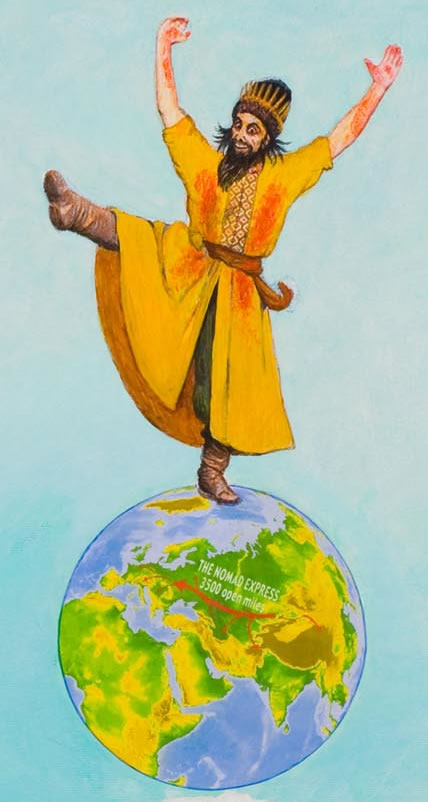
Ivan the Terrible dances triumphantly atop the globe

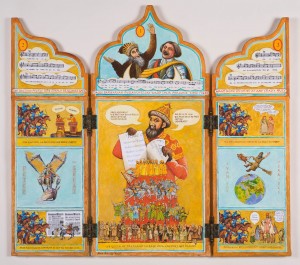
Ivan the Terrible: Detail, right panel of THE MOST EXPOSED TERRAIN ON EARTH, by Anne Bobroff-Hajal

Ivan the Terrible (Ivan IV, 1530-84) is infamous for his brutal murders of thousands of his people during the second half of his reign.  The most notorious of these killings were carried out publicly in grotesque ways, such as impaling or dousing the victim alternately with freezing and boiling water. Historians have debated whether Ivan was insane during the period he called the Oprichnina (1565-72), or was carrying out a strategy to eliminate encumbrances to his autocratic rule.

Question 1:

Was Ivan the Terrible crazy, or was he carrying out a rationally crafted policy?

I’d like to suggest a third possibility: that whether or not Ivan the Terrible was (at least at times) off his rocker, his murderous actions compeled a leap forward in the same direction as Muscovite rulers before and after him.

After all, even an unbalanced monarch grows up in a particular culture, with particular powerful people and groups around him, absorbing whatever history his mentors teach him about his country and government. Maybe even a mentally unstable ruler’s perceptions and extreme actions are so flavored by the world in which he lives that they move forward its trends even without his planning it.

Question 2:

Might a somewhat imbalanced ruler be able to continue – perhaps in a more ruthless way – trends begun by more stable rulers before him?  How would this play out?

This question doesn’t necessarily have a clear answer, but it’s interesting to think about.

Why is thinking about Ivan the Terrible important?
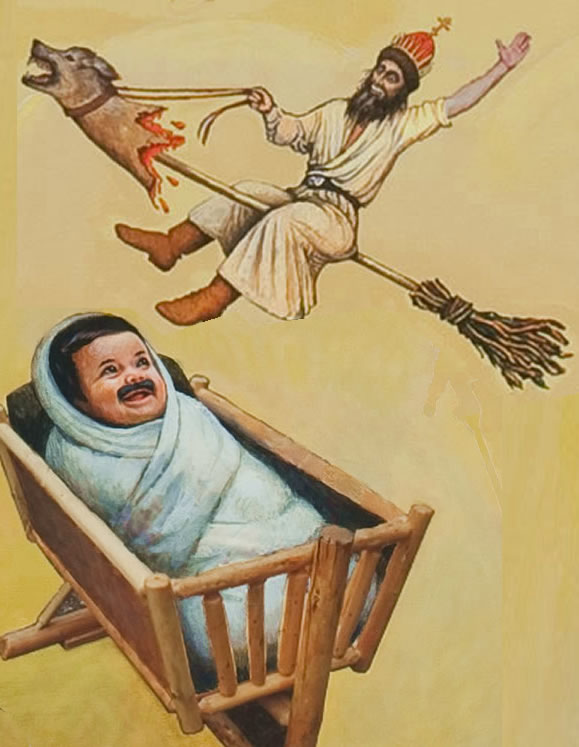
Modified detail: Ivan the Terrible blesses the infant Stalin

Ivan the Terrible as a fairy godfather giving his blessing to the infant Stalin (Modified detail from DRESS IT UP IN RESPLENDENT CLOTHES, painted by Anne Bobroff-Hajal)

Why should we bother our brains with questions about Ivan the Terrible anyway?  Aren’t they only about some looney guy centuries ago in far-off, now-pretty-irrelevant Russia?

Well for one thing, many of Ivan the Terrible’s actions were strikingly similar to those of Josef Stalin 400 years later. In the 20th century, Stalin killed something on the order of 20 million Russians, most of them innocent of the charges against them, also in hideous ways.  For example, both Ivan and Stalin executed some of their most devoted supporters. They each killed some of their best generals during or on the eve of major wars. And they each eventually turned the terror against the people who originally led it, executing many of those who had carried out its first phases.

So two Russian rulers who lived four centuries apart both committed similar horrific murders of vast numbers of their populations.  Maybe they were both crazy!
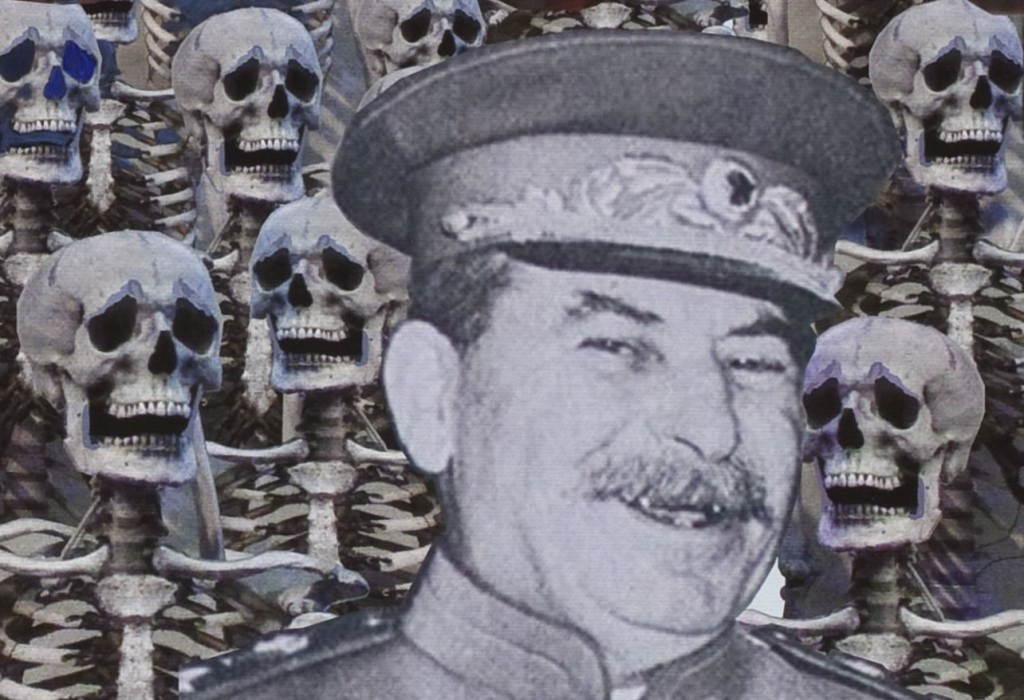
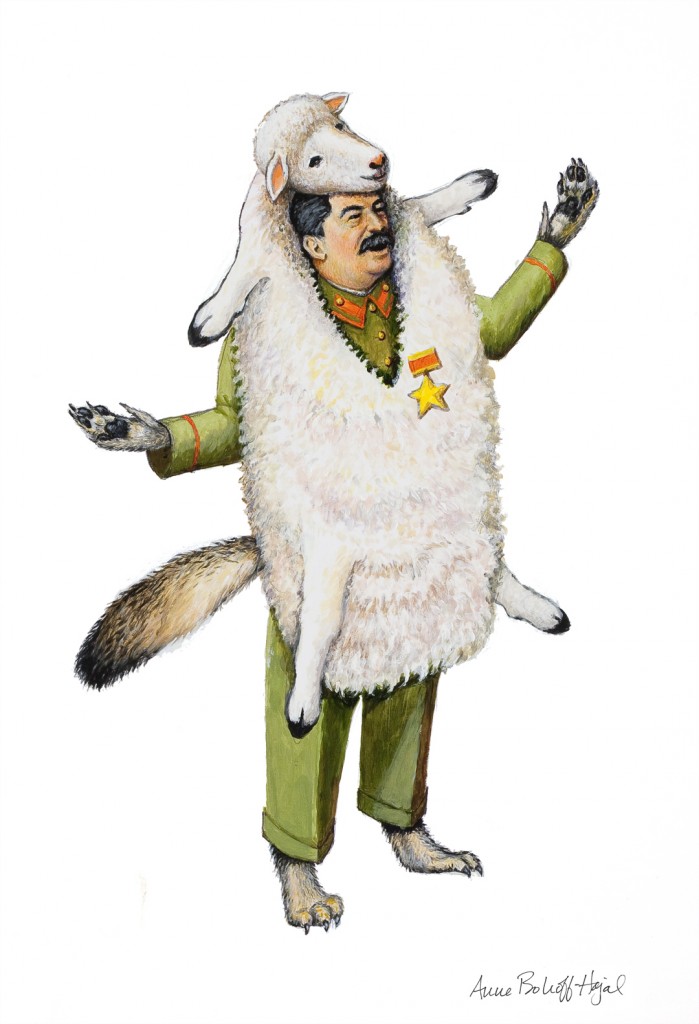
Josef Stalin.  Detail of DRESS IT UP IN RESPLENDENT CLOTHES, by Anne Bobroff-Hajal

But here again, whatever their mental status, their “crazy” behaviors were so strikingly similar that we have to wonder what was in the air in Russia – or the water, the land, or the vodka – that made two rulers almost half a millenium apart do the same maniacal things.

Question 3:

What might caused two rulers of Russia (USSR), living four centuries apart, to visit terror on their own populations in such similar ways?

Again, you won’t be able to respond to this question now. These “Big Questions” Study Guides – as well as my art about Russian history – chip away at these issues, providing ideas and evidence that students can mull over to arrive at their own opinions.

Where can you find a good summary of various historians’ views of whether Ivan was insane or had a goal and a strategy?
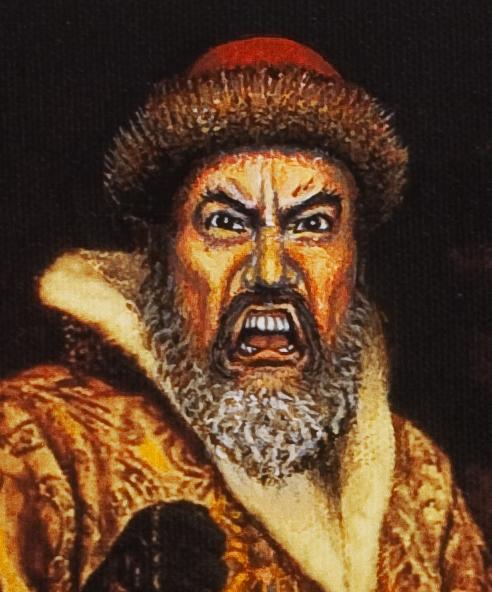
Detail of “Your Grasping, Scheming V.I.P.s,” by Anne Bobroff-Hajal: My representation of Ivan the Terrible’s face.

The two most recent books about Ivan the Terrible each provide excellent summaries of the lively ongoing debate about Ivan and his oprichnina by a number of historians in the US, Britain, and Russia.  I recommend you read both to get two perspectives:

Isabel de Madariaga, Ivan the Terrible (2008), Forward, pp. x-xiv.

Andrei Pavlov and Maureen Perrie, Ivan the Terrible (Profiles in Power series, 2003), Introduction, pp. 1-6.

Two well-known American historians of Russia make the argument that Ivan IV was mentally ill during the oprichnina:

Robert O. Crummey, author of the superb The Formation of Muscovy 1304-1613, p. 162-72.

Richard Hellie, “What Happened?  How Did He Get Away With It? Ivan Groznyi’s Paranoia and the Problem of Institutional Restraints,” Russian History 14 (1987): 199-224.

NOTE: Although I don’t personally agree with Crummey and Hellie on the issue of Ivan’s sanity, they have each written superb books, some of the very finest in the field of Russian history (Crummey’s The Formation of Muscovy and Hellie’s  Enserfment and Military Change in Muscovy; his research on slavery in Russia is also revelatory).

If Ivan’s murderous oprichnina had a rationale, what was it?
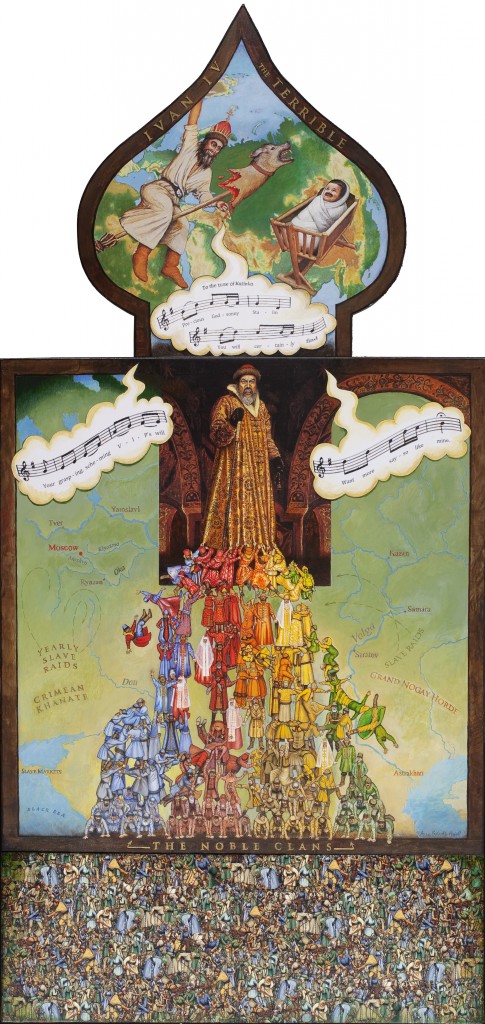
“Your Grasping, Scheming VIP’s,” by Anne Bobroff-Hajal . Acrylic paint and digital images on canvas and board . 32″ x 66″

To decide whether Ivan’s actions were insane, we need to figure out whether there was any possible rationale to them. This doesn’t mean whether his actions were right or wrong (we can probably all agree they were morally heinous).  It means we need to investigate whether Ivan himself may been pursuing a comprehensible strategy, however detestable we may find it.

Crummey has described the court in which Ivan the Terrible found himself as a young monarch who wanted the power to dictate without interference from anyone:

“The tsar lived within a spider’s web of family relationships.  Ties of kinship or marriage linked many of the powerful court clans – princely and non-titled – to one another.  These interlocking family groupings monopolized the highest commands in the army and filled almost all of the places in the Boyar Council [advisory council to the tsar]. Economically, their power rested on ownership of estates held on unconditional tenure.  Any Muscovite ruler had to reckon with them when making appointments or charting national policy.” (Crummey, p. 160).

Text continued after next image
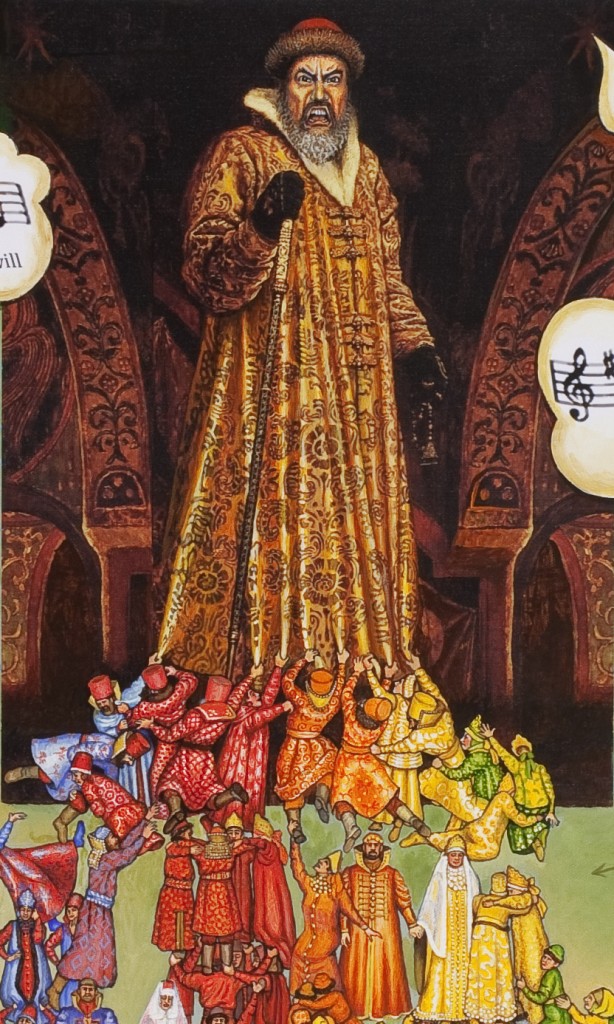
Russian tsars, including Ivan IV, didn’t like having to contend with the influence of the “web of clans” of the Russian nobility, portrayed in this detail of my “Your Grasping, Scheming V.I.P.s”

Pavlov and Perrie paint a similar portrait of the obstacles the young Ivan wanted to overcome in his drive for power:

“…the boyars – and especially those of princely origin – retained great influence.  The most eminent of the princes continued to own large family estates which were the remnants of their formerly independent principalities….  At court they comprised their own highly cohesive ‘corporations’ – the Suzdal’ princes, and Rostov princes, the Yaroslavl’ princes and the Obolensk princes among them.  These corporations were formed on the basis not only of the princes’ common ancestry, but also on their possession of hereditary estates within their former principalities.  Although their ownership of hereditary estates did not mean that the princes were independent landed magnates and opponents of centralization, it did imbue them with…influence at national level.  Conscious of their high birth, the eminent princes laid claim to the role of the tsar’s closest counsellors.  Such aristocratic pretensions on the part of the princely boyar elite could not fail to come into conflict with the autocratic aspirations of the first Russian tsar.”  (Pavlov and Perrie, p. 124).

In other words, if Ivan was to become a true autocrat, he would have to cut his way free of the “spider’s web” of clans, whose power rested on their independent landholding.

How could Ivan cut through the “spider’s web” of princely clans?

The Russian historian Sergey Platonov, writing about Ivan the Terrible during the 1920’s,

“presented the oprichnina as a policy designed to weaken the old princely aristocracy by destroying its large hereditary landed estates and redistributing them on a conditional basis to the new class of small-scale military servitors.”             Text continued after next image
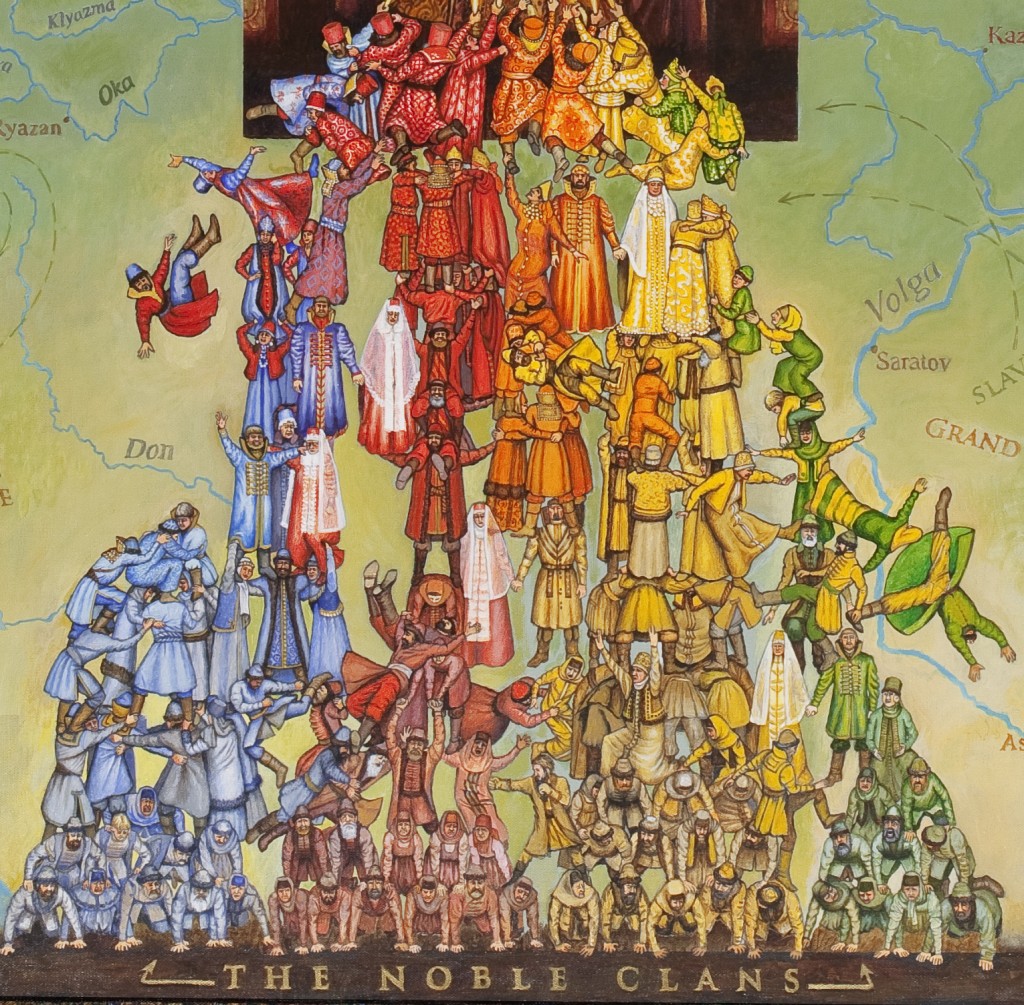
Detail of my “Your Grasping, Scheming V.I.P.’s” shows the lower levels of the noble clans.

During the oprichnina (and afterward, according to Pavlov and Perrie, p. 169-203), Ivan killed or exiled to far distant lands many of the mighty old hereditary landowners.  In their former court positions and on their former estates, said Platonov, Ivan instead installed lower-born servitors who had the right to hold the land only as long as they were in service to the tsar (called “service tenure”).  This destroyed the power base of the old hereditary landowners, removing their ability to limit the tsar’s autonomy.

Platonov’s view was generally accepted for decades, until, as so often happens, it fell out of favor when later historians raised questions about it.

Later historians’ criticisms of Platonov’s work

For one thing, some historians* observed that many of the powerful old boyar and princely clans Ivan had exiled returned to court after the 7-year-long oprichnina (or according to Pavlov and Perrie, after Ivan IV’s death, p. 198), in their own turn ousting Ivan’s low-born courtiers.  That sure made it seem that Ivan hadn’t intended to raise up those low-born courtiers after all.  It seemed that life just returned to the pre-oprichnina status quo.
Martin, Medieval Russia book cover

Janet Martin book cover

Other historians (e. g. Martin, p. 390 and Crummey p. 162-4) have argued that because Ivan was inconsistent in his choices of who to kill or exile and who to include in his oprichnina, he couldn’t have been pursuing a plan of social engineering.  He exiled some princes and kept others at court, executed some of the low-born as well as some of the high.

“Over the course of the oprichnina’s existence, men of many backgrounds served in Ivan’s private army and court.  Some came from aristocratic clans and many more from the lesser nobility.  On occasion, some members of a prominent family served in the oprichnina, while others did not….

[Of those exiled to Kazan,] princes from the regions of Starodub, Iaroslavl and Rostov made up the largest single component…. [But] a significant number were not princes at all; a few came from distinguished non-titled families and considerably more from the lower echelons of the court.”  (Crummey, p. 163-4)

Other historians have also stated that while the original oprichniki were of low birth, their composition later reverted back to the same old princes and boyars.  (However, evidence for this point seems meager and appears to ignore Andrei Pavlov’s recent extensive research** on Ivan’s exiles/land transfers, including in the period after the oprichnina was formally over.)

Historians have also argued that a move by Ivan against the princes and boyars would have been purposeless, since all Russians, from the highest nobility to the lowest peasant, already agreed on the need for an autocratic tsar.  No one, not even the princes, wanted a less centralized system.
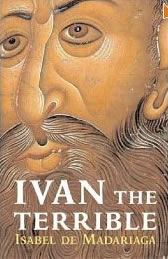
Isabel de Madariaga, Ivan the Terrible book coverAlso, a semantic confusion seems to have crept into the debate. Some of the dissenting historians have considered that, by “raising up low-born courtiers,” Platonov adherents meant that Ivan’s new henchmen became a class aware of their own interests, with an independent power base from which to push for concessions from the tsar.  These historians have accurately observed that in fact no new interest group or class arose.  In fact, the Russian autocracy became stronger following Ivan’s reign, not weaker vis-a-vis the newly elevated servitors.

“Both aristocrats (princes and boyars) and the service gentry accepted the unification of the land under the sole government of the Tsar, and the merging of service [land] tenure and allodial property…in which they all saw some advantages.  Some Riurikid [the tsar’s lineage] princes who had survived in sufficiently strong clans might still hanker after their old appanage [independent land ownership] status, but the pervasive systems…acted as a barrier against any private initiatives,…and the monopoly of lucrative service drew the aristocracy and service gentry together”  (Madariaga, p. 368)

* For example, Janet Martin, Medieval Russia, 980-1584 (2007), p. 392,  and Madariaga Ivan the Terrible, pp. 182-3.

**  Pavlov’s research articles unfortunately haven’t been translated from Russian, but they are described throughout Pavlov and Perrie book, Ivan the Terrible.

Can these viewpoints be reconciled?

It’s important for all students to read the sources themselves to form their own opinions.  But having gone over the sources recently myself in preparation for creating my new artwork about Ivan the Terrible (in my primary role as an artist), I feel energized to present my own conclusions.
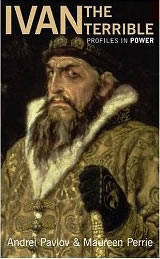
Pavlov/Perrie Ivan the Terrible

Pavlov & Perrie book cover

I  believe most points of contention about Ivan the Terrible for which real evidence exists can be integrated into a single picture of the oprichnina.

First, let’s look at some historians’ point that, since all Russians already believed they needed a single, all-powerful tsar, Ivan would have had no need to bludgeon them into that belief.  Well, as Crummy said (above), even people convinced of the need for a dictator may still battle with each other over access and influence.  And battle among themselves the Russian nobility certainly did.

One might draw an analogy to children who know in their heart of hearts they need their parents to reign supreme.  Yet they squabble endlessly to one-up their siblings and get their way.  Ivan the Terrible was like the dad trying to drive the car while the kids kicked and punched each other in the back seat.  He finally turned around and smacked them.  Or maybe I should say: tortured and beheaded some of them to cow the others into docility.

(Remember I’m not saying this is a good thing or that the Russian people got what was coming to them.  I’m only saying that Ivan didn’t like the fighting and interference, so he clobbered people to stop it.)

Now about those evictions…

Andrei Pavlov’s recent years of research in Russian archives have shown that criticisms of Platonov’s findings are on the one hand unfounded and on the other hand raise important nuances that need to be woven into our understanding of Ivan’s oprichnina.

To begin with, the monumental scale of evictions of magnates from their hereditary landholdings has now been confirmed by Pavlov’s research.  “Over the entire period of the oprichnina,” he wrote, “the majority of Russian nobles may have been moved from their homelands…” (Pavlov and Perrie, p. 142, my emphasis).  Pavlov’s sources have also shown that removing many magnates from their huge estates enabled Ivan to reward his lower born minions with landholdings and money.

It is difficult to conceive of any other ruler in Europe having the power to force such massive migrations and land ownership transfers on his own population.  Along with the terror Ivan visited on his people, this must have had a powerful impact on their way of life and their psyche.

… and the return of all those magnates to the tsar’s court…

Pavlov’s research confirms that, as asserted by recent anti-Platonov historians, many of the old princely and boyar families did return to the tsar’s court, some with promises they’d get their land back.  However, Pavlov and Perrie found this return of the magnates did not occur until after Ivan IV’s death.  They present evidence that even after the formal end of the oprichnina, Ivan continued the same oprichnina policies, relying ever more heavily on low-born henchmen (Pavlov and Perrie, pp. 169-200).

So does this mean that in the end the oprichnina had no effect, and therefore could have had no rational purpose?
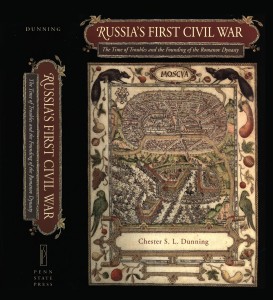
Dunning, Russia's First Civil War

Chester Dunning, RUSSIA’S FIRST CIVIL WAR book cover

Some historians’ vision that former magnates who survived the terror came back to court and went on with their lives just as before seems improbable.  The returning magnates had lived through humiliation, impoverishment, torture, and terror.  They may well have had a number of close family members and friends slaughtered, or have witnessed or certainly heard of Ivan’s ghoulish tortures and killings.  Many former princes and courtiers were likely cowed into submission by this profoundly traumatic experience.  As Chester Dunning wrote,

The resulting horror and dislocation traumatized the elite, seriously weakened many princely families, and increased the nobility’s dependence on the monarch (Russia’s First Civil War, p. 49).

In addition to the psychic impact, the princes and boyars had lost their power base: their hereditary estates.  Pavlov and Perrie write that even in cases where magnates were told their land would be returned to them,

“it was very difficult in practice to implement this policy, which involved the large-scale expropriation of lands from their new oprichniki owners, and the allocation of other lands to the latter in their stead.  In the context of the general devastation of the economy it was essentially unrealistic even to attempt this.  As a consequence only a small proportion of the [displaced] nobles received their old estates back.”  (p. 169)

The resettlement of the nobility “involved many problems and often led to their ruination and impoverishment….  [During the oprichnina,] land often passed repeatedly from one owner to another and fell into decline.  Traditional farming methods were disrupted, and this had a dire effect on the peasants.”  (Pavlov and Perrie, p. 143)

In short, while former magnates were allowed to return to high positions at court, many no longer owned the large, productive tracts of hereditary land which had been the source of their wealth and power before the oprichnina.

“Over the years of the oprichnina as a whole, the balance between hereditary and service lands, especially in the central regions of the country, shifted significantly in favour of service-tenure estates.”  (Pavlov and Perrie, p. 143)

“The oprichnina badly damaged the family estates of the princely and boyar aristocracy, and it particularly harmed the hereditary landownership of the princes.  The destruction of the boyars’ hereditary landholding and the loss of their previous links with the local nobility, led to a significant transformation of the Russian aristocracy, and made it completely dependent on the monarchy….  The sovereign’s court had previously had a territorial structure, with the most aristocratic and eminent nobles not only serving at court but at the same time heading their local associations of the nobility.  By the beginning of the 1570s this had ceased to be the case, and the court had become organized on a new and more hierarchical basis.  The privileged elite of the nobility, the Moscow ranks…had become detached from the great majority of nobles.  They now…performed their service exclusively from the ‘Moscow list’ (based in the capital), which greatly increased their dependence on the state.  This pattern of development of the sovereign’s court was to continue under Ivan Groznyi’s successors.  As a result, the upper echelons of the nobility…were essentially turned into state officials, and as such they began to implement in the localities the harsh policies of the autocracy….” (Pavlov and Perrie, p. 198-9).

Question 4:

Would it have been possible for Tsar Ivan to break up the landholding power-base of the old princes, boyars, and courtiers without using terror?  Could he simply have peacefully decreed that the large hereditary estates were to be divided and distributed to a wider group of nobles?

Why did Ivan turn to the low born nobility to carry out his policies?

I suspect Ivan mounted his terror precisely because he knew the magnates would never give up their large landholdings peacefully.  But how could he find people willing and able to carry out years of executions, tortures, and evictions across the country?  He did it by turning to the impoverished bottom of the noble class and offering them rewards they could never have won before the oprichnina.

“Service in the oprichnina opened up for low-born nobles new opportunities for a successful career and to enhance the social standing of their clan. Sometimes oprichniki of humble birth, in defiance of the traditions of precedence* received higher service posts than more eminent…boyars and nobles.  The latter, fearing the tsar’s disfavor, did not dare openly defend the honour of their clan, and had to accept their loss….” (Pavlov and Perrie, p. 113; see also p.187)

*Precedence was the all-important key to high posts in Russia, and the source of most of the battles among them for status and influence.

The newly-elevated low-born, “being completely dependent on state service, and obliged to the tsar for their career and material welfare, …provided Ivan IV with a loyal and reliable base of support for implementing his political plans.” (Pavlov and Perrie, p. 113-14).

But as a number of recent anti-Platonov historians have pointed out, Ivan didn’t want to raise up the low-born nobles as a new upper class, conscious of their common interests and eager to press their demands on the tsar.  Quite the opposite.  Ivan’s goal was to destroy the ability of all classes to limit his own will.

What about Ivan’s inconsistency in attacking or rewarding the magnates vs the more lowly?

Historians such as Martin and Crummey accurately point out that Ivan was inconsistent in his rewards and punishments, sometimes exiling the lowborn and giving favors to princes. Crummey takes this inconsistency as one indication of Ivan’s insanity.

But I believe his point is answered by historians who have noted that the oprichnina strengthened the autocracy, not any one strata of the nobility.  Ivan rewarded low-born nobles for a period of time in order to win their loyalty as his tools in his larger plan.

If Ivan wanted to assert his power over all levels of society, he couldn’t consistently reward any given category of people, or punish any other given category.  His goal was not to create a new powerful class of favorites, but to undermine the security of all of them.

So Ivan had to be somewhat capricious.  Only in this way could he make clear to every class of people that they had no independent safety outside his good will.

Question 5:

After reading some of the sources what is your own picture of Ivan the Terrible and the oprichnina?  If you’d like to challenge any part of my reasoning – or if you’d like to agree – I’d love to hear from you in a comment or via email.

Final note:

You may have noticed that this entire discussion has been about different levels of nobility, not about those most subservient of all, the soon-to-be enserfed peasants.  And of course, they were the real losers in all this.  We’ll take up their lives more in later Study Guides.
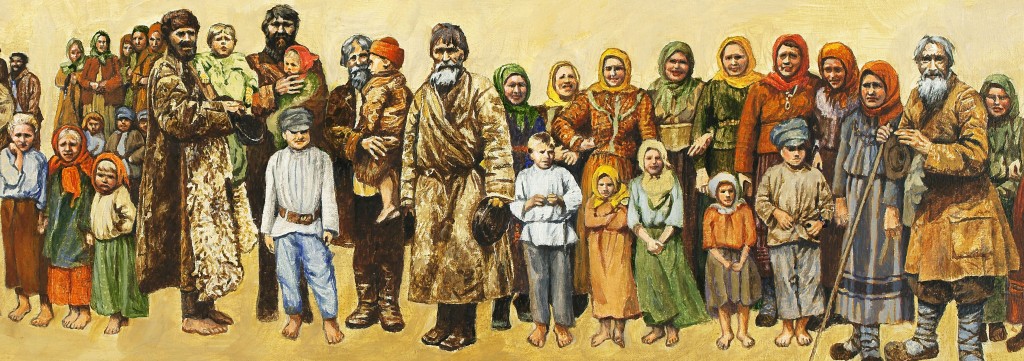
Detail of Still With You painting.

Detail of painting: “Still With You,” by Anne Bobroff-Hajal

Fun research question

Why, in my painting of Ivan the Terrible above, is he riding on a broom with a severed dog’s head on its front?  Why did the real Ivan choose these symbols?
Russian History “Big Questions” Study Guide: Military History on the Endless Steppe Frontier

Tuesday, November 15th, 2011

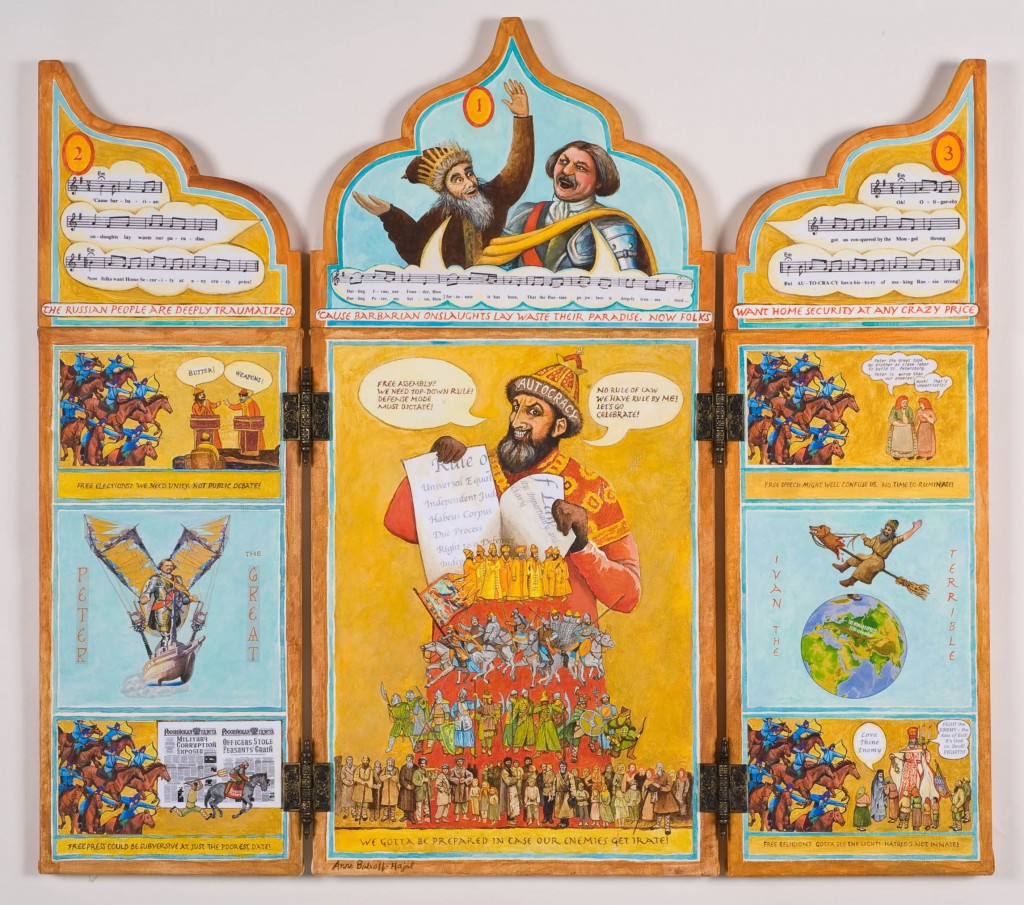
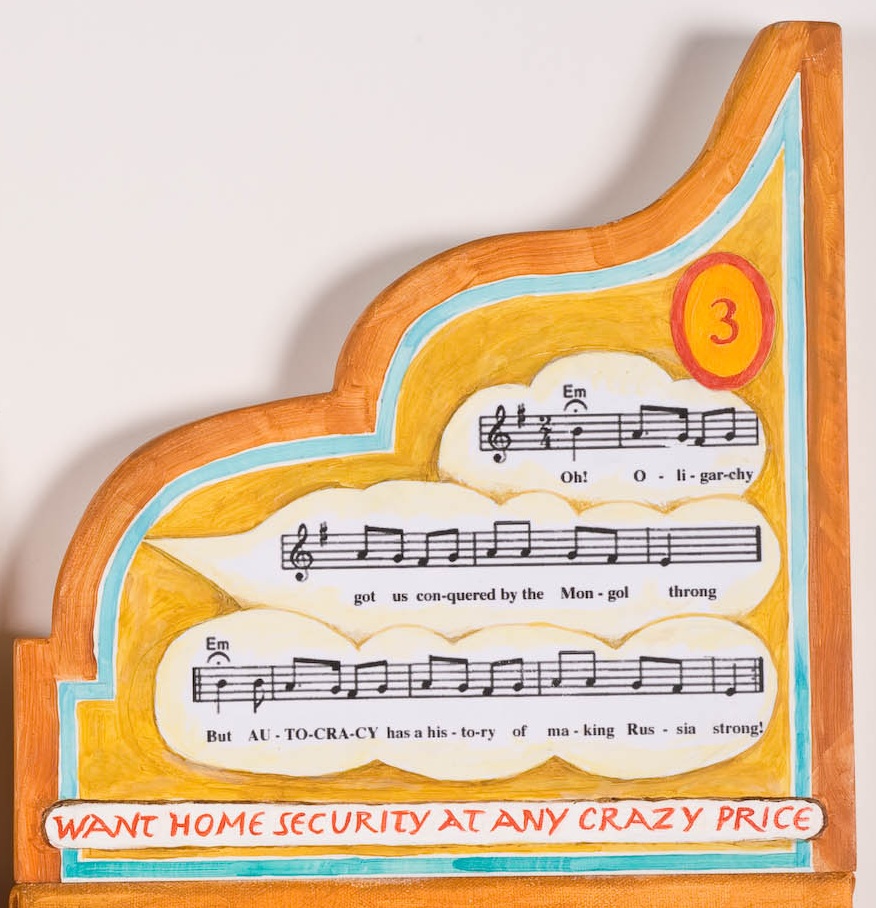
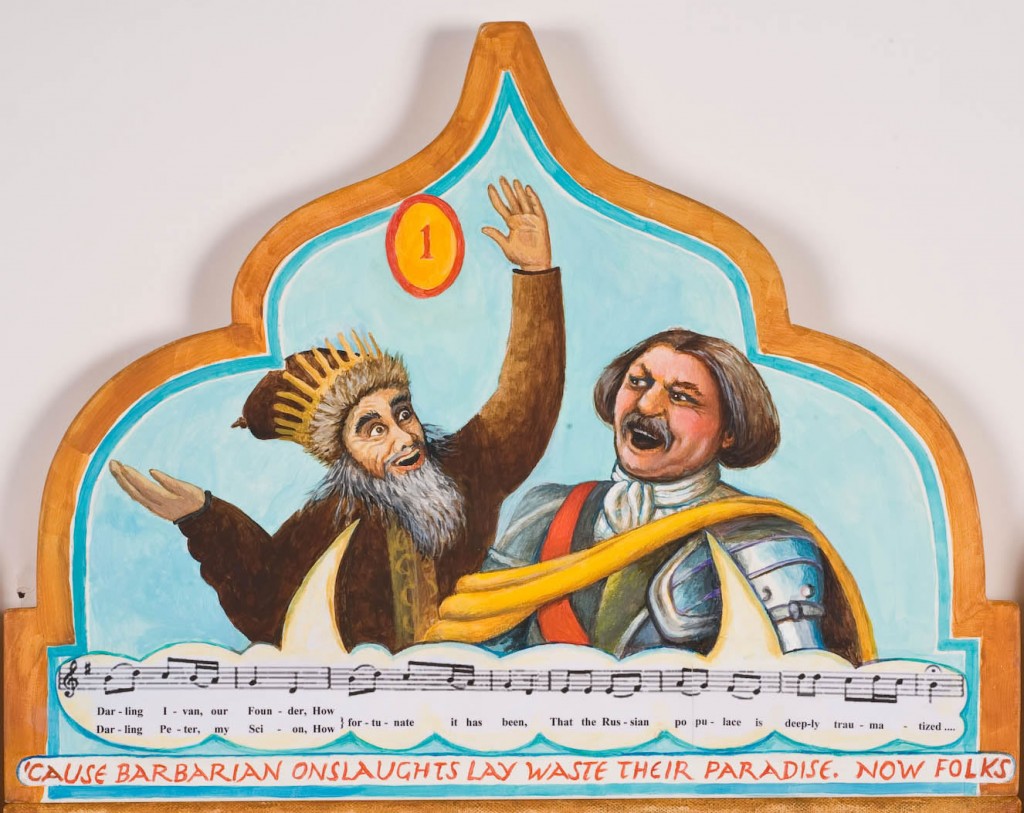
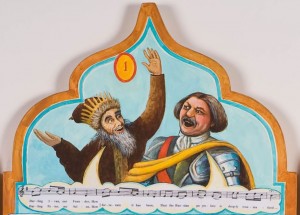
Two PLAYGROUND OF THE AUTOCRATS main characters, Ivan the Terrible and Peter the Great, sing about the glories of autocracy. Detail from "Home Security At Any Crazy Price"

This is the second in a series of lively, fun, and challenging study guides illustrated by my artwork about Russian history.  (The first, Introductory Study Guide is here).  

In addition to being an artist, I have a Ph. D. in Russian History from the University of Michigan.  My new paintings and mixed media works about Russia are collectively titled PLAYGROUND OF THE AUTOCRATS.  

_____

“Big Questions” to think about as you study:

A. Was Russia forced to expand to take over the southern steppes all the way to the Black Sea in order to protect its people from constant Tatar invasion and slave raiding?

"Home Security At Any Crazy Price," by Anne Bobroff-Hajal . Acrylic paint and digital images on canvas and board . 36" x 40" . 2009

B. Or was Russia greedily expansionist, grabbing up territory it wanted rather than needed to protect its people? Could Russia have built a single strong defensive “Great Wall of Russia” effectively enough to block all Tatar incursions, rather than multiple “Great Walls” ever farther south?

Food-for-thought questions:

C.  Might the Tatars have had other choices than slave-trading and raiding to support themselves?  Why were slaves so widely used at that time, including by the Ottoman Empire?

D.  Are the Tatars and Ottomans the bad guys in this saga, and the Russians the good?  Is reality more complex than that, or is this a clear cut case of good vs. evil?

You won’t be able to answer these questions now.  But think of them as mysteries and yourselves as detectives.  As you learn more, look for clues that may help you form your own opinions.

Russia’s Military History on the Endless Steppe

If you want to understand Russia, you need to be able to picture its massive expenditure of resources and human lives – for nearly its first five centuries – to protect against invasions and slave raids across its southern steppe frontier.   Russia contains the largest expanse of flat land on earth.  There was very little natural protection on the vast plains between Russia and the Black Sea.  In the southern grasslands, there weren’t even forests to hinder invaders.  Russia therefore had to create a man-made defensive system to protect its immense open frontier.  (Continued below image)

Detail of left panel, "Home Security At Any Crazy Price," by Anne Bobroff-Hajal . Acrylic paint and digital images on canvas and board . 36" x 40" . 2009

When we envision Russia’s military history, we often think of its wars with European and Baltic nations to its west or of Russia’s rapid expansion across Siberia.

But at least as important in shaping Russia’s government and society was its southern frontier.  This frontier was perhaps unique in all the world in its vast size, combined with its nomadic Tatar inhabitants who lived largely by raiding and slaving, partly to supply the powerful Ottoman Empire next door to them.

Why Have Many Westerners Paid Little Attention to Russia’s Southern Frontier?

Americans and other Westerners may tend to focus on Russia’s eastern and western wars because we identify with them.  European neighbors were Western, like ourselves.  And Russia’s expansion across Siberia mirrors US pioneering expansion across our own western frontier.  In short, we have points of reference in our own experience for Russia’s battles with populations to its east and west. (Continued below image)

Detail of left panel of "Home Security At Any Crazy Price"

But for the US, there is no parallel to Russia’s southern border.  Over half our southern limit is formed by water: the Gulfs of Mexico and California. The single country bordering our south, Mexico, was far less powerful than the Ottoman Empire and its client Tatar khanates.

So we have no point of reference for Russia’s south.  It’s not easy for us to wrap our heads around the implications of the largest expanse of land on earth without natural barriers to prevent constant incursion and annual “harvesting of the steppe,” the abducting of hundreds of thousands of Slavs sold into slavery in the powerful neighboring empire (Ottoman).

Let’s try to give ourselves some points of reference to help us picture Russia’s centuries-long struggle to make its southern population safe along this vast open frontier.

Southern Russia’s Garrison Towns

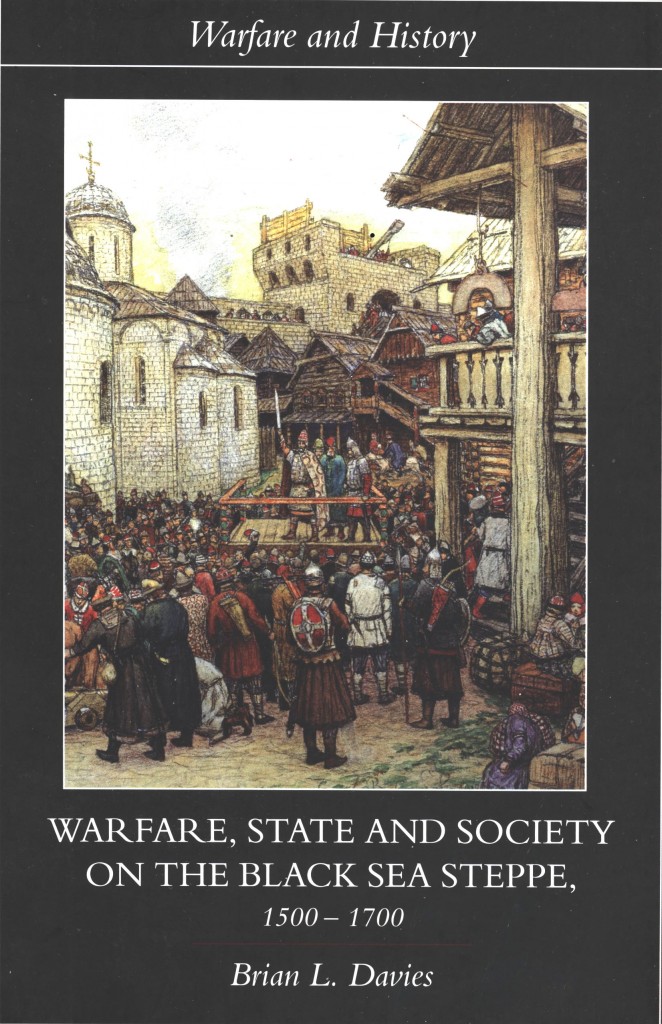
Davies, WARFARE, STATE AND SOCIETY ON THE BLACK SEA STEPPE

Brian L. Davies book cover

Most towns in southern Russia were originally founded by Moscow as garrisons designed to protect against invasions and raids.  Towns couldn’t rise on the steppe organically, based on trade or agriculture, because a settled conglomeration of people would be an immediate target for Tatar raiders.  Towns could exist only if the central government built a garrison, with troops to protect it and patrol the surrounding wide open plains.  For example, in 1677-8, “the southern regions mustered the largest number of town servicemen ever, nearly 47,000 in seventy-three cities.”  (Stevens, p. 127).

The “Great Walls of Russia”

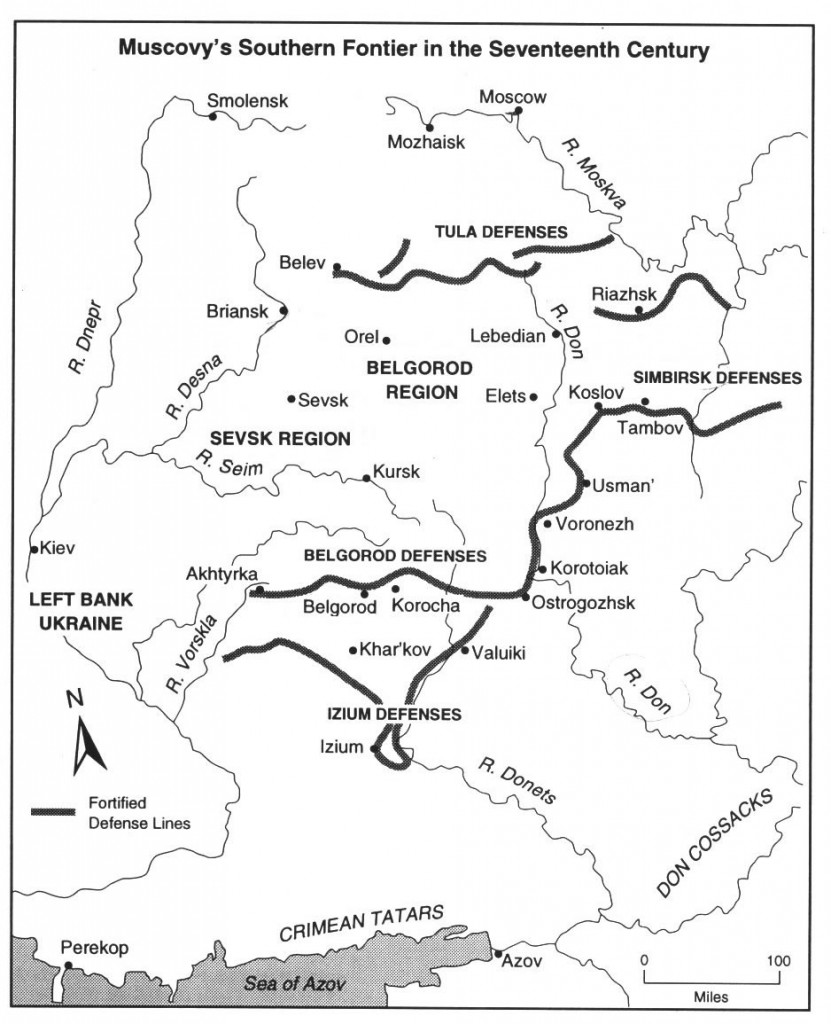
Map of Russia's southern defensive lines in the 17th century, from Stevens, SOLDIERS OF THE STEPPE

As early as the 15th century , the Russian government began constructing a series of what have been called “the Great Walls of Russia,” each several hundred miles farther south in the steppe.   These lines were a combination of fortified towns, stockades, earthen ramparts, trenches, guard posts, and mobile patrols.

Brian L. Davies  describes a section of the Belgorod Line, a 25 km earthen wall built by 950 laborers in 5 months:

This wall stood nearly 4 meters high and had seventy bartizans [overhanging turrets], four earthen forts, breastworks, and ditch and anti-cavalry fences.

Who Lived on the Steppes and Patrolled the “Great Walls?”

There were very few peasants living and farming on the southern plains because they would have been too vulnerable to raiders.   (Continued below image)

Detail of right panel of "Home Security At Any Crazy Price"

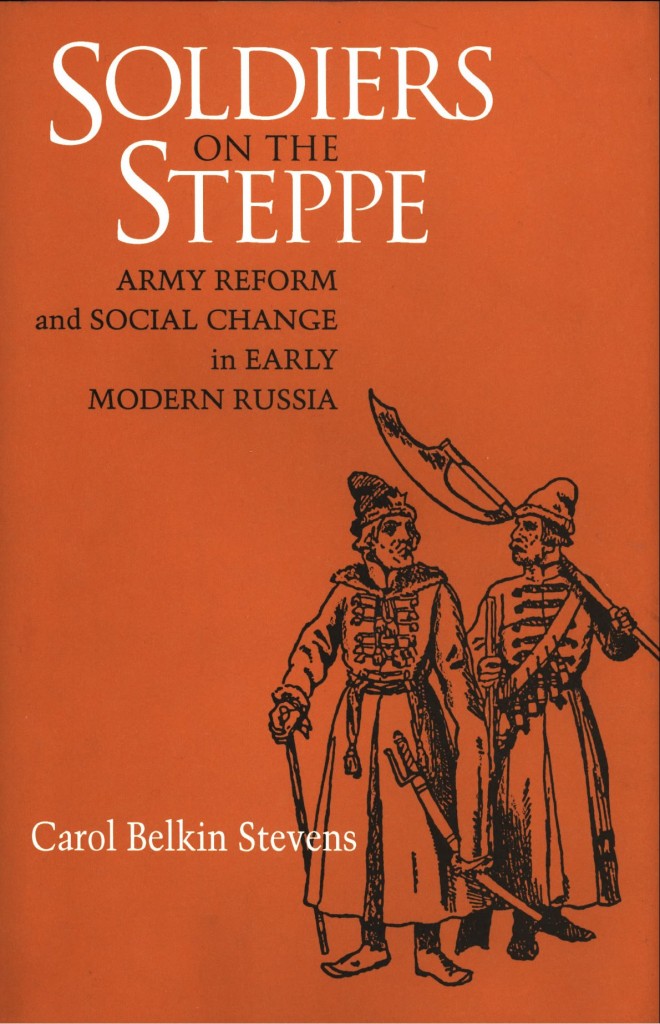
So to create a population to guard Russia’s defensive lines, Moscow sent recruits to the frontier, providing them with plots of land near garrisons to farm for their own livelihood and for taxes.  Carol Belkin Stevens (Kira Stevens) has done brilliant research into the lives of these people for her Soldiers on the Steppe: Army Reform and Social Change in Early Modern Russia.  If you’re writing a term paper on this subject, her book is a must.

Daily Lives of the Frontier Garrison Army

Garrison servicemen were responsible both for guarding their forts and for patrolling the long defensive lines snaking out from their towns.  Constant vigilance was needed to spot fast-moving, skilled Tatar raiders moving across the steppe.  For example, writes Stevens, in the town of Valuiki,

Seventy mounted steppe patrolmen left the fortress at six-day intervals from late spring through early fall.  Their tour of the steppe was extensive…watching for signs of Tatar approach….  Mounted servicemen patrolled between outlying towers or small fortresses and into the distant districts.  Cavalrymen in shifts of six relayed any messages or goods locally; sometimes they provided escort and protection to officially sanctioned groups traveling toward the lower Don.  Beyond the frontier they also stood guard over work on distant and exposed fields or carried news of imminent attack to outlying villages….  Closer to Valuiki, fifty mounted [troops] patrolled the towers of the fortress….

Warnings of imminent Tatar attack led to general alerts, and town walls were manned more densely – often by garrison servitors from other towns.  Musketeers and hereditary servicemen escorted criers with news, orders, and calls to arms around the province.  (Stevens, p. 131-2)    (Continued below image)

Detail, right panel of "Home Security At Any Crazy Price"

In addition, these servicemen repaired old and built new fortification lines.  For example, the southern-most Izium line was constructed by 30,000 men over several years.  “Anticipated Tatar attacks during the construction of the Izium wall placed nearby garrisons on alert, even while town servicemen from further north were actively engaged in building.”   (Stevens, p. 133-4).

Provisioning Garrisons and Campaign Armies over Vast Distances

Stevens Soldiers on the Steppe

Carol Belkin Stevens book cover

In addition to supporting themselves on their own farm plots, southern servicemen were required to contribute grain for the support of campaign forces and people constructing new defenses farther south.  They were responsible for carting this grain themselves to central storage depots, which could be a hundred miles or more away.   Servicemen had to build granaries, warehouses, and river boats to move grain southward; they also worked on the docks.  “Because  old boats could not easily be returned upriver, the gathering of labor, materials, iron parts, and the selection of loaders, escorts, and rowers were annual events (Stevens, p. 134-5).

In the context of continual danger from the south, only a powerful central government could mobilize such massive efforts, and squeeze such great resources and labor from its people.

Stevens gives an amazing description of the first attempt to move campaign troops across the entire steppe to try to do battle with the Crimean Khanate on its own stronghold:

…the army and its supplies were a nearly unmanageable mass….  The massive army led by Prince Golitsyn proceeded slowly across the steppe.  It was organized with an advance guard of ten regiments, followed by a long rectangle made up of an estimated one hundred regiments and the supply train.  In that long rectangle, the main infantry forces surrounded a moving barricade of 14,000 horse-drawn carts that were arranged in ten rows and flanked on the sides by 6,000 more carts in seventeen parallel rows.  The front and flanks of this oblong – 2.3 miles across and 1.2 miles long – were protected by cavalry, with the artillery bringing up the rear.

[At best] the army would have needed more than two and one-half months of any summer campaign to reach…the Crimea and return.  In addition, any such venture required the availability of at least some food, water, and wood along the route….

By 1687 Muscovy could, by exerting extraordinary organizational effort, successfully gather more than enough food for that part of the 112,000 man army it chose to supply.  Russian campaigns against the Crimea, however, posed unusual problems in the disbursement of supply to a large army.  Elsewhere in Europe, similar disbursement problems would be resolved partly by reliance on local agriculture and partly by a series of provision magazines, at regular and quite short intervals….  Neither option was available for the Muscovites proceeding across scantly populated and hostile steppes against Crimea. (Stevens, p. 119-20; my emphasis)

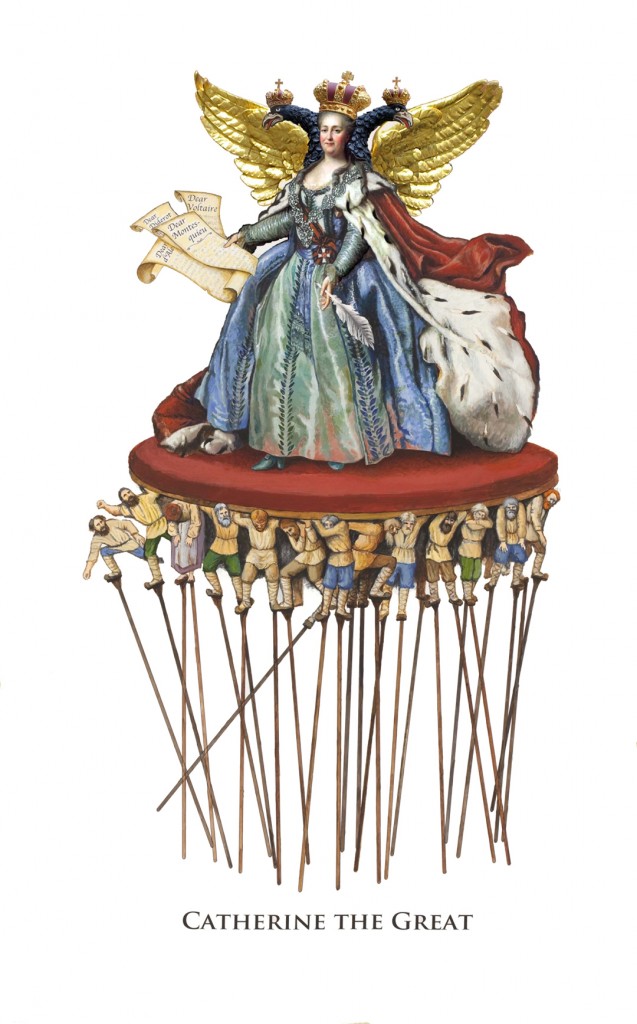
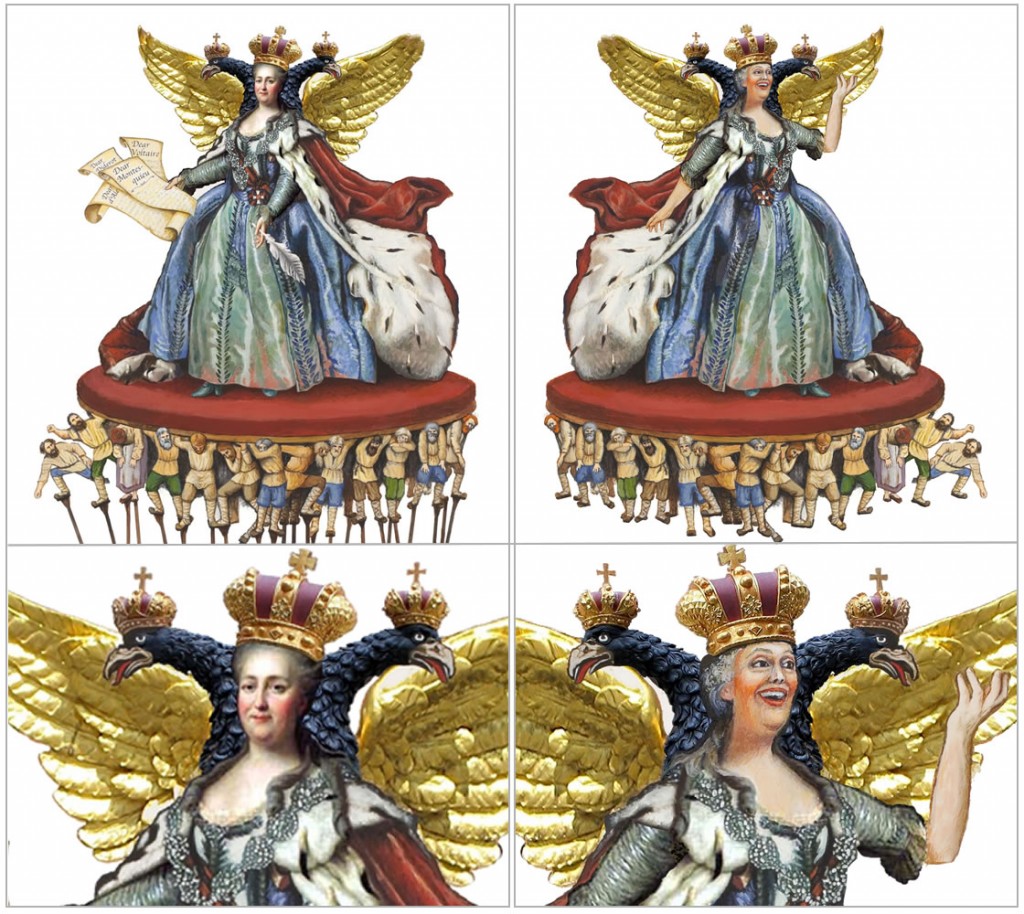
Catherine the Great character from PLAYGROUND OF THE AUTOCRATS by Anne Bobroff-Hajal

In fact, Golitsyn’s army was never able to reach the Crimea.  “The Tatars had burned the grass of the open steppe; to cross that territory, the army would have had to invest enormous effort searching for fodder for its more than 100,000 horses.”  They had to turn back homeward without ever seriously engaging the enemy.

It would take almost another century before the Crimea was conquered, by Catherine the Great.

More on the Tatar Enemies

Brian L. Davies and Kira Stevens have done all-important research on Russia’s extraordinary southern struggles, each from a different perspective of the Russian side.  The terrific work of Michael Khodarkovsky, published in Russia’s Steppe Frontier, The Making of a Colonial Empire, 1500-1800 (in an Indiana-Michigan series, one of whose two general editors was my UM advisor, William G. Rosenberg), in addition gives more of a sense of the Tatars the Russians battled against.

This trio of books is essential reading for anyone studying Russia’s south.  In fact, given the importance of the south to all of Russian history and the shaping of its society even today, these books are important for anyone studying Russia period.

My icon-like Playground of the Autocrats artwork

My PLAYGROUND OF THE AUTOCRATS artwork plays whimsically with the serious saga of the impact of Russia’s peculiar defensive dilemma on its government and society.  I believe that Russia’s autocratic government arose in response to the military struggles described in the work of Davies, Stevens, and Khodarkovsky.  Russian society was organized as a military chain of command, with no independently-organized power bases.  For five centuries, the entire country was ever-prepared to fight against the raids and invasion which came multiple times virtually every year.  And Russia’s rulers took full advantage of its people’s desperation, building what Ronald Wright called a protection racket.

For more on PLAYGROUND OF THE AUTOCRATS, please see the article recently published by Terrain.org, A Journal of the Built and Natural Environment, as well as other posts here.  A PLAYGROUND triptych, “Home Security At Any Crazy Price,” was described by the New York Times as “an homage to Joseph Cornell…full of wonderful goodies.”


Russian History “Big Questions” Study Guide: The First & Ultimate Questions

Wednesday, November 2nd, 2011

This is the first in a series of lively, fun, and challenging study guides illustrated by my artwork about Russian history.  In addition to being an artist, I have a Ph. D. in Russian History from the University of Michigan.  My new paintings and mixed media works about Russia are collectively titled PLAYGROUND OF THE AUTOCRATS.  

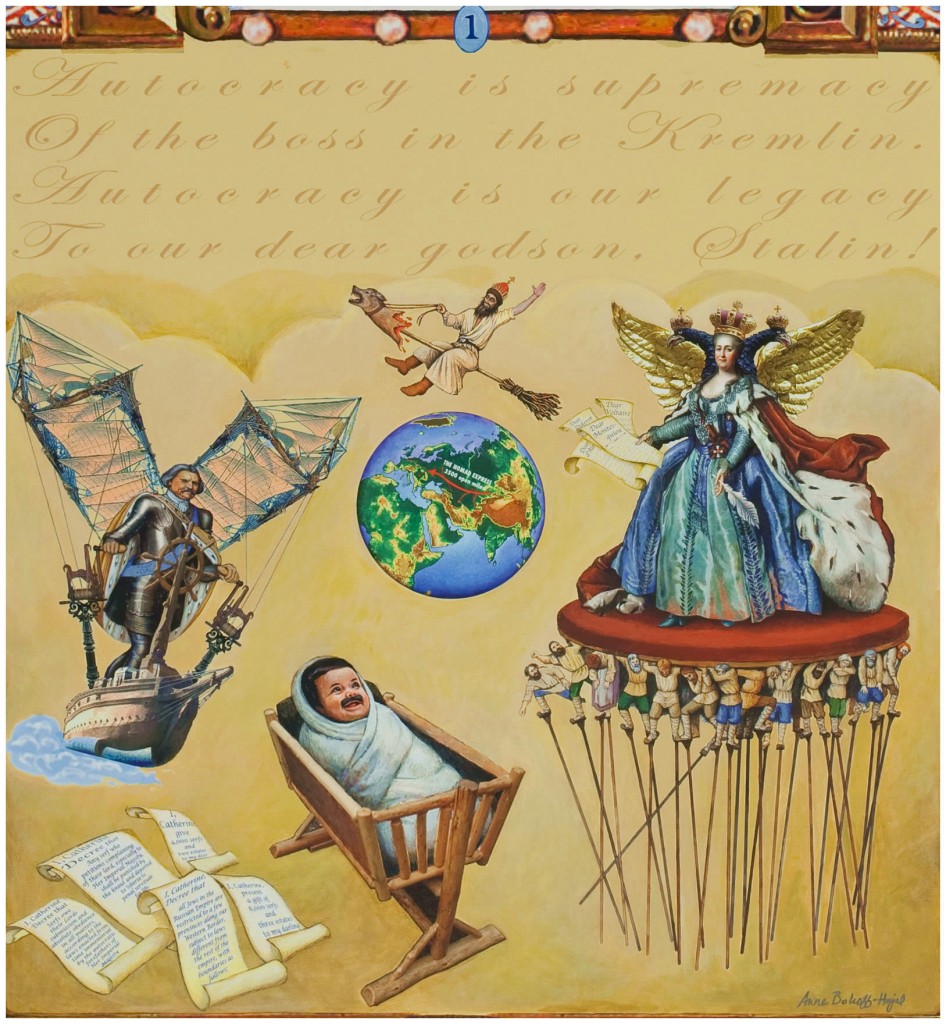
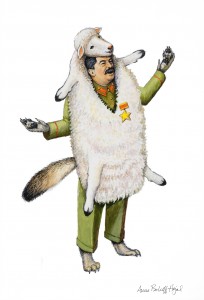
My Playground of the Autocrats art animates a framework for studying Russian history.  This framework explores how Russia’s present-day society and government are embedded its past, from the 13th century through the rise of Muscovy, Tsarism, Communism and post-Communism.  In the image below, the Tsarist godparents of a mustached infant Stalin bestow the blessings of their autocratic past on him, to his delight.

Stalin’s tsarist “godparents” bestow the “blessing” of Russia’s past on Soviet Communism.  Detail of central panel from “Dress It Up In Resplendent Clothes” by Anne Bobroff-Hajal

In these Study Guides, I’ll suggest “big questions” for discussion.  I’ll take a long perspective, not focusing on fine details: less on trees and more on forest.  Actually, I’ll take another giant step back from the forest to see it in wider perspective, to ask what forest conditions cause certain trees to grow there but not others, one forest ecosystem to develop instead of another:

What caused an autocratic state to grow on the vast territory that became Russia, rather than another form of government?  Was it pure chance, or were there particular conditions that engendered it?

Three Quotations

Detail of center panel of “Home Security At Any Crazy Price,” by Anne Bobroff-Hajal

From Chester Dunning and Norman S. Smith, “Moving Beyond Absolutism: Was Early Modern Russia a ‘Fiscal-Military’ State?”  Russian History, 33, No. 1 (Spring 2006) pp. 38-40 (my bold):

“The origins of Russian autocracy are complex and controversial… [They] resulted in the rapid development of a service state…in which he performance of duties that directly or indirectly bolstered the country’s security were required from virtually everyone.  As a result, Russia’s tsarist system became ‘one of the most compulsory in Europe….’

“Coming into the sixteenth century, Russia was, more than any other contemporary society, ‘organized for warfare.’  During the sixteenth century Russian military forces fought almost constantly, and Russia actually emerged as a major military power before the reign of Ivan the Terrible (1547-84), the founder of the Russian empire.  The sixteenth century also witnessed the rapid development of a powerful Russian central state administration….  As in other fiscal-military states, that led to extremely coercive efforts to harness Russian society to the task of paying for the prohibitively expensive costs of early modern warfare.  The extraction of domestic resources was greatly facilitated by the fact that nowhere else in Europe was the principle of service to the state pressed as far as in Russia….

“Generously rewarded for life-long service, the tsar’s bureaucrats were incredibly loyal and hardworking, and they succeeded admirably at imposing the central state’s authority.

“From the very beginning, Russia’s bureaucrats were primarly oriented to the task of raising, financing, and supplying the tsar’s military forces.  They were not hampered by the concerns of bankers or merchants and were therefore basically free to extract resources from the economy with no concern for or understanding of the impact of their actions.  Taxes were imposed with zeal to pay for the cost of war….  Over the course of the [16th] century taxes for many Russians rose 600 percent….”

Detail of center panel of “The Most Exposed Terrain on Earth,” by Anne Bobroff-Hajal

Why was the 15th and 16th century Russian state so continually focused on war, devoting more of its resources to military mobilization than did any other society?  Research over the last decade or so indicates that Russia’s vast open southern steppe frontier forced the country to mobilize militarily from top to bottom. Virtually every year, semi-nomadic Tatar raiders, in small groups and large, galloped across the wide open plain to plunder and “harvest the steppe” of humans to sell into slavery in Crimean slave markets. Over several centuries, hundreds of thousands of Russians were abducted and marched in chains across the steppes to be sold into bondage.  No population except Africans has been enslaved more than the Slavs.

Some of the historians who have researched Russia’s southern steppe frontier are Carol Belkin Stevens, Michael Khodarkovsky, and Brian L. Davies, who wrote in his Warfare, State and Society on the Black Sea Steppe, 1500-1700 (pp.1, 17, 23):

“For nearly four centuries – from the reign of Moscow Grand Prince Vasilii III through the reign of Russian Empress Catherine the Great – the Russian government, army, and people confronted the threats of Crimean Tatar invasion and raiding on their southern frontier….

Brian Davies, book cover

“There were forty-three major Crimean and Nogai attacks on Muscovite territory just in the first half of the sixteenth century….  Large Tatar forces were able to penetrate into the heartland of Muscovy even in years when…the Russians [were able] to increase regimental strengths along their southern frontier.  In 1571 Khan Devlet Girei invaded with an army of 40,000 Crimeans, Nogais, and Circassians and burned much of Moscow, allegedly killing 80,ooo and carrying off 150,000 captives.  The Tatars burned the suburbs of Moscow again in 1592 while the bulk of Russian forces were busy fighting the Swedes on the northwester frontier.  In 1633, while the tsar’s army was preoccupied in a western campaign…the Crimeans and Nogais launched devastating attacks upon the interior districts of Kashir and Serpukhov….

“[S]laveraiding was essential to the economy of the Crimean Khanate.  And if Tatar slaveraiding was a lower-intensity threat than invasion, it was also a nearly constant threat and inflicted heavy costs….  Tatar slavers raided the southernmost Muscovite colonies almost every summer, capturing servicemen and peasants working in their fields, driving off herds of livestock, burning villages and town suburbs, and ambushing patrols and merchant caravans.  Most of these raids were undertaken by chambuly of a few hundred men yet were able to do a great deal of damage.”

Hellie, Enserfment and Military Change in Muscovy

Richard Hellie book cover

Every member of the Russian gentry was obligated to mobilize for half of every summer along the frontier to defend against raids.  This put huge a burden on gentry members who also had to maintain agriculture on what were often small estates.  Wrote Richard Hellie in Enserfment and Military Change in Muscovy (p. 29),

…it was not a standing army.  Usually one half was called up in the spring, to await an expected Tatar invasion on the frontier, and served to mid-summer.  Then it was replaced by the other half, which served until late autumn.  During either offensive or defensive emergencies, which were frequent throughout this period, both ‘halves’ were summoned simultaneously….  The success of any mobilization call was highly dependent on the condition of agriculture at the moment of the summons.  If a serviceman’s lands could not provide the wherewithal for his service, he would not report for duty.

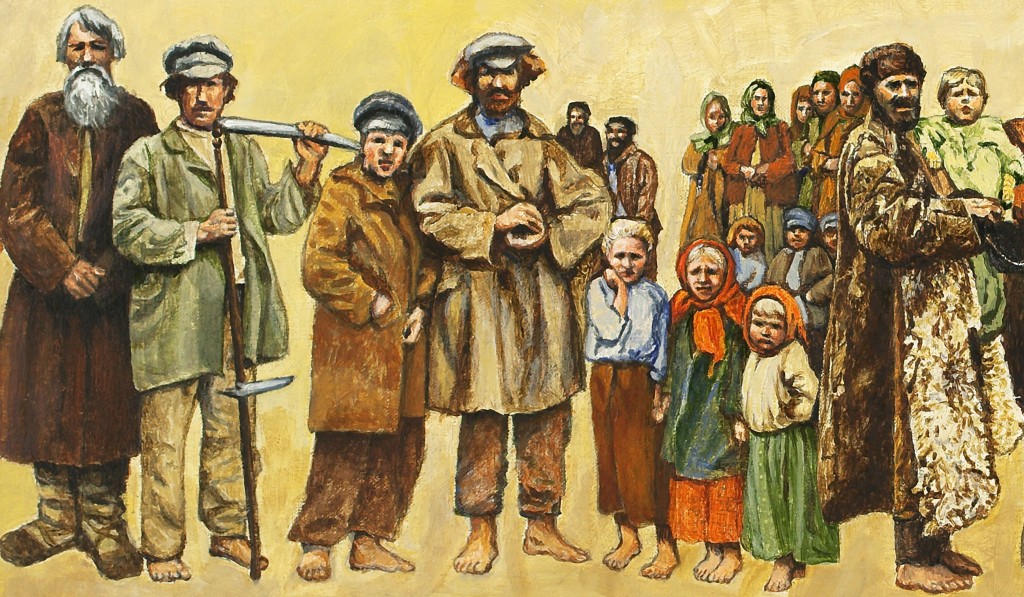
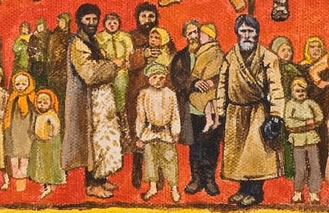
Russian Peasants in Detail of “Still With You,” by Anne Bobroff-Hajal

To the extent possible given the immense drain on resources, all of Russian society was organized like an army ready for war.  The Tsar was commander in chief.  Independent organizations and institutions were not allowed, just as in armies the chain of command from must always to be obeyed.  While Tsar and elites benefited most from this system, the general populace acquiesced in order to be protected against constant threat from across Russia’s great flatland.

Discussion Question 1:

A.  Are there factors beyond human decisions that shape the development of societies in general and in particular Russia?

B.  Or are human beings and their free choices the primary drivers of history, including in Russia?

C.  Can you think of a different position altogether, or some combination of A and B?

Discussion Question 2:

A.  Once an autocratic “garrison state” was formed in Russia, could it have been eradicated in later periods when the country was less vulnerable to outside attack?

B.  Or were elites able to maintain themselves in power even after the “garrison state” was no longer as necessary?

    1. Was the psychology of the majority of people so molded by autocracy that most couldn’t envision an alternative?
    2. Did the lack of development of institutions and power bases independent of the government block the possibility of transformation to a less autocratic state?

In other words, is my triptych godparent image accurate or not?  Is the past the godparent to the future, no matter how revolutionary that future seems superficially?

These are very big questions that you won’t be able to fully answer at the beginning of your Russian history study.  As you read and hear more about Russia, you’ll gather more evidence to form your own opinions about them.

Additional Links:

On the similarities between the trade in Slav and African slaves: Britannica.com.

Robert O. Crummey, The Formation of Muscovy, 1304-1613

Chester Dunning, Russia’s First Civil War: The Time of Troubles and the Founding of the Romanov Dynasty.

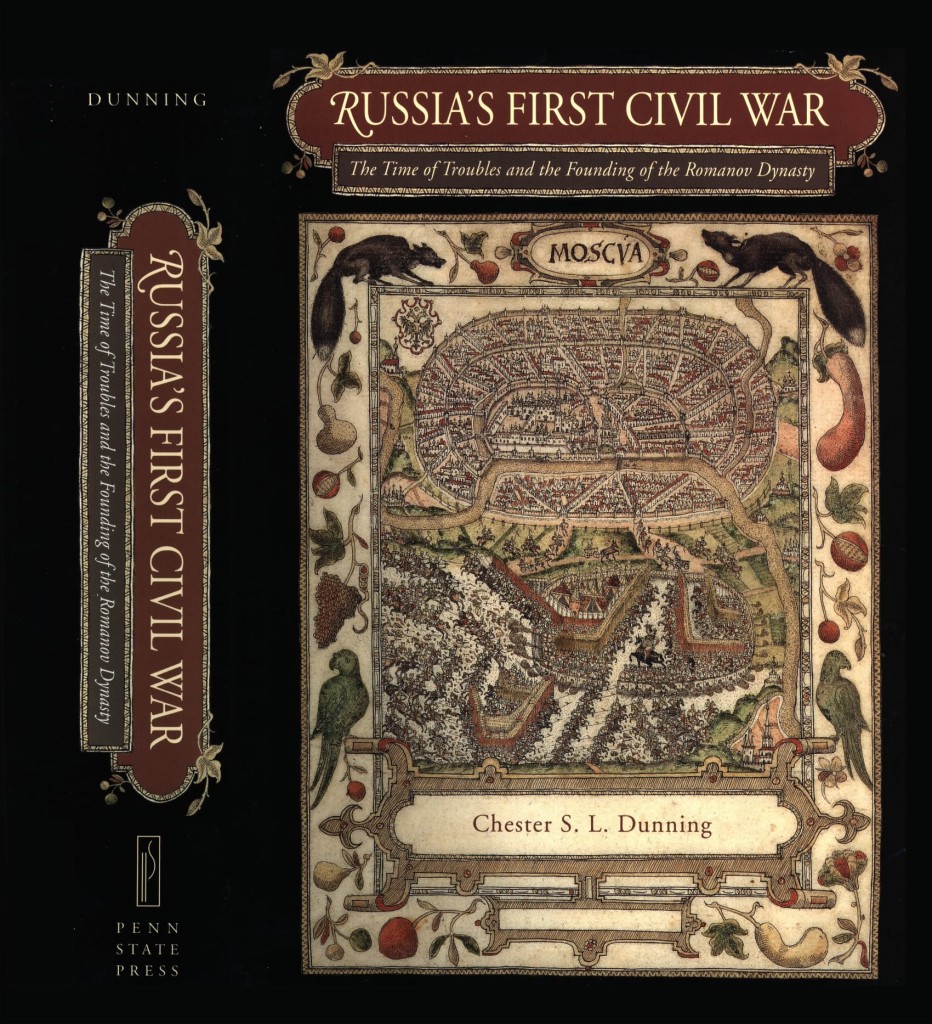
Dunning, Russia's First Civil War

The beautiful cover of Chester Dunning’s book RUSSIA’S FIRST CIVIL WAR, THE TIME OF TROUBLES AND THE FOUNDING OF THE ROMANOV DYNASTY, published by Penn State University Press, 2001, shows “The Rebel Siege of Moscow, 1606”


Playground of the Autocrats in Terrain.org

Thursday, October 13th, 2011

Playground of the Autocrats: The Russian Empire and How Terrain Shapes Society

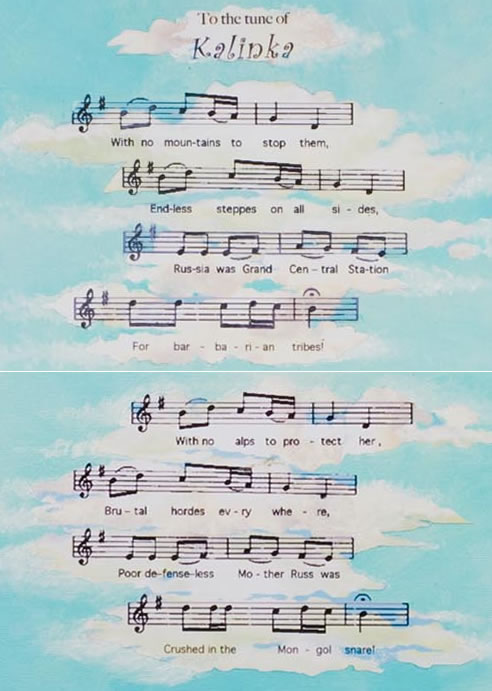
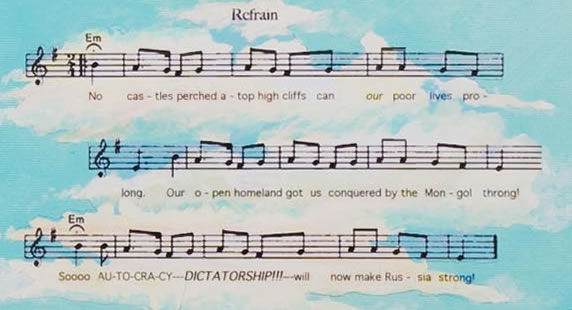
A wonderful article about my Playground of the Autocrats Russian history triptychs was published in the Fall/Winter 2011 issue of Terrain.org, A Journal of the Built and Natural Environments.  It boasts lots of images and even audio recordings of the original lyrics I wrote to the tune of Kalinka, probably the most popular folksong in Russia.

There are separate hypertext selections about each of my triptychs:

Most Exposed Terrain on Earth: Portraying Human Vulnerability on the Endless Steppes

Home Security At Any Crazy Price: What If We Had a 9/11 Every Year For Centuries?

Dress It Up in Resplendent Clothes: Stalin Builds on the Flatlands Past

… and other sections about the vast Russian flatland (steppes), which made the Muscovite state vulnerable to Mongol invasions and the massive trade in Slavic slaves, giving rise to a garrison state:

Landscape Form and Military Defense

The Immense Russian Flatland

Mongol Occupation and the Slav Slave Trade: the “Harvesting of the Steppe”

Terrain.org.While you’re there, please check out all the other great articles in the Fall/Winter 2011 issue of Terrain.org, whose editor-in-chief is Simmons Buntin.  Terrain is, in the words of its wonderful About page,

a twice yearly online journal searching for that interface—the integration—among the built and natural environments that might be called the soul of place.

It is … a celebration of the symbiosis between the built and natural environments where it exists, and an examination and discourse where it does not.

The literary, journalistic, and artistic works contained with Terrain.org are of the highest quality, submitted by a variety of contributors for a diverse audience, including some of the finest material previously appearing in Terra Nova: Nature & Culture. The works may be idealistic, technical, historical, philosophical, and more. Above all, they focus on the environments around us—the built and natural environments—that both affect and are affected by the human species.
Terrain.org strives to be both a resource and a pleasure, a compass and a shelter…


What If We Had a 9/11 Every Year for Centuries?
Friday, July 15th, 2011

“Home Security At Any Crazy Price” 

Long before 9/11, I had written early drafts of lyrics for what would become one of my mixed media artworks about Russia, Home Security at Any Crazy Price.

At the time I thought my theme was very specific to Russian history, a bit too esoteric for most Americans.  It was about Tsars building their dictatorship by taking advantage of popular fears from centuries of brutal enemy onslaughts.  I planned to paint Ivan the Terrible and Peter the Great singing to each other:

Darling Ivan, our Founder (Darling Peter, my Scion),
How fortunate it has been
That the Russian populace is deeply traumatized
‘Cause barbarian onslaughts lay waste their paradise.
Now folks want home security at any crazy price.         (Continued below image)

“Home Security At Any Crazy Price,” by Anne Bobroff-Hajal . 36″ x 40″ .  Acrylic and digital images on canvas and board . 2009

Then came 9/11.  Many Americans’ response – their sudden willingness to give up personal freedoms if the government could only keep them safe – revealed that a similar dynamic to Russia’s can play out wherever people come under attack and feel profoundly threatened.

All at once, my planned artwork seemed absolutely current and relevant to the US today.                                                                                                                    Continued below image

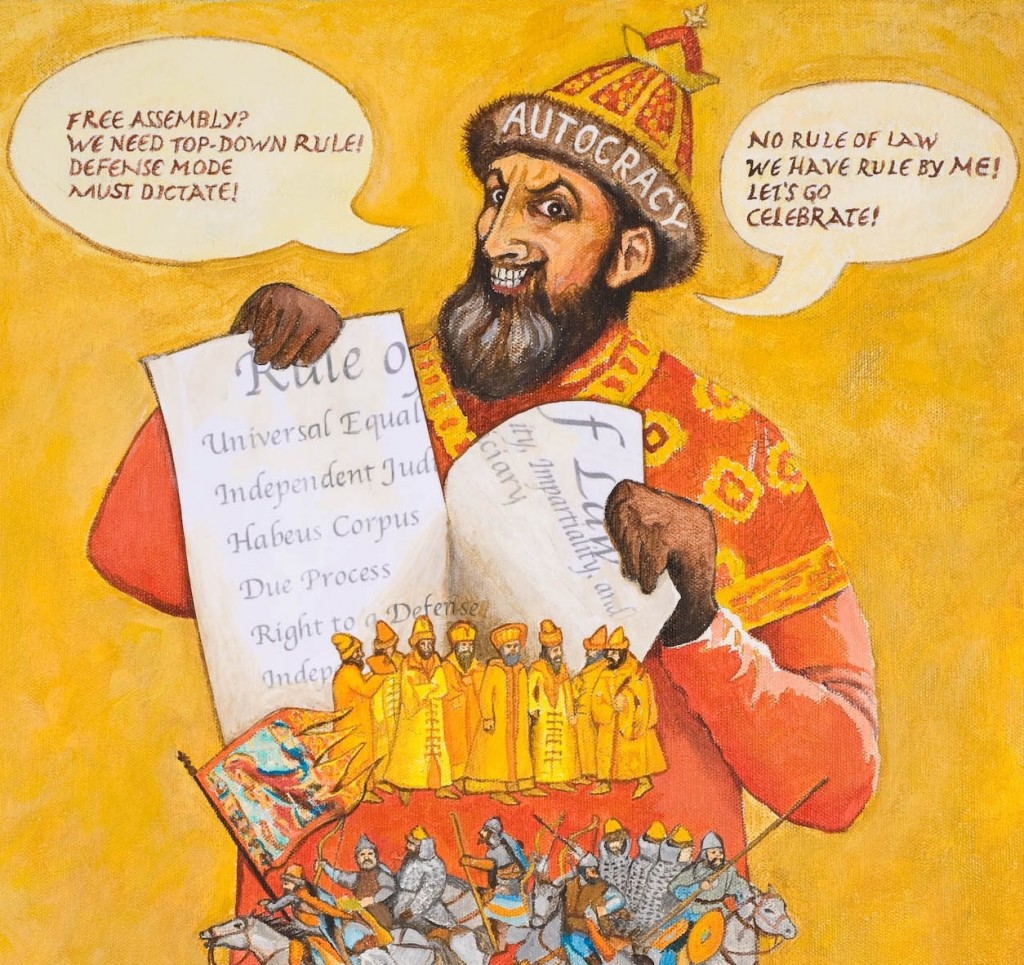
Detail of center panel of “Home Security At Any Crazy Price,” by Anne Bobroff-Hajal

Americans have relaxed a bit since 2001, having experienced no further attacks on the scale of 9/11.  We’re no longer as ready to trade our civil liberties for a strong government to protect us from seemingly imminent terror.

But what if…

Detail of right panel of “Home Security At Any Crazy Price,” by Anne Bobroff-Haja

But what if the US had had repeated assaults every year since 2001, in which thousands of Americans were killed?  And if yearly onslaughts continued indefinitely?

What if we lived in a land so vulnerable that we had a 9/11 every year for over five centuries?

Then what kind of government would we be willing to tolerate?  One that abridged our personal freedoms constantly in order to keep us ever-mobilized and battle-ready?  Would we accept our entire society being organized like a military hierarchy, with a single tsar at the top commanding us into position to survive our unending state of emergency?

What can our 9/11 experience help us fathom about Russia?

Few Americans are aware that Russia was born and forged in terror from outside its borders: constant devastation by enemies and the kidnapping into slavery of hundreds of thousands of Russians, from the 13th century till the 18th.

Detail: Right upper panel of “Home Security At Any Crazy Price,” by Anne Bobroff-Hajal

First, ferocious, brilliantly-skilled Mongol raiders pillaged, sacked, brutalized, and occupied Russia for a couple of hundred years.  For centuries after that, the Mongols’ descendants, the Tatars, swept across Russia virtually every summer, abducting 5,000, 10,000, 20,000 or more people each year to sell in the Black Sea slave market, a straight shot across the steppes to the south.

In fact, our word “slave” derives from “Slav.”  No population in the world other than Africans have been enslaved more than Slavs.  (For more on the reasons, see “The Most Exposed Terrain on Earth.”)

In short, Muscovites were traumatized by terror, as were New Yorkers on 9/11.  But  Russians were terrorized again and again for hundreds of years.

Well, haven’t all countries been attacked throughout history?

Every country in history has been repeatedly attacked.  Their people too have had to drop normal life to run inside inside the walls of their local castle for protection.

What was different about Russia was the frequency of assaults.  Slave raids occurred not once in 10 or 25 years – but every year.  Because these raids occurred every year, they earned the moniker “the harvesting of the steppe.”  Every member of the Russian gentry was responsible for military duty at the frontier for one half of every single summer to protect the vast southern border against raids.

Detail of center panel from “Home Security At Any Crazy Price,” by Anne Bobroff-Hajal

The frequency of attacks on Russia was partly due to its lack of natural protective barriers along a longer open border with powerful enemies than anywhere else on earth.

The only geographic area comparable with Russia’s southern frontier might be the American Great Plains frontier (north/south orientation) in early US history.  But next to the US frontier lay the remnants of native tribes nearly wiped out by disease spread from Europe to the New World.  Next to the Russian frontier, in contrast, were large, flourishing, major powers of the day: the Crimean Khanate, the Ottoman Empire.

It would be as if the early United States had had the equivalent of both El Qaeda and Akhmedinezhad’s government living along its frontier.

Tsarist autocracy was military rule

The tsarist state was military hierarchy writ large (above).  The entire society could never relax from war preparations and fighting.  Centers of power independent of the tsar couldn’t develop because the military chain of command always had to be in effect society-wide.

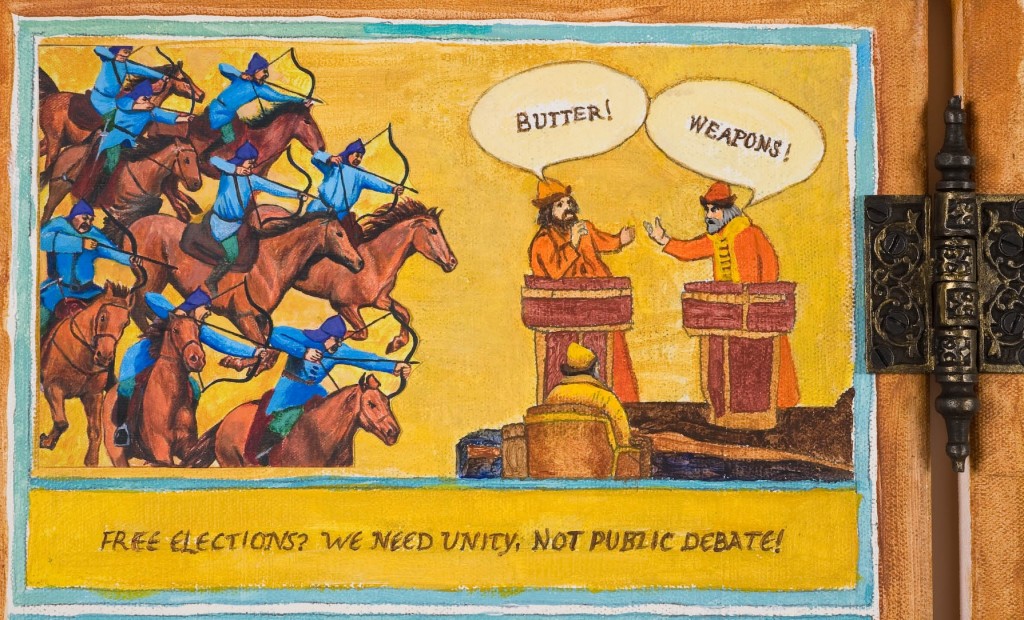
Home Security At Any Crazy Price visualizes the impact on civil liberties of the unending threat of attack.                                                                                       Continued below image

Detail of lower left panel of “Home Security At Any Crazy Price,” by Anne Bobroff-Hajal

Why didn’t civil liberties blossom after the slave raid threat ended in the late 18th century?

Institutions which have been forged over a period of five centuries don’t change overnight.  New autocrats make use of earlier institutions – controlled press, secret police, patronage – to maintain and strengthen their power.

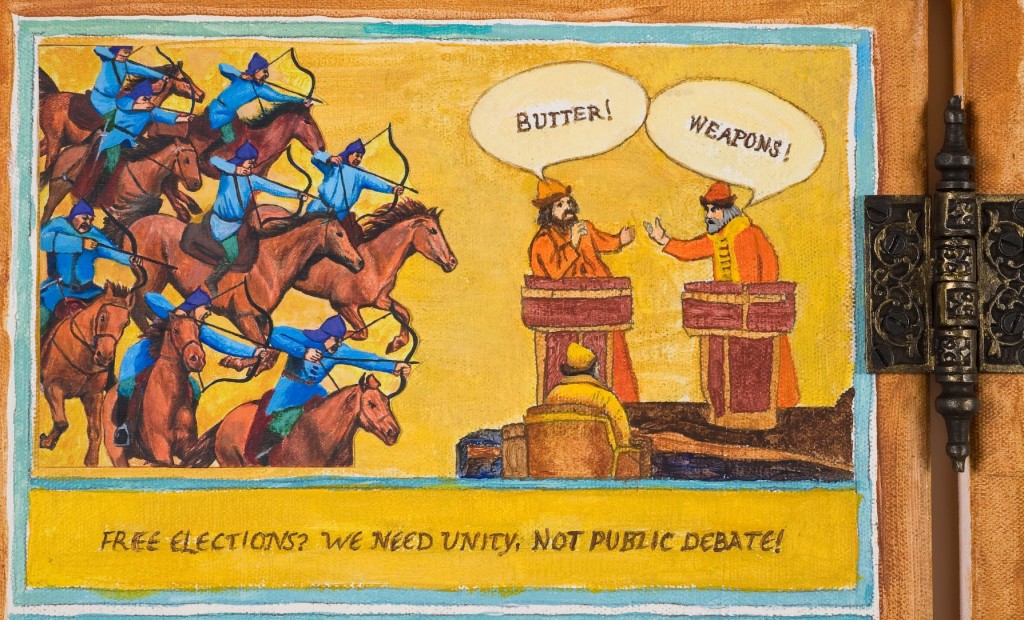
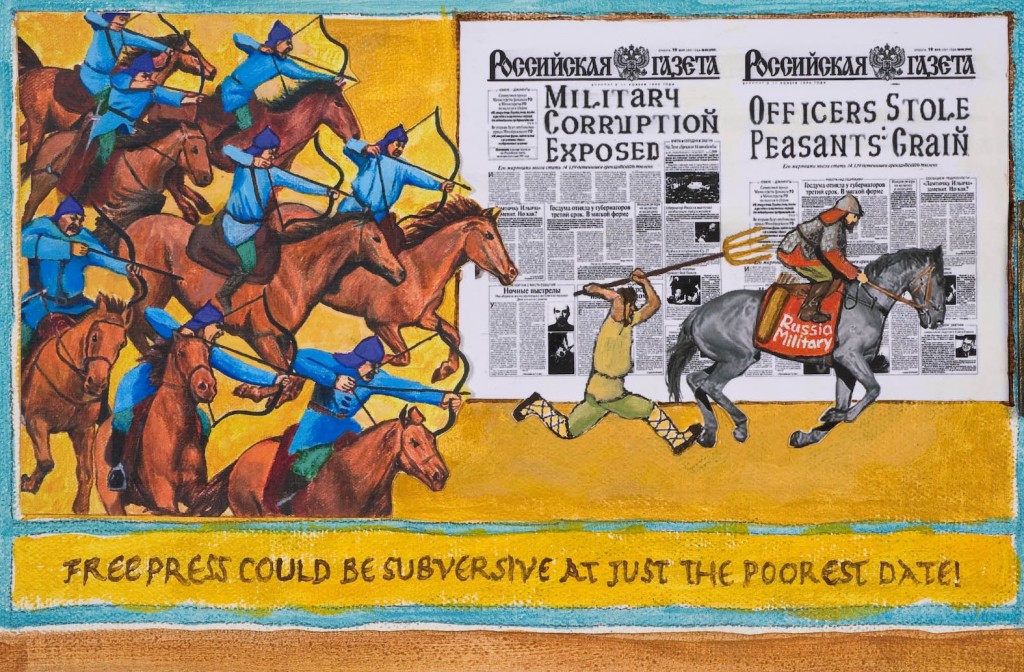
Detail of right panel of “Home Security At Any Crazy Price,” by Anne Bobroff-Hajal

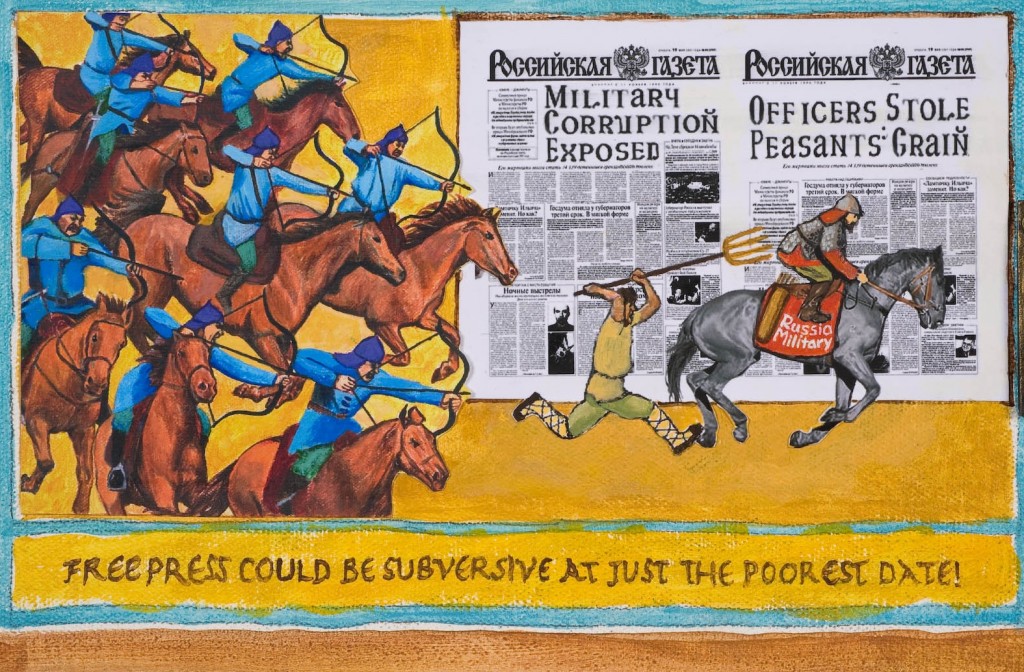
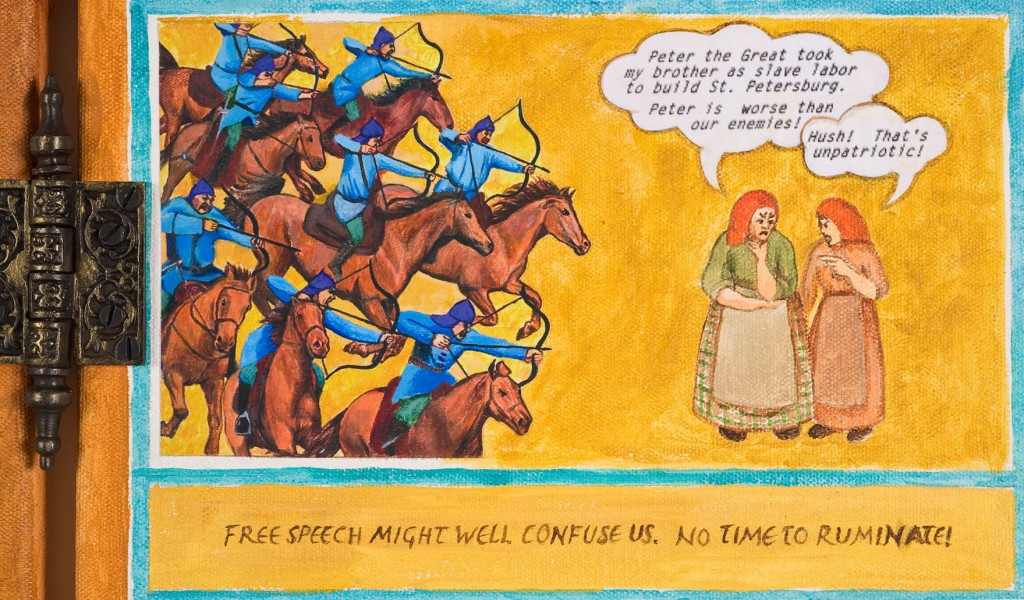
Since the fall of Communism, Russia is again becoming more centralized.  Putin has asserted control over the media.  No non-Kremlin newspaper can garner significant circulation.  Journalists who report stories the government doesn’t like are murdered.  Real opposition political parties aren’t allowed to run candidates.

Will Russia ever become a fully pluralistic society?  I don’t know, but I’m interested in watching to see.                                                                                                       Continued below image

Detail of lower right panel, “Home Security At Any Crazy Price,” by Anne Bobroff-Hajal.

What can Russia and our own experience of 9/11 teach us about ourselves?

The US experience of terrorism on 9/11 can help us better grasp why Russia developed an autocratic state.  A nation of people who experienced almost yearly trauma for centuries adapted to their society’s being permanently organized like a military chain of command with no insubordination from the ranks.

We can also learn from Russia’s experience the terrible consequences of sacrificing civil liberties for security over the long term.  Russian history can serve as a cautionary tale for what could happen to us if we’re too ready to trade personal freedoms for powerful government. ■

Below image are links to more posts about PLAYGROUND OF THE AUTOCRATS triptychs.

Detail: Top center panel of “Home Security At Any Crazy Price,” by Anne Bobroff-Hajal

An introduction to the PLAYGROUND OF THE AUTOCRATS series is here.  Other posts about these triptychs are:

Portraying the Vast Flatland of the Playground

The Most Exposed Terrain On Earth

Designing the Character of Peter the Great

Catherine the Great: A Satirical Visualization of Russian History and Society

What is Catherine the Great Singing in Her Triptych?

How I Painted and Composited Catherine the Great (and Stalin)

“The Most Exposed Terrain on Earth:” A Satirical Visualization of Russian History

Thursday, July 14th, 2011

How does an artist portray a grand sweep of centuries?

Detail of center panel of “The Most Exposed Terrain on Earth,” by Anne Bobroff-Hajal

Russian history is full of high drama.  Mongol raiders thundering across the endless steppes toward small Muscovite towns.  Human terror and suffering.  Tsarist defenses and brilliance, ambition and intrigue.  Russian culture’s astonishing splendor and beauty.

It all makes a perfect subject for art.

But how can a painter visualize a grand sweep of centuries?  What recipe can be cooked up to entertainingly portray a millenium of Russian history?

That’s the challenge I set for myself in my series of triptychs collectively entitled PLAYGROUND OF THE AUTOCRATS.  The first in the series is The Most Exposed Terrain on Earth.

A detail of my “recipe” to convey this triptych’s story is to the right.  I use satire, color, action – and song lyrics (see images below).

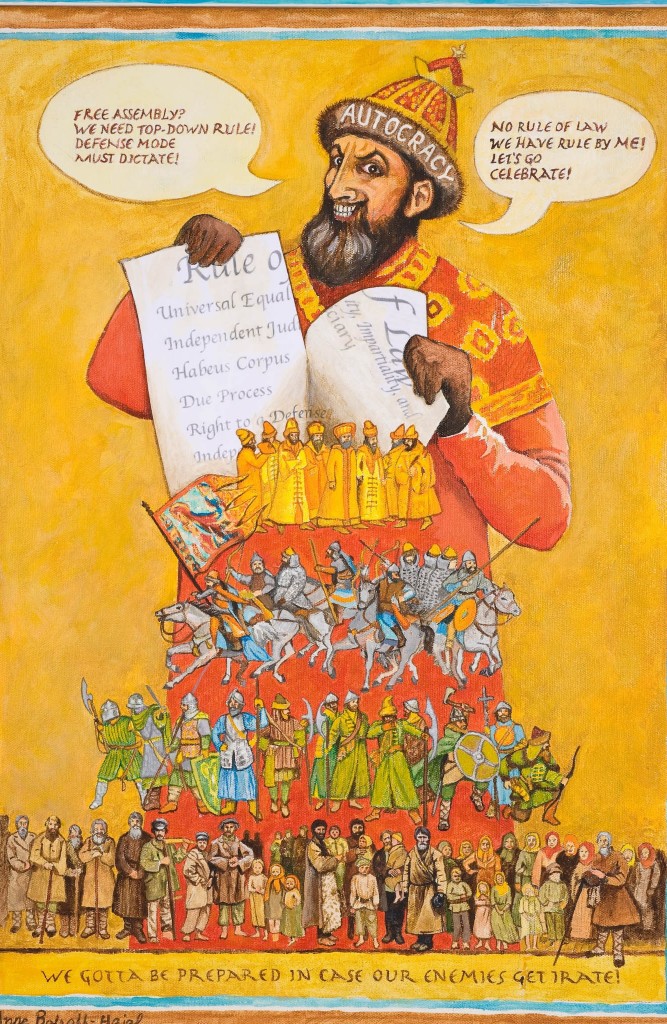
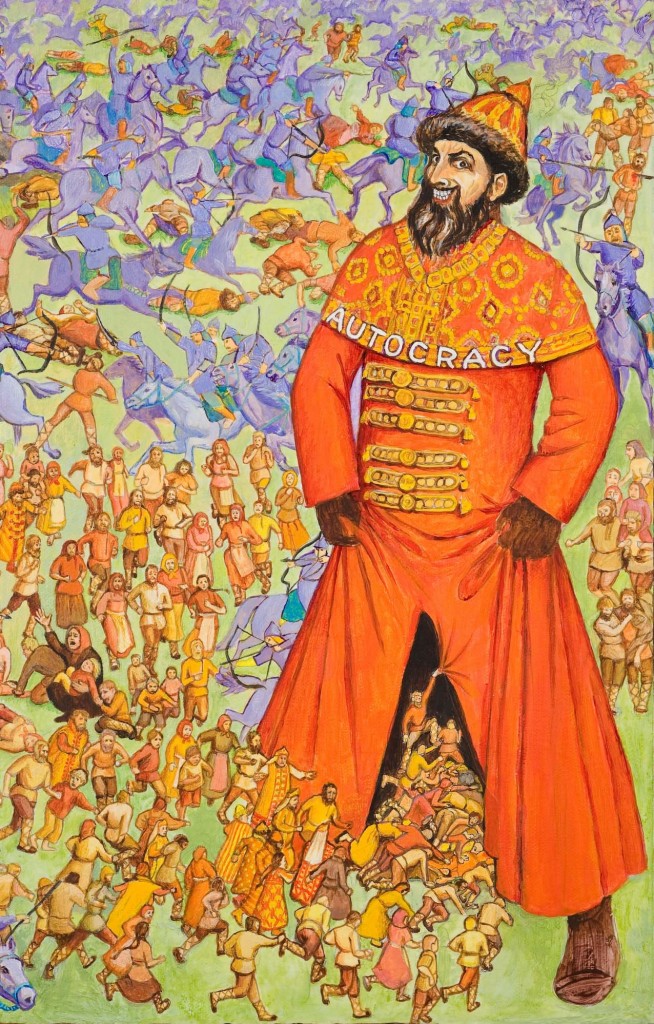
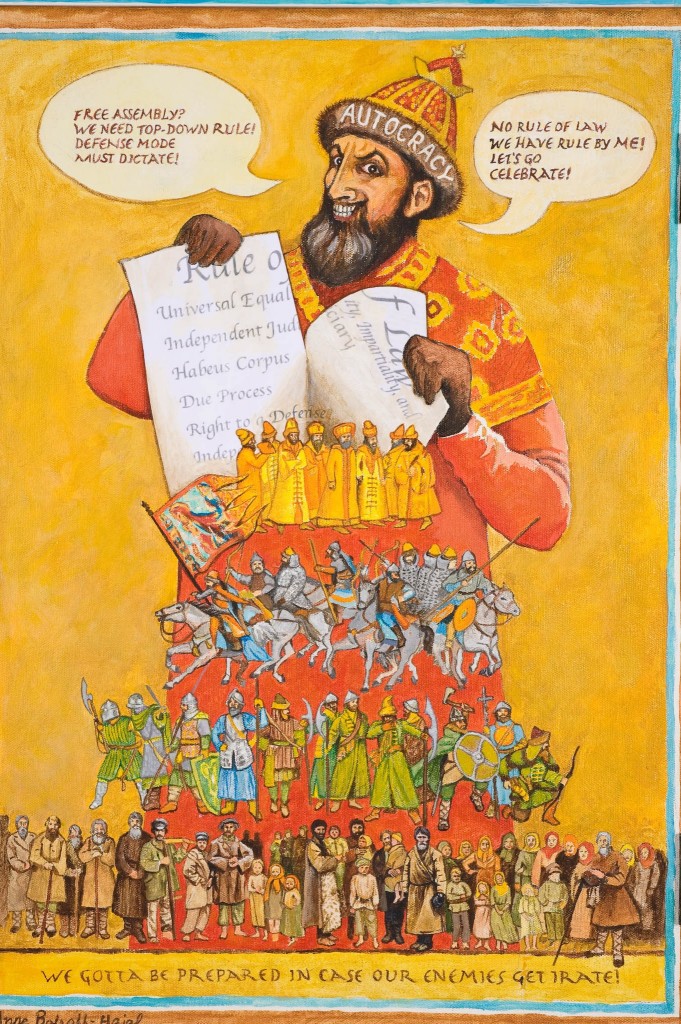
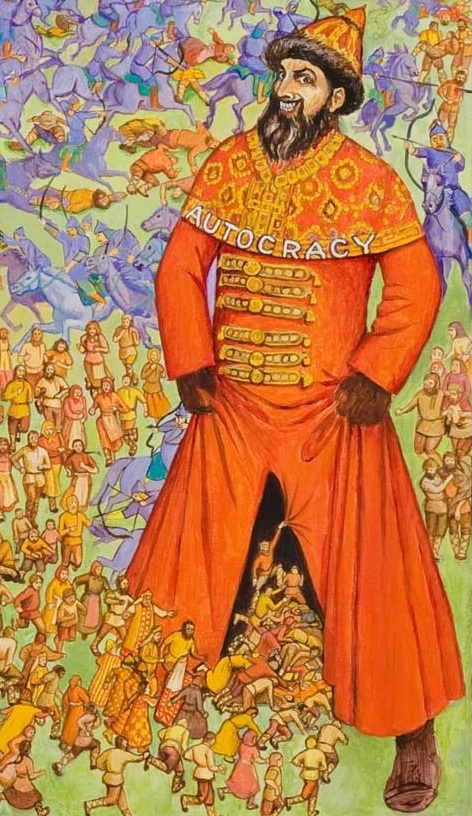
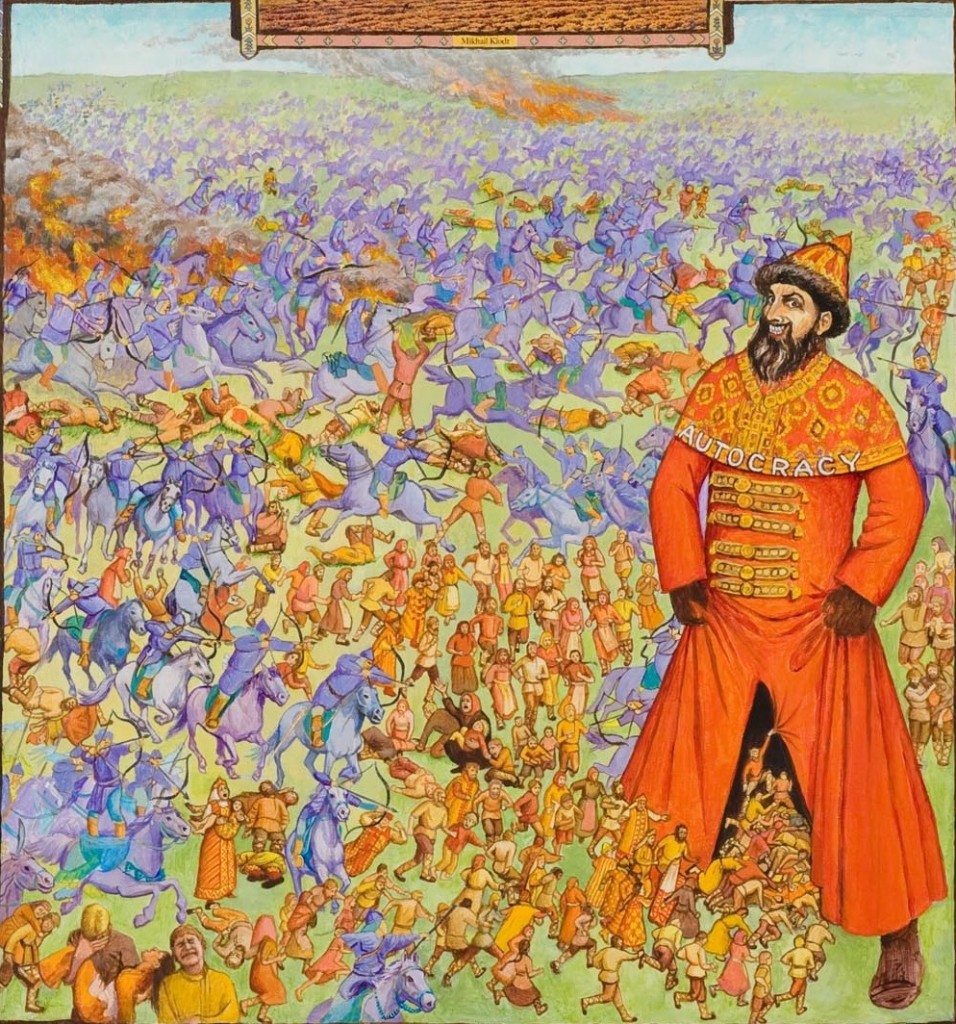
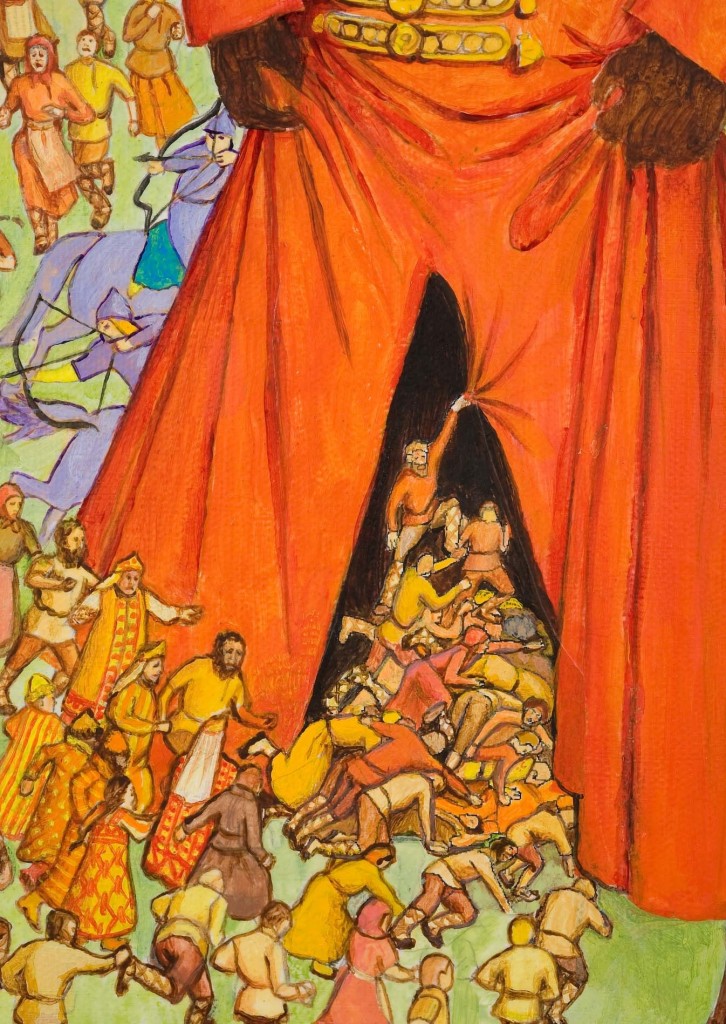
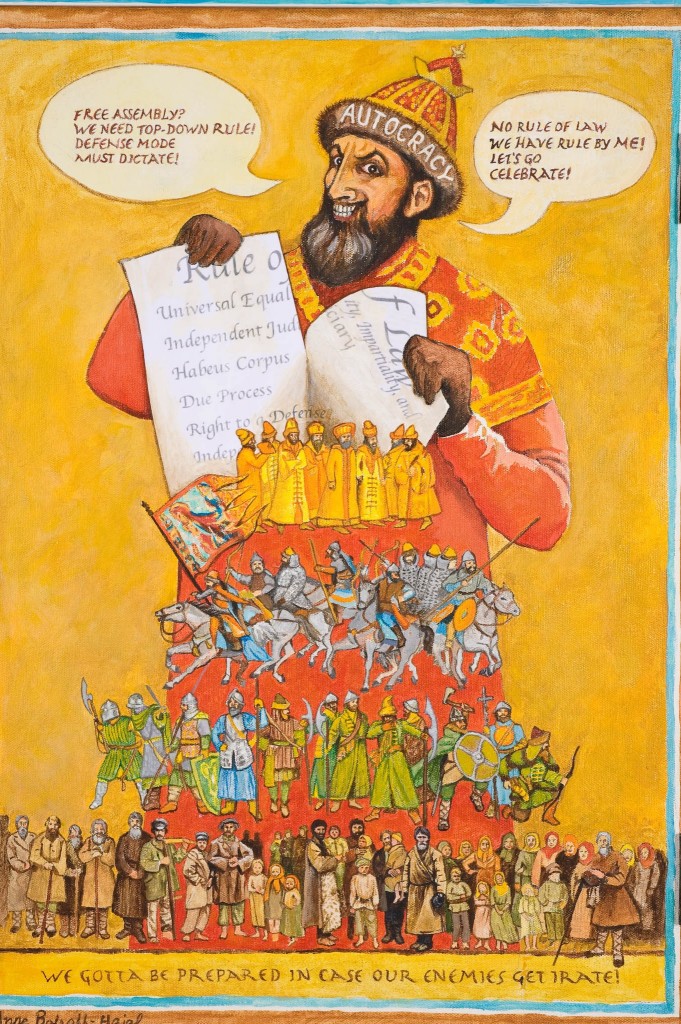
But my most important ingredient for each triptych is visualization of a historical process.  The centerpiece of my visualization of The Most Exposed Terrain on Earth is a tsar-type figure (above) lifting his skirts to gather in lots of Russians underneath.

Hmm, the viewer might ask.  Who is this guy labeled “AUTOCRACY,” and why is he grinning with malevolent glee?  And what’s going on with all those frantic people running to hide inside his robe?

Just what historical process am I visualizing here?

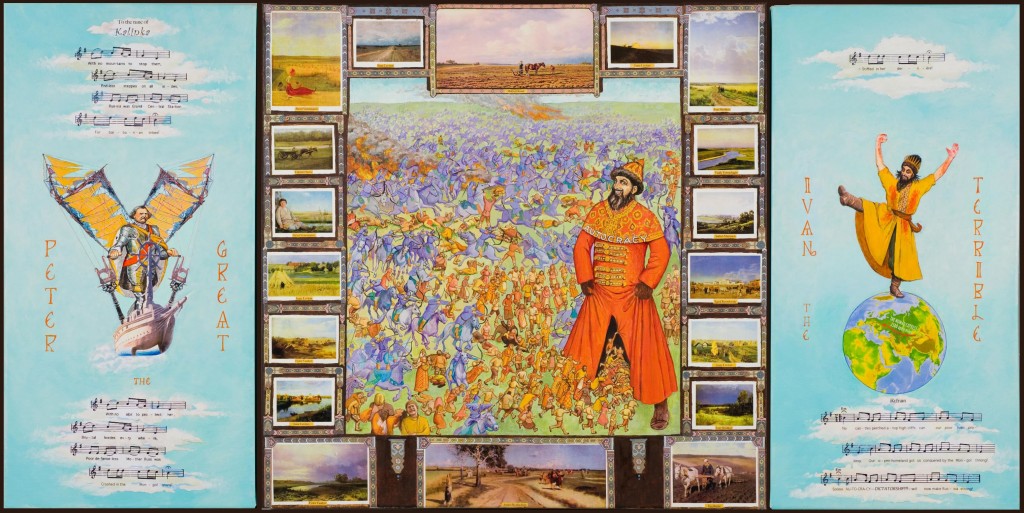
“The Most Exposed Terrain on Earth” . 24″ x 48″ . Acrylic and digital images on canvas

The true story behind my triptych

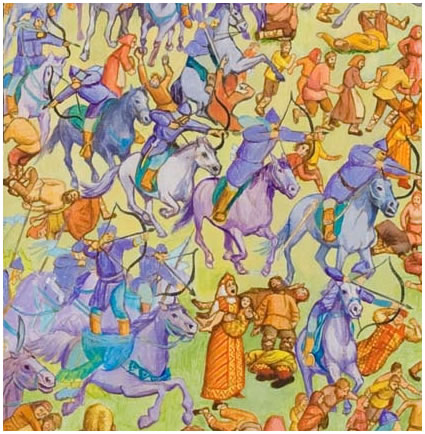
Detail of Mongols in middle panel of “The Most Exposed Terrain on Earth,” by Anne Bobroff-Hajal

Muscovy – later Russia – arose and was forged in an inferno during the 200 years when ferocious, brilliantly-skilled Mongol warriors pillaged, sacked, brutalized, and dominated it – and the centuries following, when the Mongol’s descendants – the Nogay Horde, the Crimean Khanate and others – continually raided and plundered it.

The Mongols’ war organization, tactics, and composite bows were the great military advances of their day.  “The level of organization of the Mongol army was not seen elsewhere in the Middle Ages and stands in marked contrast to that of the feuding Russian Princes.”

If Russia was to survive, its fractious princes needed to whip themselves into a unified fighting force under a single central command, and fast.

Painting the Mongol peril to Russia

To portray Mongol attacks, I painted a battle scene filled with fierce Mongols terrifying Russian peasants and nobles.                                                   Continued below image.


Detail of center panel of “The Most Exposed Terrain on Earth,” by Anne Bobroff-Hajal


For the models I needed to paint from, I collected photos of present-day archers shooting Mongol-style bows from horseback, and drawings of Mongol battle-wear.

I painted Russians of all classes running for their lives, and used color to differentiate between them and the invaders: indigos, purple, blue for the Mongols, and warm oranges, reds, yellows for the Russians.  This make the two combatant sides immediately “readable” by the viewer.

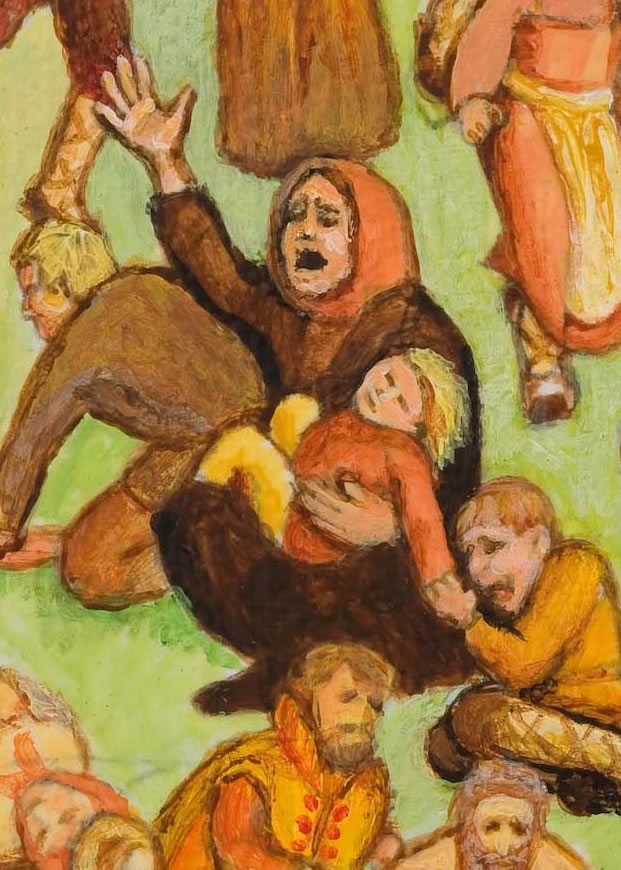
I wanted to convey the tragedy and terror experienced by individual victims, so I conceived a Russian peasant woman (right) and a noblewoman (above) each holding a wounded child.  I balanced color and composition in such a way that the peasant woman stands out from the crowds of people running and shooting.

But what does that red-robed guy labeled “AUTOCRACY” represent?

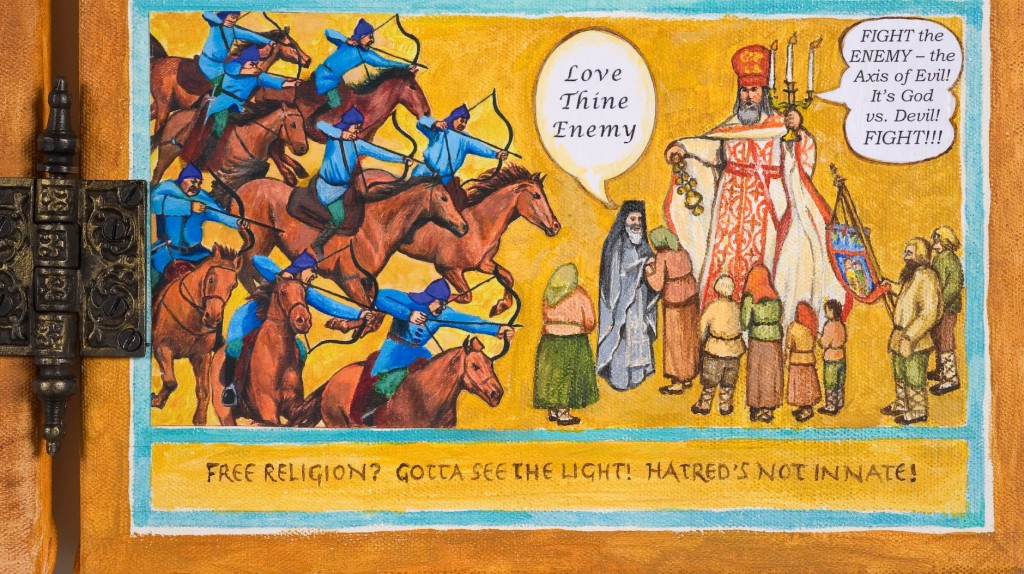
The necessity for Russians of all classes to unify beneath a single commander presented the tsars with an opportunity to amass vast power and wealth for themselves. Russians of every level of society, desperate for protection against enemies, ceded independent power bases to their defender, the state.

The state leveraged this situation to its own fullest benefit.

Detail of central panel of “The Most Exposed Terrain on Earth,” by Anne Bobroff-Hajal

So my triptych’s AUTOCRACY character is a satirical visualization of how the tsars as a group took advantage of five centuries of nonstop attacks on the Russian people to secure their absolute rule: autocracy.

But wait a minute…

Europeans, too, sought protection against enemies from their monarchs.  Yet tsarist dictatorships didn’t develop there.  What was different in Russia?

A land wide open to Mongol pillage and Tatar slave raids

Even after the Russians threw off the long Mongol occupation, they were far from safe.  The economy of the neighboring Crimean Khanate and other nearby Hordes was based on the slave trade: abducting and selling Slavs.  So virtually every summer, Tatar raiders rode north across the steppe into Russia, kidnapping thousands of people to sell into slavery in the Black Sea slave market.

These raids occurred not every 10 or 20 years, but essentially every year. Over several centuries, hundreds of thousands of Russians were seized as slaves.

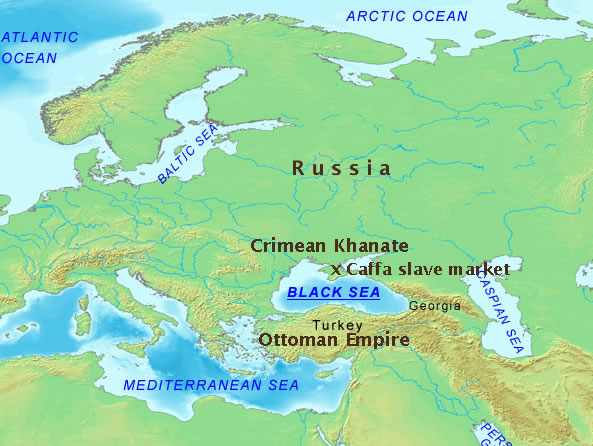
Geographic relationship of Russia to Crimean Khanate and Ottoman Empire

Our very word “slave” derives from “Slav.”  No population in the world other than Africans have been enslaved more than Slavs.

Why was Russia so vulnerable to these raids?

A glance at a map (right) shows why Russia was so vulnerable to yearly attack.  There was nothing but wide open steppe between Russia and the Crimean Khanate with its slave market (and Ottoman slave-purchasers directly across the Black Sea).  Highly mobile, skilled raiders could pour across the steppes each summer, capture thousands of Russians, and head back to the huge international slave market, Caffa, a straight shot across the unobstructed plain.

Russia is by far the largest wide-open plain on earth.  Glance at the world maps toward the end of this post if you have any doubts.  No mountain barrier protected the Russians.  For their state to survive, they had to build their own human barrier.

Details of left panel of “The Most Exposed Terrain on Earth,” by Anne Bobroff-Hajal

In short, Russians lived in the most exposed terrain on earth.  They could never stand down from battle-readiness.  Their society had to be permanently organized like – indeed it was – a military chain of command.

Portraying the most exposed terrain on earth

One way I’ve visually conveyed the relationship between landscape and autocracy is through painting the Mongol battle raging on a flat plain. And I painted AUTOCRACY towering in the midst of this wide-open battlefield, skirts held open to receive the terrorized Russian people.

Another way I conveyed the flatness of Russia’s endless steppes is through song lyrics “sung” by characters I designed for Peter the Great and Ivan the Terrible.  I wrote these lyrics to the tune of the ubiquitous folksong, Kalinka.  Images of the lyrics are above and below.  (For more about the characters who sing the lyrics and how I designed them, please see here, here, and here.)

Detail of lower left panel of “The Most Exposed Terrain on Earth,” by Anne Bobroff-Hajal

A last way I conveyed the endless, wide-open flatness of Russia – the largest on earth – was through a border around the center panel of the triptych.  I created this border from digital images of paintings by the great 19th century Russian painters called the Peredvizhniki.  You can find much more detail on my process of building this border here.

*        *       *

Other posts about PLAYGROUND OF THE AUTOCRATS triptychs

Posts about other tryipychs in the series are here:

Catherine the Great: A Satirical Visualization of Russian History and Society

What is Catherine the Great Singing in Her Triptych?

How I Painted and Composited Catherine the Great (and Stalin)

What If We Had a 9/11 Every Year for Centuries?  “Home Security At Any Crazy Price”

The Most Exposed Terrain On Earth

Portraying the Vast Flatland of the Playground

Designing the Character of Peter the Great

Playground of the Autocrats

What is Catherine the Great Singing in Her Triptych?

Friday, July 8th, 2011

An introduction to “Dress It Up in Resplendent Clothes” is here; the artistic process behind it is here.

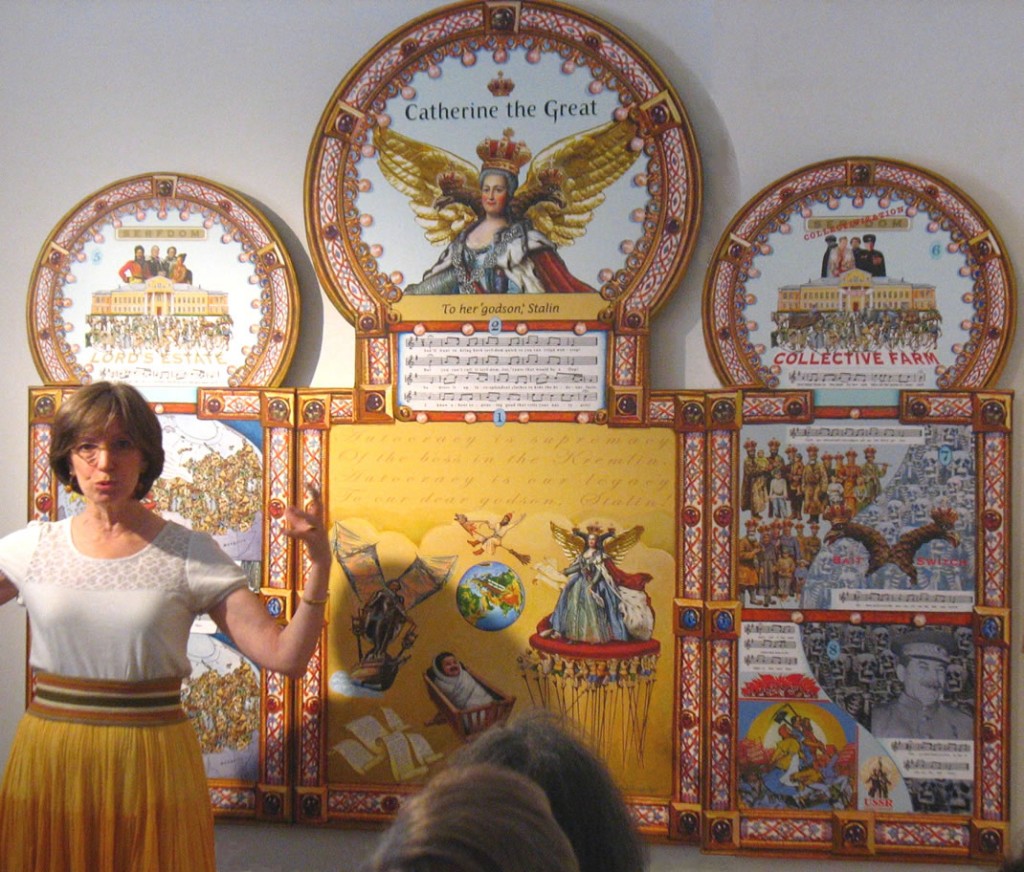
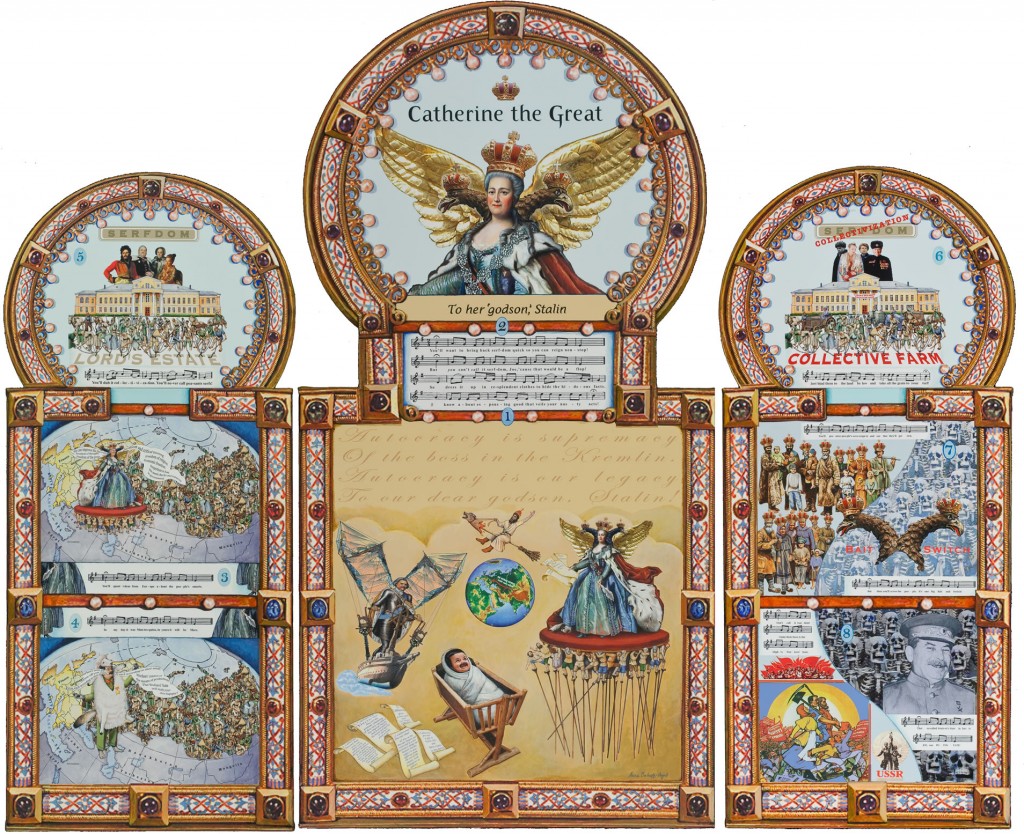
“Dress It Up in Resplendent Clothes,” by Anne Bobroff-Hajal. Triptych is 7 feet by 6 feet.

PLAYGROUND OF THE AUTOCRATS is a series of artworks that – like comic books and graphic novels – tell stories through pictures.  PLAYGROUND’s tales are about modern Russia, “narrated” in song by the likes of Ivan the Terrible and Catherine the Great.

My whimsical imperial characters sound off through original lyrics I wrote to the tune of the famous Russian folksong, Kalinka. The lyrics are about the “gifts” Stalin received from Tsarist history, the foundation on which he built his country’s most powerful dictatorship ever.

If viewers wish, they can navigate their way through PLAYGROUND’s arias in sequence by following the numbers I’ve painted on each panel.

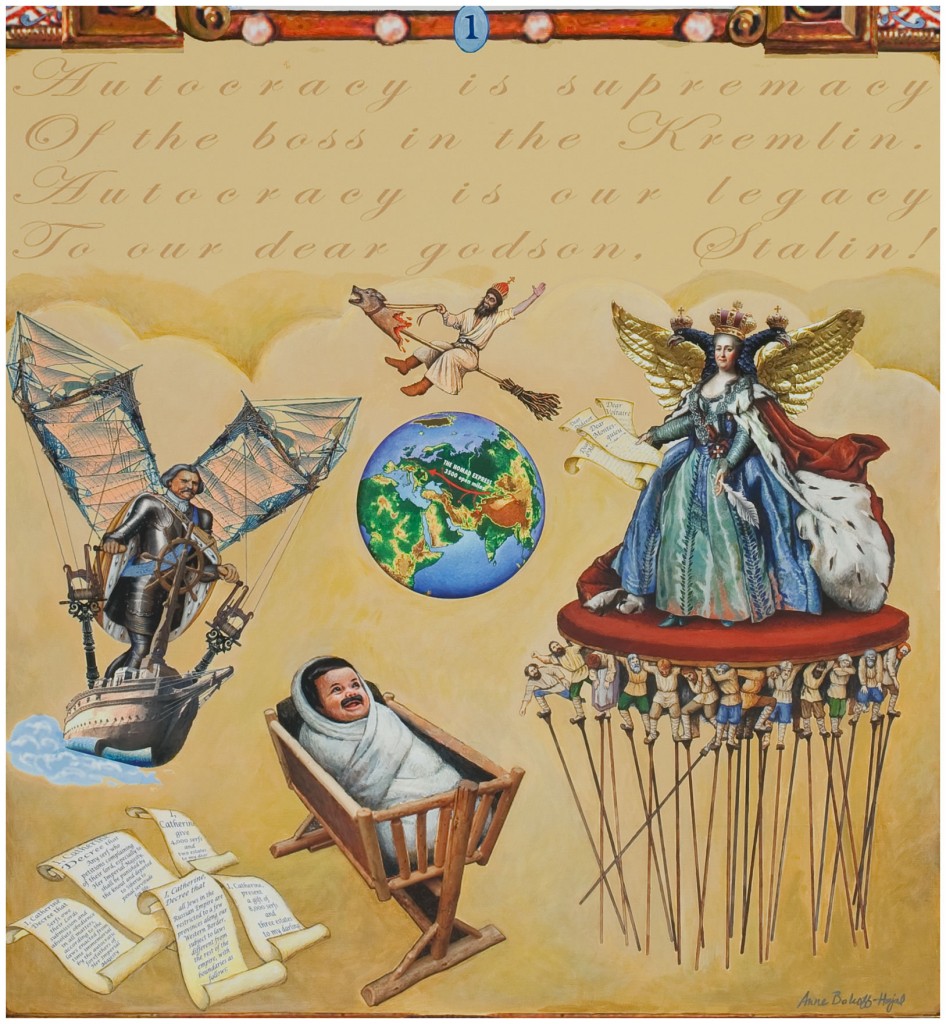
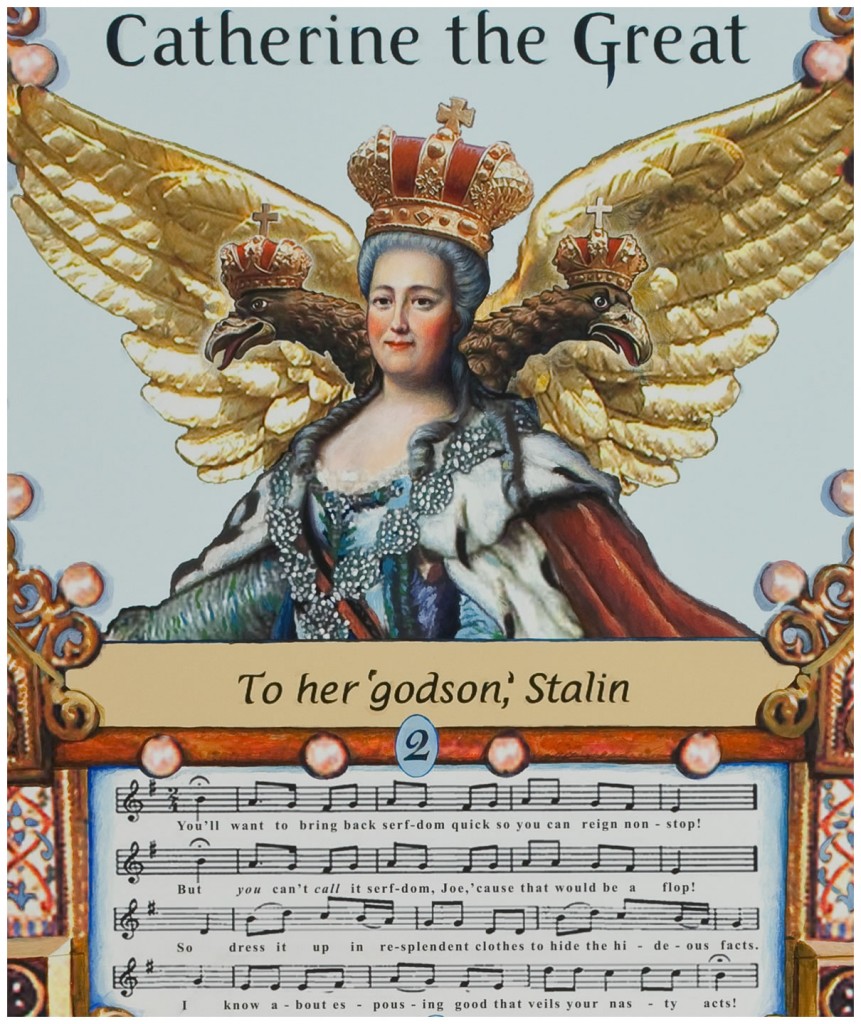
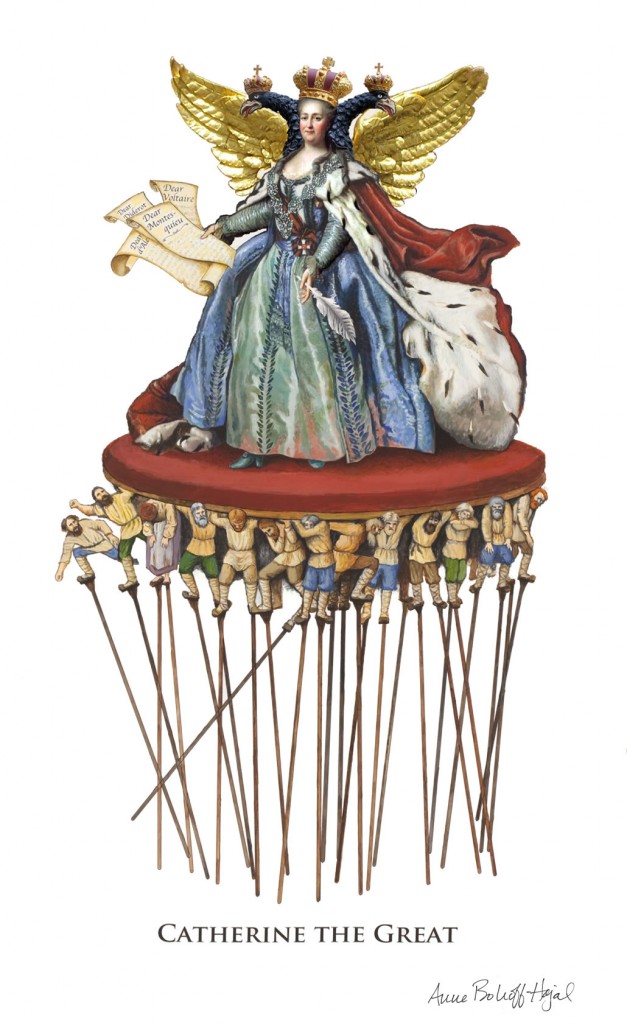
My most recent PLAYGROUND triptych, Dress It Up in Resplendent Clothes (above), is “sung” by Catherine the Great, one of Stalin’s three “fairy godparents.” In Panel 1 below, Catherine gives her blessing from Russia’s past to the delighted, mustached baby Stalin.

Detail: center bottom panel (1) of “Dress It Up in Resplendent Clothes,” by Anne Bobroff-Hajal

My inspiration for this scene was my childhood memory of a Sleeping Beauty picture book.  The story began with an illustration of Sleeping Beauty as a baby princess, her three fairy godmothers flying in a circle above her cradle.  Each fairy godmother bestowed a personal blessing for some life bounty for the little princess.

This fairy-godmother memory came to me as I was originally pondering how to visualize Russia’s past as godparent to its present. So I imagined that in each PLAYGROUND triptych, my whimsical Russian “godparents” – Ivan the Terrible, Peter the Great, and Catherine the Great – would bequeath historical blessings on the infant Stalin.

I’ll let my character Catherine speak for herself through her lyrics in the following images, beginning with Panel 2 in which she sings:

You’ll want to bring back serfdom quick so you can reign non-stop!
But you can’t call it serfdom, Joe, ’cause that would be a flop!
So dress it up in resplendent clothes to hide the hideous facts.
I know about espousing good that veils your nasty acts!

Detail: top center panel (2) of “Dress It Up in Resplendent Clothes,” by Anne Bobroff-Hajal

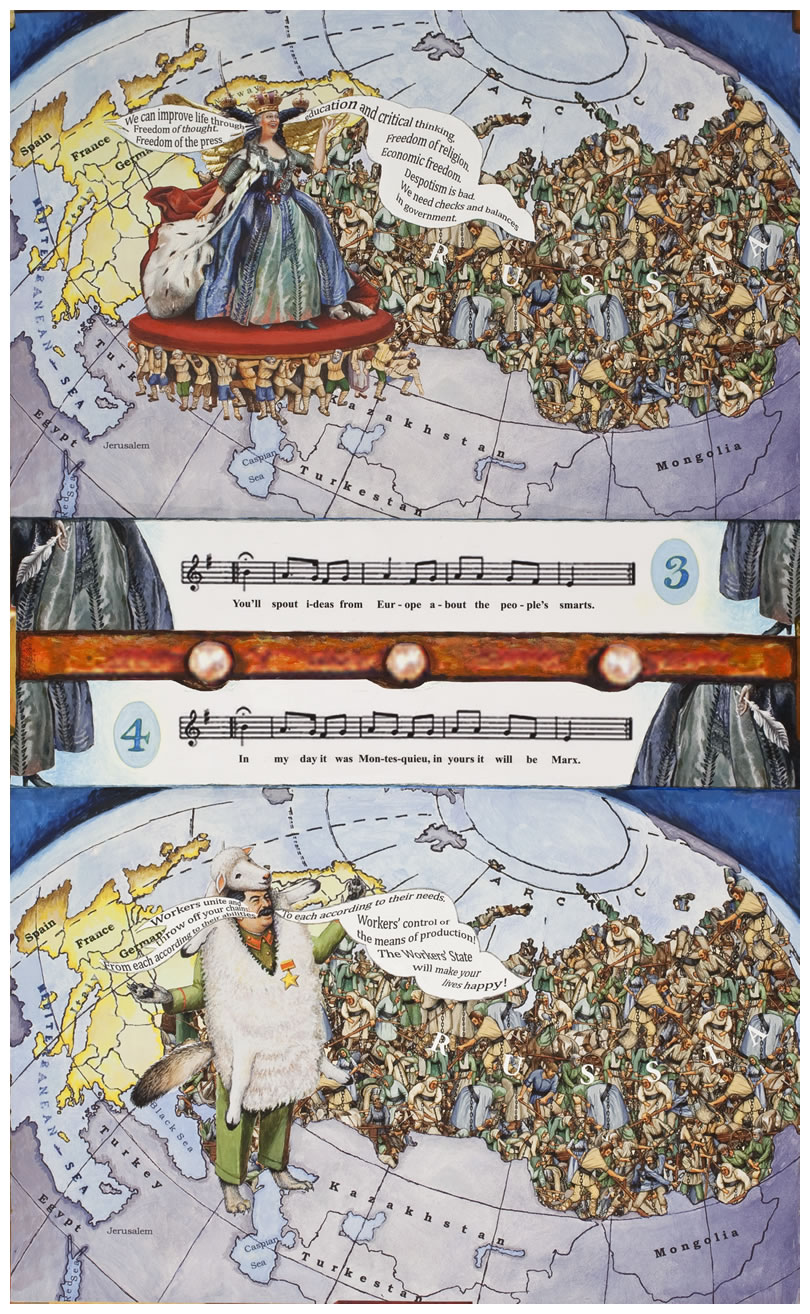
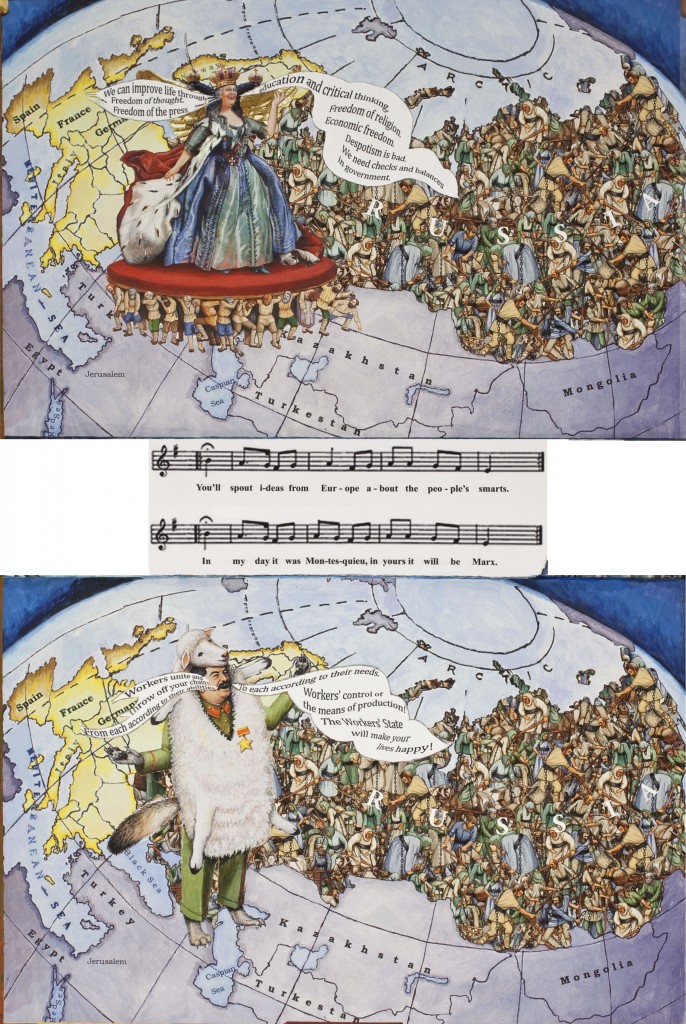
Catherine advises Stalin (Panels 3 and 4) that new European ideas championing the lower classes can be used to muddy popular consciousness of what the ruler is really doing (a closeup of the Russian peasants is in this post).

You’ll spout ideas from Europe
About the people’s smarts.
In my day it was Montesquieu,
In yours it will be Marx.

Detail: Left lower panels (3 & 4) of “Dress It Up in Resplendent Clothes,” by Anne Bobroff-Hajal

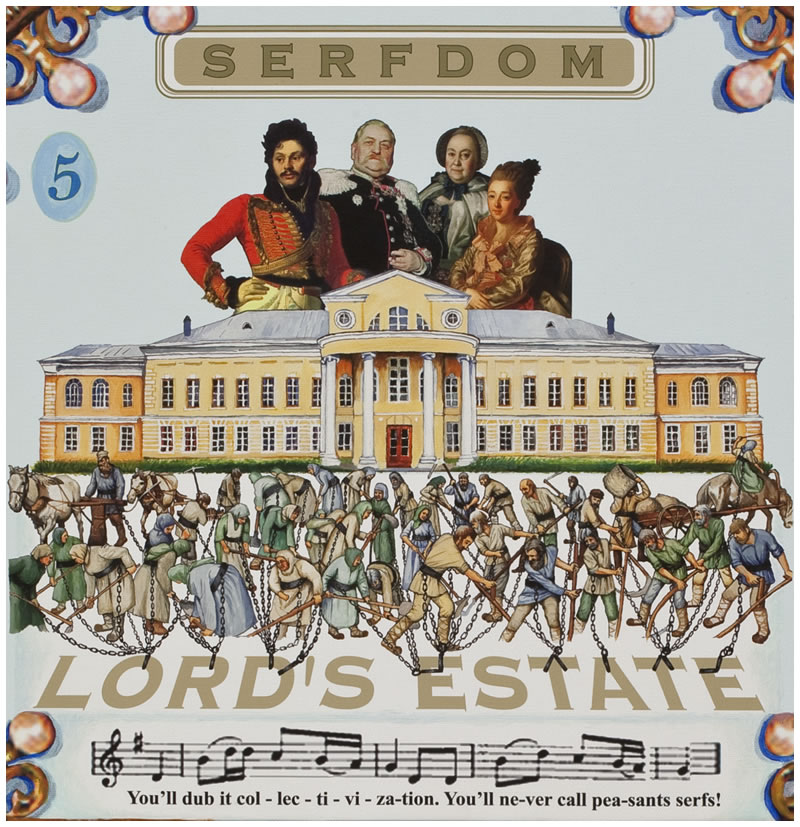
Catherine counsels Stalin in panels 5-6 about serfdom, the fundamental economic engine of Russian society – or as Stalin renamed and reinstituted it, “collectivization.”

You’ll dub it collectivization.
You’ll never call peasants serfs.
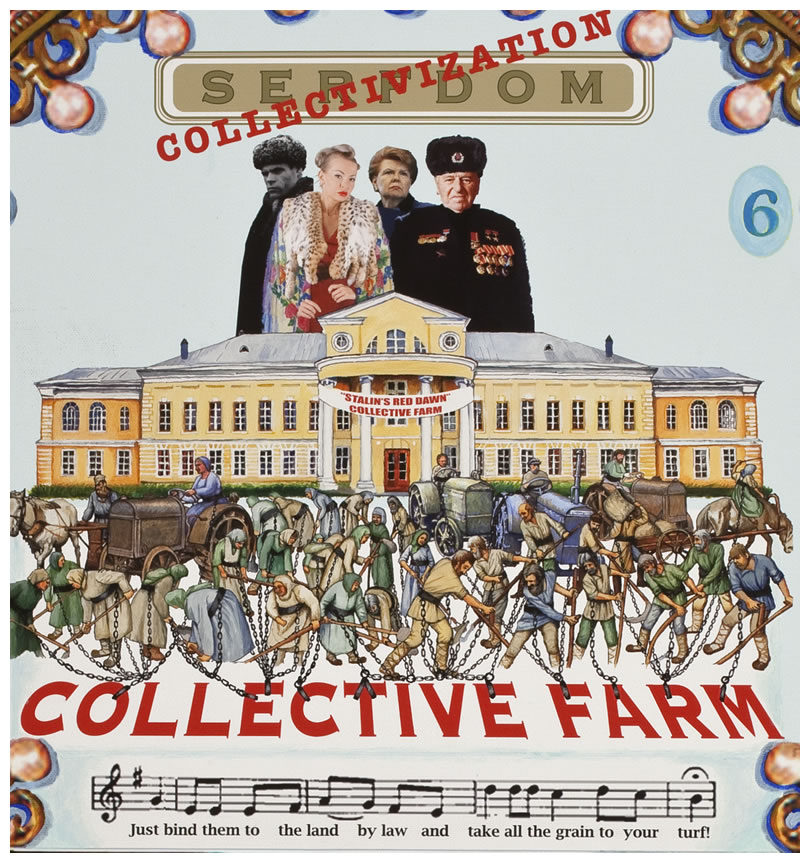
Just bind them to the land by law
And take all their grain to your turf!

Detail: Left top panel (5) of “Dress It Up in Resplendent Clothes,” by Anne Bobroff-Hajal

Collectivization was essentially serfdom by another name – with the addition of tractors, as in Panel 6 below.

Detail of upper right panel (6) of “Dress It Up in Resplendent Clothes,” by Anne Bobroff-Hajal

The last verses:

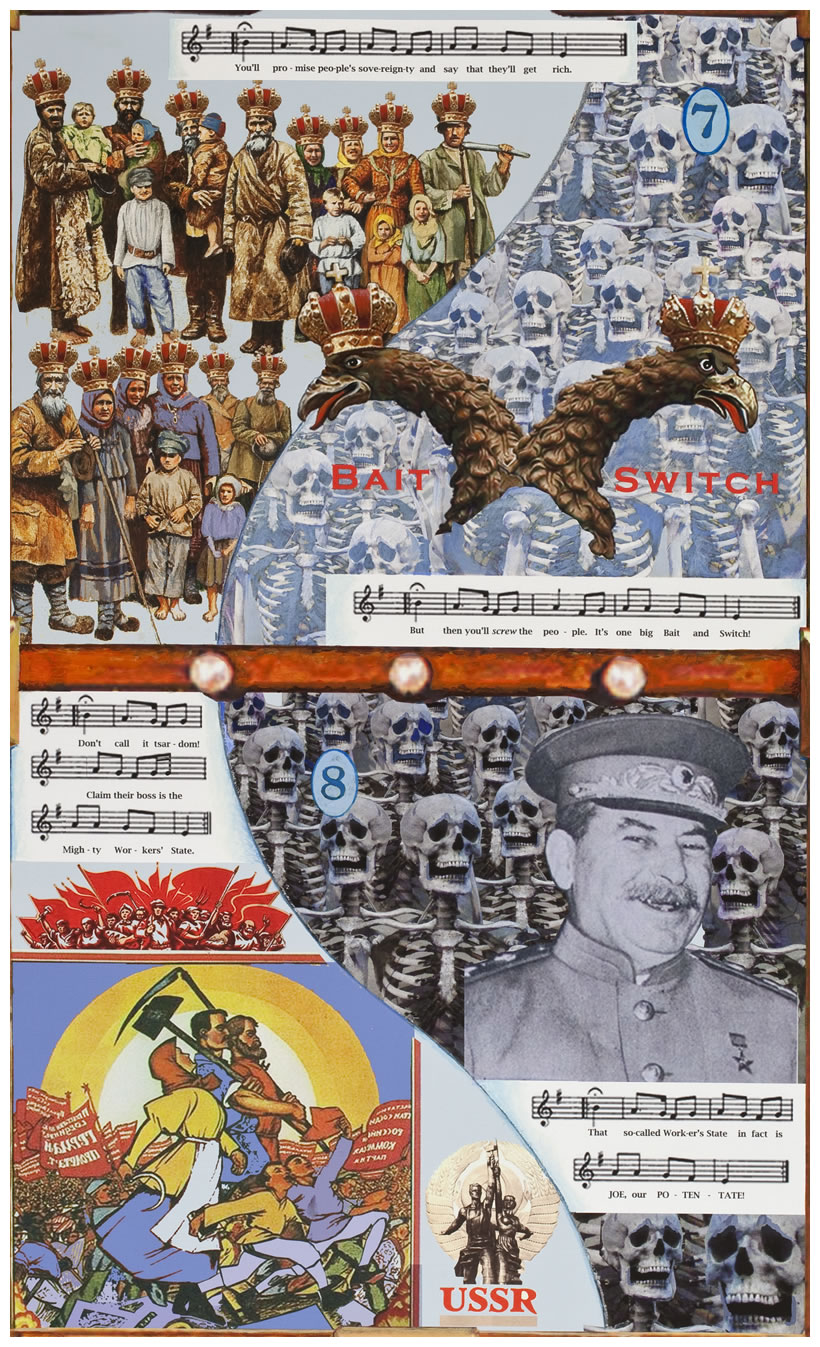
You’ll promise people’s sovereignty and say that they’ll get rich.
But then you’ll screw the people!  It’s one big Bait and Switch!

Don’t call it tsardom!  Say their boss is the mighty Workers’ State.
That so-called Worker’s State in fact is JOE, our POTENTATE!

Detail of right panels 7 & 8 of “Dress It Up in Resplendent Clothes,” by Anne BobroffHajal

Details of other Playground of the Autocrats triptychs are here and here:

Home Security At Any Crazy Price

The Most Exposed Terrain on Earth


How I Painted and Composited Catherine the Great (and Stalin)

Wednesday, June 29th, 2011

You can find more about the images and ideas behind “Dress it Up” here.  Closeups of each of its images in sequence are here.

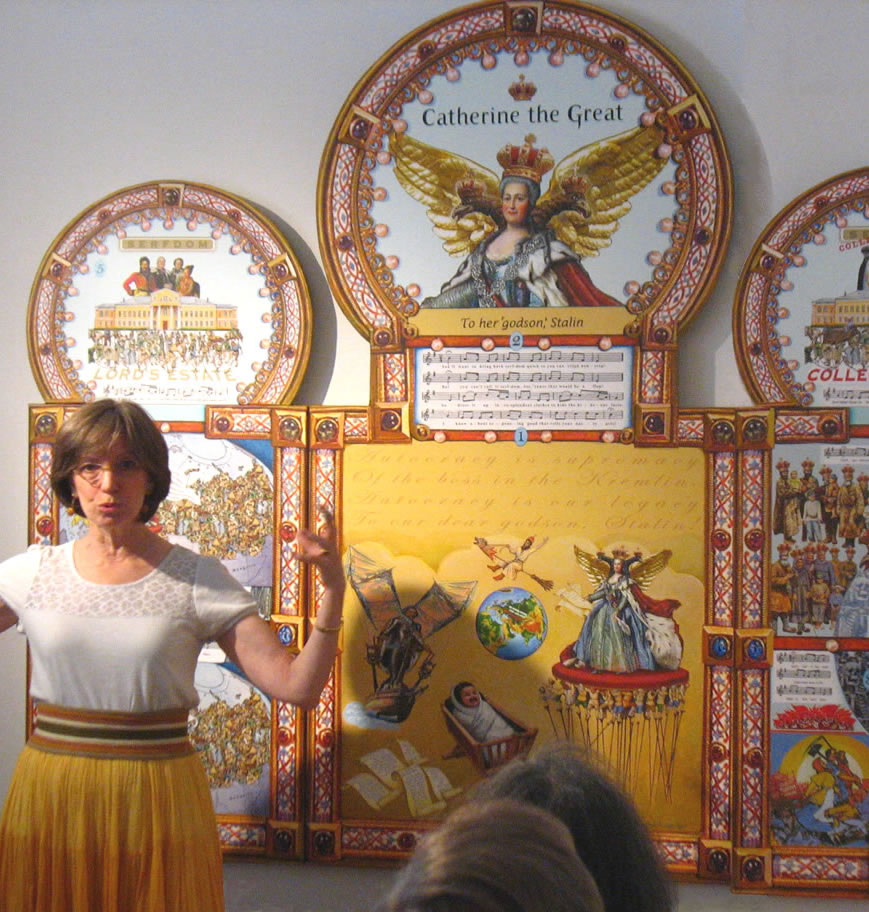
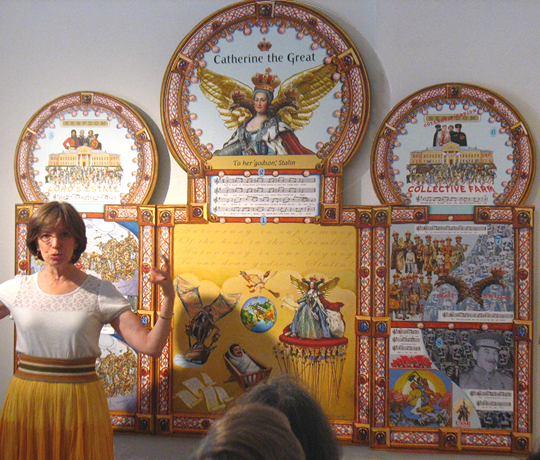
Virtually everyone who sees “Dress It Up in Resplendent Clothes,” my new 7-foot  triptych about Catherine the Great, asks me which parts are painted and which are digital.  The answer to this question is as complicated as the finished triptych looks.

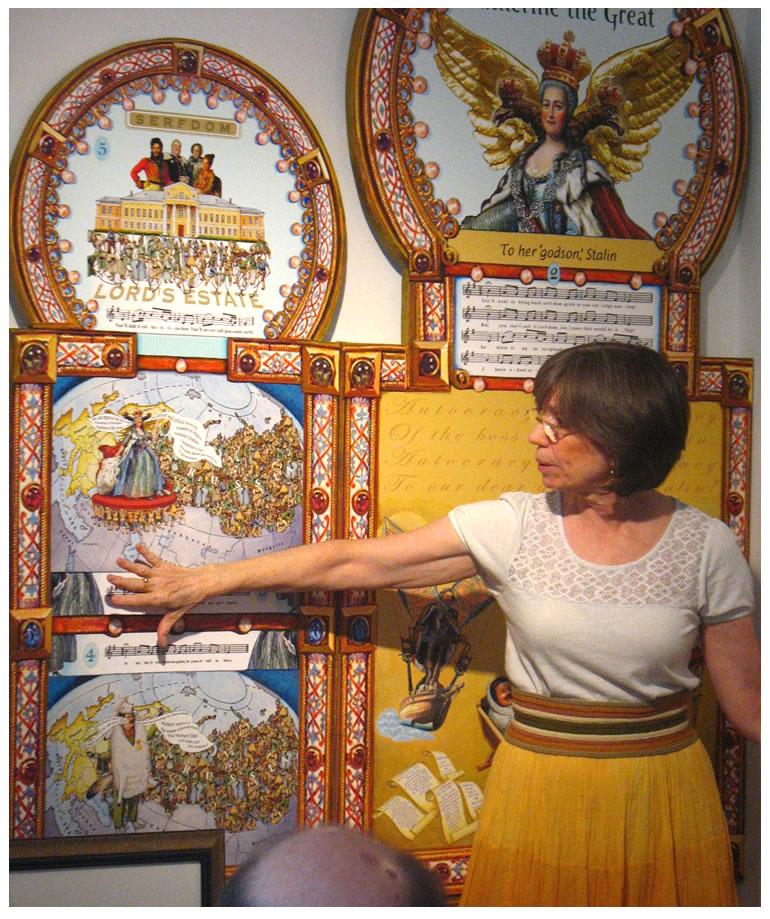
Anne Bobroff-Hajal: gallery talk about techniques used to create “Dress It Up in Resplendent Clothes,” partially visible in background.

So I’m going to use this post to describe my process, which involves a series of layers:

  1. First I paint the highly-detailed individual panels larger than they’ll be in the final triptych.
  2. Then I photograph what I’d painted and print it (on paper), combined with  digital photos of e. g. the Russian Imperial symbol (the double-headed eagle).
  3. I paint on top of this print, then have it photographed and reprinted, and paint again on the print.  I repeat this process as many times are needed to get the effect I want.
  4. Finally, I composite reduced-size versions of all these components into the final triptych and have it professionally printed on canvas.
  5. On the final triptych, I spend another month or two painting additional images and many adjustments on the canvas to balance the whole composition and get the effects I want.

“Dress It Up in Resplendent Clothes” took over a year to complete.

Why did I develop this layered work process?

An experience I had while painting my previous PLAYGROUND OF THE AUTOCRATS triptych moved me toward this process.

Detail of “Home Security at Any Crazy Price,” by Anne Bobroff-Hajal

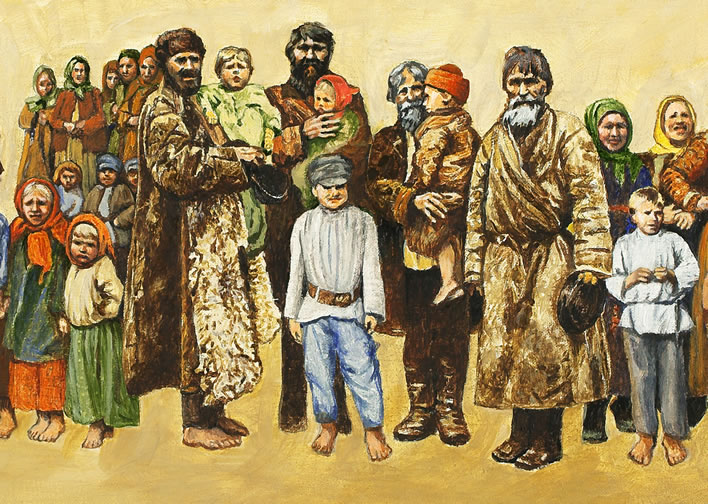
In the detail (left) of that triptych, “Home Security at Any Crazy Price,” notice the row of peasants I painted along the bottom. As my “models” for these serfs, I had collected a lot of old, low resolution black and white photos of Russian peasants.  I was in love with their sheepskin coats and bast sandals – but most of all with their profoundly expressive faces.  I’d been looking forward to painting them.

But as it turned out, I was under time constraints preparing for an exhibit.  And I realized that the tiny size of the peasants (the tallest was under 3 inches high) in this triptych was going to make it impossible to paint them in any detail.

The less-complicated peasants actually work better in “Home Security” than a more detailed version would have.  The triptych was selected by curator Nan Rosenthal for her “Contemporary Confrontations” exhibit at the Katonah Art Museum and singled out in the NY Times review of the show.

Detail of line of peasants from “Home Security at Any Crazy Price,” by Anne Bobroff-Hajal. The actual size of the tallest peasant painted is under 3 inches.

This made me wonder whether I should let go of my tendency to paint so precisely.  A freer interpretation is sometimes better.

But then I kept thinking of those faces gazing out of the past.

Haunted by faces from the past

So once the exhibit was over, I decided to paint the same row of peasants again, this time larger so I’d be able to convey their expressions and the textures of their clothing more fully.  I spent the next two months painting them (you can see and scroll over the entire row of peasants in the finished painting here.)

Three images demonstrate the difference size made.  First is the detail above from the the row of peasants as they appear in “Home Security.”

Next is a detail of the same peasants as I painted them roughly twice as large.

Detail of “Still With You,” by Anne Bobroff-Hajal. Actual painted size of tallest peasant is 6 inches.

Reduction of detailed peasants to size of those in “Home Security at Any Crazy Price” (small image with red background, above)


If I had then chosen to photograph and digitally reduce the larger painting to “Home Security” size, it would have looked like this (right).   As you can see, this way of working generates a lot more detail in small images.  It began to make me feel the possibilities of painting images larger and then reducing them digitally to fit into the final triptych.

Whether “looser” or more precise is better stylistically, I have to accept that as an artist, I’ll always tend to be attracted to finding ways to express more detail.

The influence of animation techniques on my process

Animation is created from hundreds or thousands of carefully-designed drawings passing in front of your eyes so quickly that they give the illusion of movement.  Whether at 24 frames per second or 12, animation requires huge numbers of drawings.

In the days before computer animation (and probably still today to some extent), animation artists cut down on their nearly-impossible drawing work load by using bits and pieces of previous drawings.  If Minnie Mouse’s hands moved from one moment to the next but the rest of her body didn’t, her body drawing could be reused and only the new hand position drawn.  In the next few frames, if her leg moved but not her hands, the old hand drawings would be merged with the new foot drawings.

In addition, backgrounds were reused through many frames, with characters drawn moving in the foreground.

My involvement with and love for animation as an art form brought this influence to bear on “Dress It Up,” as you’ll see below.

Catherine the Great and Stalin speechifying to the Russian people

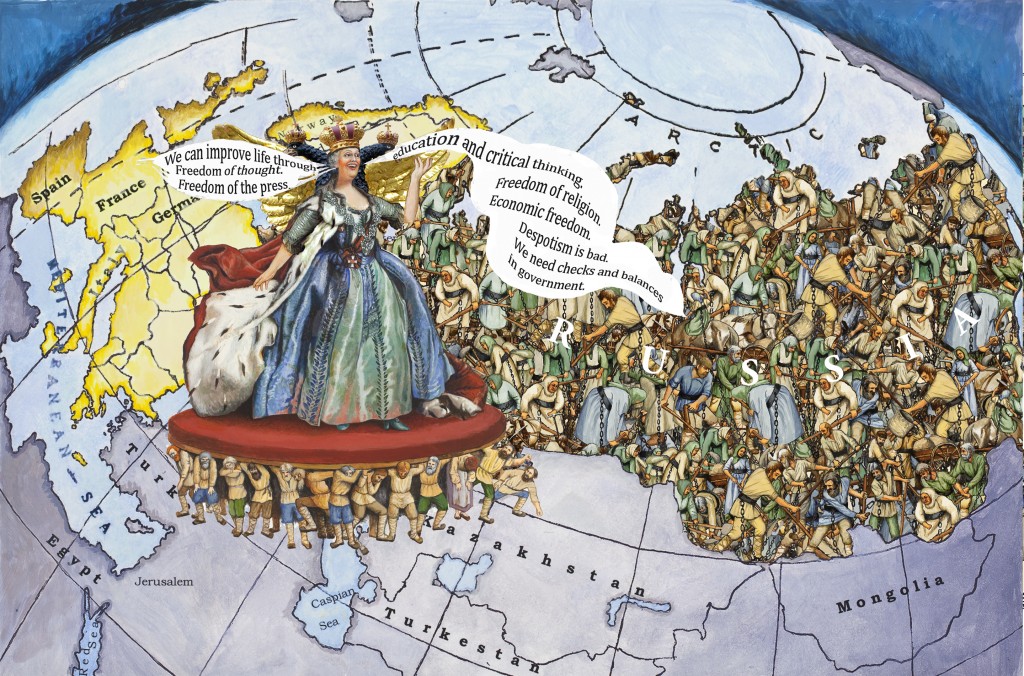
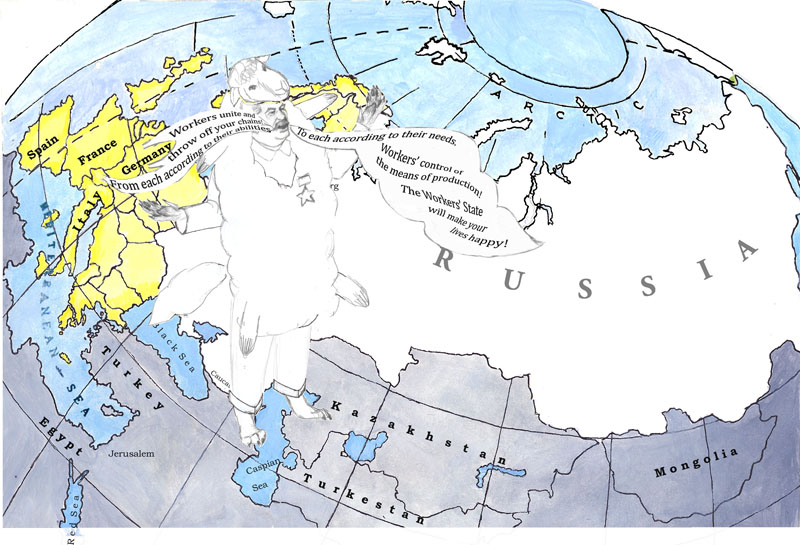
The left panel of “Dress It Up” portrays Catherine and then Stalin each sucking up lofty ideas from Europe and spouting them out over the Russian people in billows.  For Catherine, the European ideas were from the French Enlightenment; for Stalin they were Marxism (as the lyrics in the image describe).

The two images below are the final realization of what I saw in my imagination as I began working on visualizing this historical repetition.  (For a close-up of all those peasants, scroll down to the last image of this post.)

How did I realize my vision?

Detail of left panel of “Dress It Up in Resplendent Clothes,” by Anne Bobroff-Hajal.  Actual panel image is 18″ wide.

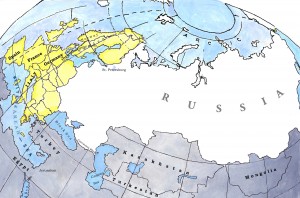
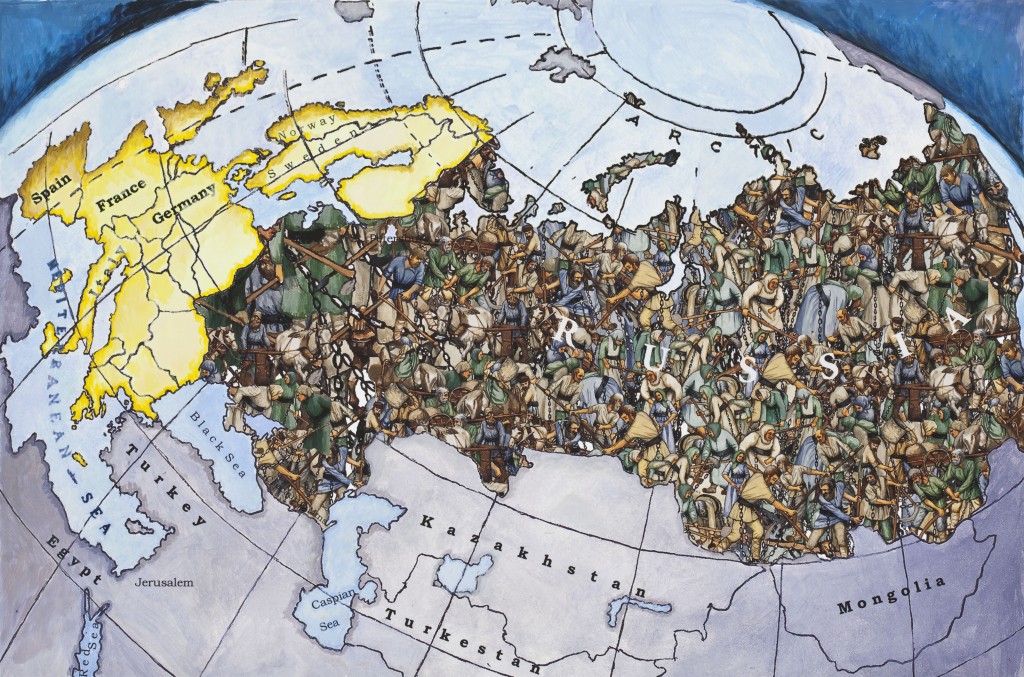
Map I created for left panel of “Dress It Up in Resplendent Clothes.”  Actual width: 18″

I began by painting a roughly globe-like map  focusing directly on Russia, with Europe visible around the curve of the earth.  Finding a map like this turned out to be impossible: most maps aren’t centered on Russia.  None have a peripheral Europe around the bend in the background.

So as my model, I ended up using my actual world globe placed in the position I wanted.

After painting it, I had it photographed so I’d have a digital image.

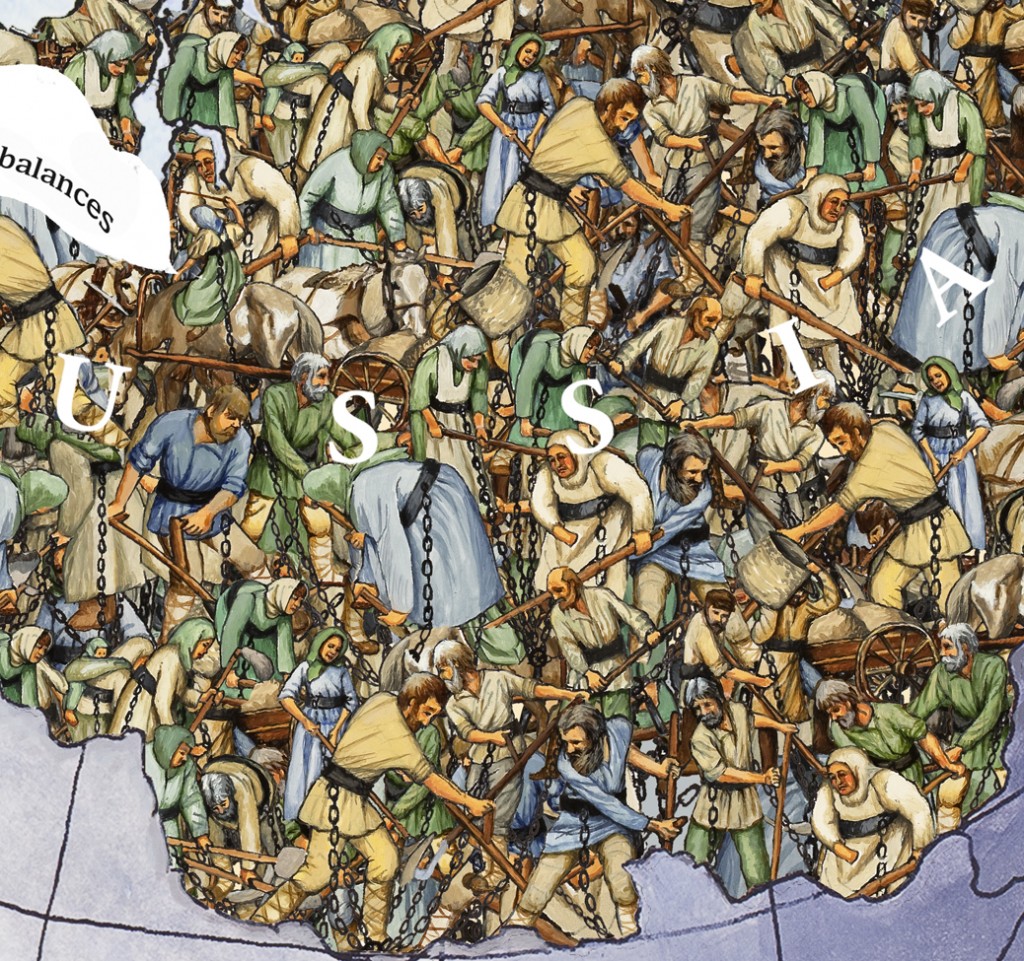
How could I portray a country full of peasants?

I pictured Catherine and Stalin speaking to untold numbers of peasants in Russia.  How could I convey the effect of so many peasants?

First I imported my digitalized painted map into my computer.  Then I began to experiment with various ways of using multiple copies of my paintings of peasants to fill the white “RUSSIA” space.  But I just could not get what I wanted.  I kept periodically coming back to this problem for almost an entire year, without success.

Finally, as I was playing with manipulating multiple, layered copies of another painting I had done of peasants (see below), I made one of those lucky mistakes – and suddenly had what I’d been struggling to find for so long.

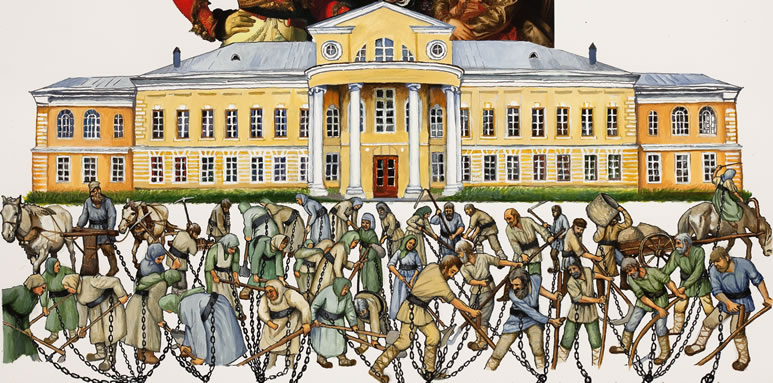
Detail of “Serfdom,” upper left (round) panel of “Dress It Up in Resplendent Clothes,” by Anne Bobroff-Hajal. This was my painting which I manipulated digitally to fill “Russia” on the map for the lower left panel.


Map with digital images of my painted peasants composited in.

For a close-up look of the peasants in the map, scroll down to the last image of this post.

Why work digitally?  Why not paint everything the old-fashioned way?

Why didn’t I just paint those peasants, you might ask?  Why did I create this look digitally?

There are two reasons.  One is that painting these serfs the first time – finding models for the scythers and other field workers, drawing and arranging them to fit into the composition, working out all those chains (each serf has a chain attached to a specific point at the bottom of the image), and then painting the whole thing – took a couple of months.  Painting them all over again would have been prohibitive time-wise.  If I’d spent time doing that, I couldn’t have created other parts of “Dress It Up.”

The second reason I worked with my painted serfs digitally is that it enabled me to play around limitlessly with layering of copies of my painting, fades, and color changes.  This play is what eventually led me to the multi-layered look in the final triptych.

(Parenthetically, I do almost all the huge amount of planning for my triptychs in the computer.  Integrating all the bits and pieces of my artwork into a coherent whole would probably be impossible without this.)

Next, Catherine and Stalin

Now that I had my map complete, I needed to create Catherine and Stalin as orators speaking words from Europe to the Russian people.

My process here was similar to classic animation procedure: I used a single background twice, with two different characters in the foreground.  Again, the reason was the same as in animation: repainting this very complex background twice would have been prohibitive time-wise.

I had already designed my Catherine the Great character.  Now I needed to create a Catherine who looked the same but airily orating.  And she needed to face the opposite direction, toward Russia on my map and away from Europe.  Both her head and her arms needed to be different.

I created my orating Catherine the same way an animator might.  I began with my painted character.  I had her photographed so I could manipulate her digitally in my computer.  In Photoshop, I flipped her horizontally to make her face toward Russia and away from Europe.  I had this version printed.  Then I painted a new head and new arms on the print.

Upper left: my character design of Catherine the Great (head and wings are digital photos; I painted most of clothing and the serfs). Lower left: close up of character design face, taken from an actual portrait of Catherine the Great. Upper right: my 2nd version of Catherine, orating. Lower right: close up of face I painted, along with new arm.

Stalin as an orating wolf in sheep’s clothing, by Anne Bobroff-Hajal

I created my orating Stalin as a wolf in sheep’s clothing.  This design went through a number of iterations along the way as I debated how wolf-like Stalin’s body and posture should be, how he should be clothed, and whether his face would be human or wolf.

A larger image of this design can be seen in this post.

Last, the speech bubbles

The last element needed for my “spout ideas from Europe” panel was speech bubbles.  In fact, the entire composition of map and orators was planned at every step to accommodate speech bubbles that would represent Catherine and Stalin sucking in ideas from Europe and spouting them out again over the Russian populace.  (Catherine’s bubble sucked in from France; Stalin’s from Marx’s Germany.)

Below is one of my many, many planning images.  In this one, I composited my pencil sketch of Stalin into my map and began to play with how I would shape and size the speech bubbles.  I did this to check whether all of Stalin’s parts would fit properly into the map without blocking any crucial bits of it.  I also needed to be sure that legibly phrase-filled bubbles could fit from Europe to Stalin’s mouth.

Planning image for Stalin’s speech bubbles, by Anne Bobroff-Hajal


I approached the other panels of “Dress It Up” in the same way.

Completing the final triptych

Once all the images for “Dress It Up” were completed by this process, I reduced their sizes to fit into the 7-foot width of the triptych.  I composited them and had them printed on canvas.  I then spent roughly six weeks doing additional painting on top of the canvas.  For example, I painted the large portrait of Catherine’s face in the center round top panel, replicating her historic portrait.  I painted Stalin as a baby directly on this canvas – that character doesn’t exist anywhere except on the final triptych.

Catherine the Great: a Satirical Visualization of Russian History and Society

Tuesday, June 21st, 2011

My PLAYGROUND OF THE AUTOCRATS triptych’s bag of tricks….

Anne Bobroff-Hajal gallery talk on “Dress It Up in Resplendent Clothes,” June 2011.

I don’t usually focus on my own artwork in this blog.  But for the moment, I’m throwing modesty to the monsoons to celebrate completing my latest satirical triptych about Russian culture and history.

My series of icon-like Russia triptychs is collectively called PLAYGROUND OF THE AUTOCRATS.  In them, Peter and Catherine the Greats, Ivan the Terrible and Stalin host viewers on romps through the wild and wooly forces that have shaped Russian history over the centuries since the Mongol invasions to the present day.  It’s a saga of Tsarism and Soviet Communism (more or less the same dictatorship by different names): the past as godparent to the present.

Below is the character I invented for Catherine the Great.  She’s the star of my newest, 7-foot wide visual/historical spectacle titled Dress It Up in Resplendent Clothes.


Dress It Up in Resplendent Clothes took me well over a year to complete (more on my process of creating it is here).  It’s currently being exhibited at the Blue Door Gallery in the Arts District of Yonkers, NY, just north of NYC.  (If you’re in NY and want to check out the exhibit, you can have a bite to eat nearby afterward – walk over to Peter Kelly’s X20 on the Hudson River pier, or to Zuppa the next block over from the gallery.)

(Continue reading below the image for more about Dress It Up.)

“Dress It Up in Resplendent Clothes”          .         7′ x 6′         .         Acrylic and digital images on canvas and board          .         2011

What do I hope you’ll find in these insanely-elaborate artworks?

My first goal with my triptych’s bag of tricks is to amuse and amaze you.

“Stalin in Sheep’s Clothing” . 12″ x 15″ . Acrylic on paper . 2010 . (Appears in lower left panel of “Dress It Up in Resplendent Clothes”)

But if you decide to keep gazing around the pageant I portray, I also want to horrify you, and make you cry, and show you some of the vast historical forces that sweep up hapless human beings in their powerful gales.

So #1, bring you a smile.  After all, Russia has fantastic history, a lush and glorious culture, enchanting and powerful characters.

If you choose to go deeper, I hope to enrich your experience and understanding of the extremes of the human condition.  Tragedy.  Joy.  War.  Deception.  Terror.

You’ll find War and Tragedy in my first triptych, The Most Exposed Terrain on Earth. The second triptych, Home Security at Any Crazy Price, features Terror and Manipulation.

In Dress It Up In Resplendent Clothes, Catherine brings Disguise and Deception.

All in the spirit of fun, mind you!

Catherine the Great, Our Heroine

Many Americans have several associations with Catherine the Great.  Tales of her sexual adventures.  Her fabulous art collections.  Her reputation as a beacon of the French enlightenment in “backward Russia.”

Anne Bobroff-Hajal gallery talk about “Dress It Up in Resplendent Clothes,” June, 2011.

She’s famous for having corresponded with the leading European thinkers of her time: Voltaire, Montesquieu, D’Alembert, Diderot (you’ll notice above that I’ve painted her holding letters she’s written to them with that feather pen in her other hand).

Less often noted are some very unenlightened policies Catherine enacted.  Every time she dumped a lover, she’d give him a new estate or two along with thousands of serfs to boost his wounded self-esteem.  She extended serfdom in general.  And she instituted the Jewish Pale of Settlement, which confined Russian Jews to living only in specified territories along the western border of her Empire.

How do I paint Russian history?

My triptychs use a technique common to icons, comic books, and animation story boards: they’re made up of a series of pictures that tell a story.  Below is one of the images I painted of Catherine the Great.  It forms the upper half of the left panel of the triptych.

Left panel detail of “Dress It Up in Resplendent Clothes,” by Anne Bobroff-Hajal:      Catherine speaks words of the French Enlightenment while the Russian peasants live in serfdom.   18″ x 12″ .  2011  

Below is a detail of Catherine’s captive audience, my depiction of her Russian serfs.

Detail of Russian serfs from “Dress It Up in Resplendent Clothes,” by Anne Bobroff-Hajal

There are many more scenes that make up the story I tell in Dress It Up in Resplendent Clothes, many more chapters to my tale.   Stalin is involved, as the inheritor of the tsarist system and the history of serfdom.  Oh, and the story is told in lyrics which I wrote to the well-known, beloved Russian folk tune KALINKA.  The music and lyrics are all in the tryptich, too.  You can see closeups of each panel here.

One Artist, Two Worlds

How did I get myself into the years of research, planning, writing of lyrics, and painting it takes to create each PLAYGROUND triptych?

I am an artist.  But for about a decade of my life, I was under the impression that I was an academic historian, so I went to grad school to earn a Ph. D. in Russian history.  The thrilling part was living for a year in the USSR, that great hall of crazy mirrors, doing dissertation research.  My dissertation was later published as a scholarly book, Working Women in Russia Under the Hunger Tsars.

But ultimately I became aware that I was seeing history in pictures that were more compelling to me than were academic debates.  I set off on a long and twisted journey to find a path combining my two worlds, art and history.

The result, finally, has been PLAYGROUND OF THE AUTOCRATS.

Closeups of each “Dress It Up” panel in sequence are here; more on my process of creating it is here.

Hand Drawing Tutorial #14: Creating a Custom Grid as You Draw

Sunday, June 12th, 2011

Hand Tutorial 14 Final Drawing


Artists often use grids to help them draw.  A common example is when an artist is re-drawing a small sketch they’ve completed onto a larger canvas or onto a wall for a mural.

Albrecht Durer's grid. A physical grid made of wood and wires is placed between the artist and the subject he's drawing. He's sketched a corresponding grid on his paper. The vertical instrument in front of his nose is a guide to keep his head in the same position each time he looks through the wire grid, so he always sees the identical view through each grid square.

Grids are so helpful that historically, people have rigged up ways of applying physical grids to the real world when drawing from life.  See the picture to the right for Albrecht Durer’s set-up.  Betty Edwards says dozens of versions of such devices have been recorded in the US Patent Office (New Drawing on the Right Side of the Brain, p. 100).

Why are grids so helpful in drawing?

As I’ve said in previous tutorials: it’s always easier to draw a small, simple shape than to draw a large complex one.  Artists use grids to chop up complex images into small bits that are easier to draw.

In earlier tutorials, I’ve used the concepts of constructing a jigsaw puzzle and seeing with the “right brain” to help you “chop up” your drawing into little easily-drawn pieces,

I haven’t yet talked much about the fact that, while constructing the “jigsaw puzzle,” in my mind’s eye, I’m applying an imaginary grid to help me draw the pieces in their proper places, sizes, and shapes.  More accurately, I’m imagining bits of a grid only where and when I need them.

What is a “custom grid?”

What do I mean by drawing “a grid where and when I need” it?   I mean that each time I’m about to draw a new line in my sketch, I run my eye over other lines I’ve drawn, to see which might end or begin at the same level as the bit I’m about to draw, and so serve as a compass to guide me.  I look to see whether the hand-part I’m about to draw is, for example, at the same level as the middle of the joint on the finger I’ve just drawn.  Or which previous hand-part is directly above or beneath the bit I’m sketching next.

In my drawing for this tutorial, I’ve actually sketched many of the lines I usually just envision in my mind.  You’ll see that this technique helps me build up an imaginary web of lines and reference points that enable me to pinpoint where each new line of the hand should be drawn.  I don’t put a wire grid between me and my hand, nor do I pencil an entire grid on my paper.  But the effect is close to the same.  I’m imagining the pieces of a grid that I need at any given moment.

The video at the end of this post will demonstrate how I do this.

Tutorial 14 Hand Pose

This is the first tutorial in which we’re drawing our hands from the standpoint of some one facing us, instead of from our own viewpoint.  In my last post, I showed how to take photos to use for these poses if you have to do it entirely on your own.  If you haven’t taken photos that will work for this tutorial – or don’t have some one willing to pose for you – please go back to see how to do this.  Try to replicate roughly the same pose as the one above for your own drawing.

First hand tutorial pose "A Simple Drawing of the Hand"

Since this is the first drawing from “the outside,” I’m using the simplest pose of the group of photos I took in Tutorial 13.  This pose mirrors the simple pose from our own vantage point which began this series of hand tutorials.

Natural subtleties in photos

Interestingly, we’re adding one small complexity in this pose compared to that very first one, in which our hand rested on a table (see right).  All the fingers in the first tutorial relaxed onto the surface of the table, so all were supported in the same plane.

In Pose 14, though, I held my hand in the air as I took a photo.  As a result, my pinky was poised at a different angle than the rest of my fingers.  So I was drawing it from a slightly foreshortened perspective.

This hand pose looks relaxed and natural in a way many of the ones I’ve drawn from life don’t.  This is because it’s not easy to hold a relaxed pose for a long time while you draw (in addition to which I have to keep reaching around the tripod to take photos of my drawing in action).  It’s really tough to hold your hand in the air in a natural position for very long, so it’s easier to draw the hand resting on a table.  But that really limits the number of poses available to you.

What I love about working from photos is you can freeze fleeting poses that in life couldn’t be held naturally for very long (this is why life drawing teaches you to draw incredibly quickly, sometimes in 10-second or 30-second poses).

Work materials and set up

Refer back to the relevant sections of this tutorial for your work materials and set up.  When drawing from photos, use the vertical set up.  Drawing with your paper vertical always gives you a better angle; the only reason we’ve used a table in the past is as a place to rest the hand when drawing from life.

Be sure you’re seeing see both your drawing and your model straight on!  If you’re seeing either from an angle, shift your setup until you’re seeing them properly.

Stand up while you’re drawing!

Whatever your setup is, it’s always best to stand up while you’re drawing so you can move back and forth to see your work from different distances as it progresses.

Standing up also helps you see both your model and your drawing straight on.  When you sit down, you’re almost always seeing your drawing at a slant.  This will distort your work.  You’ll end up being very upset if you’ve produced something that looks gorgeous from your sitting position, but is skewed when you look at it from any other angle (e. g., when you display it on your wall).

Hand Tutorial #14 video

As you watch the video below, notice the guidelines I’m constantly sketching in.  (I usually don’t actually draw most of these guidelines; I simply picture them in my mind.)

{"numImgs":"58","constrain":"height","cvalue":"450","shellcss":"width:609px;padding:4px;margin:14px auto 0;"}

All of the vertical and horizontal lines I make are like a standard grid.  But early on, before I have many lines done that I can use for reference, I often begin by looking for triangular shapes at the top of the hand.  (The beginning of any drawing is always the most difficult part, because you have no anchors created yet.)  So at first my “grid” contains more slanted lines than straight ones.

Late in the drawing, I erase the guidelines.  By this point, I usually have the hand completely sketched in, so I can now see its parts in small enough pieces to continue without needing guidelines.

At one point (by Frame 24), you’ll see that I realized I’d made a mistake in my judgment of grids and shapes.  This happens all the time!  Don’t let it upset you.  Just correct your error and keep moving forward.

My hand in Tutorial 14 pose.

I realized in Frame 24 that I’d made a mistake somewhere because that pinky was going to be very fat!  I didn’t know right away where my error was – on the pinky side of the hand or the forefinger or where.  As always, I believe in continuing to move forward sketching other areas, in order to help orient myself to figure out where my mistake happened.

By Frame 37, I’ve decided I’ve placed my middle finger too high (in negative-space terms, I haven’t made the negative space between pointer and middle finger a wide enough triangle).  I corrected that, making a big erasure in Frame 39, and moved on to finish the drawing.

How did I figure out where I made my error?  In Frame 35, I drew in the bottom line of the pinky.  This line intersected the hand in a place that would have shaped the hand incorrectly.  I was going to have to do major surgery on my drawing!  In Frame 36, I used the shadow along the bottom of my hand to judge the proper placement of all the hand parts, then moved ahead with the surgery in Frames 37-42.

Have fun drawing!