

(Haven’t read Part 1? Click here.)
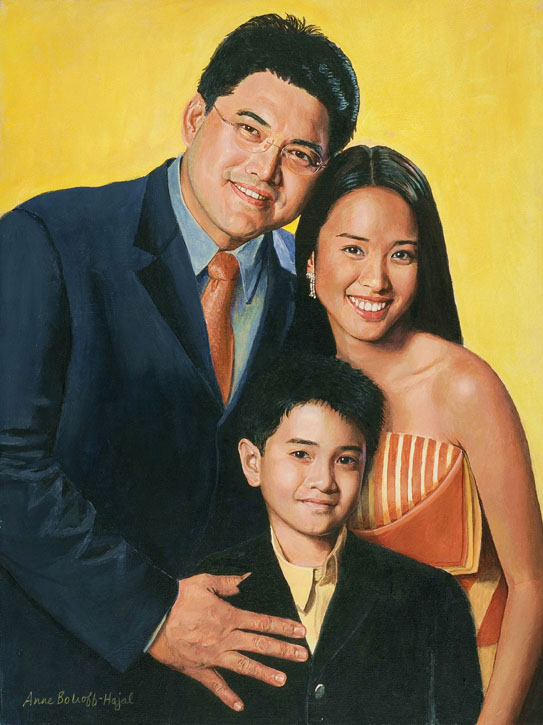
As I said at the end of my last post, I’d like to bring a new perspective to personal snapshots as the basis for portraits. I believe that, treated properly, a client’s snapshots can indeed be the core of a terrific work of art. This post will explain why. (Future installments will talk about how.)
A caveat: I believe snapshots can be used successfully only by an artist who has a huge bank of visual knowledge of how the 3-dimensional world works, together with lots of experience drawing and painting from life. Some one who never paints from anything except photos is unlikely – I would think – to have the skills and experience they need to create fine art portraits from snapshots.
But why even bother with snapshots? If an artist is using photos, why not just use technically perfect ones taken by the artist under controlled conditions?
Well, sometimes photos taken by the artist can make wonderful portraits. There are some subjects who “come alive” in front of any camera. These people produce captivating expressions no matter who’s taking the photo. But often that’s not the case.
To explain why I feel that capturing personal expression is so important, I need first to describe my personal artistic goals in portraiture.
I am passionate about painting how my subjects relate to other people. To me, painting an expressionless face for its physical characteristics alone is to paint a person isolated from human contact. It makes me lonely just to think about it.
To connect with other people, human beings use words, the voice, touch, body language, facial expression, and so on. But portraiture is a visual medium. We can’t paint sound or touch. So if we want to paint the way a person engages other people, we need to paint their facial expression and body language. These are how we visually communicate our needs and emotions to each other.
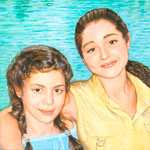
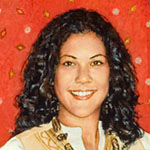
I recently took two nearly-identical snapshots of my grown daughter. The first shows the serene smile of the young woman my daughter has become. In the second photo, underneath her grown-up smile I can see the breathless, excited smile she had as a little girl. The differences between the expressions in these two photos are very subtle. If I were commissioning a portrait of her, I would want that very particular expression in the second photo: the one in which I see both the mischievous, merry little girl and the self-confident young woman. But I doubt that an artist who didn’t know her could have elicited that expression so personal to her while posing her in artificially perfect conditions.
Snapshots taken by family or friends are often more likely to capture expressions like this. Such expressions are frequently intimate, brought forth only in particular surroundings and situations. That is why I would rather work from a defective snapshot that captures the subject’s unique expression and surroundings than work from a technically perfect but impersonal photo I’ve taken myself.
Human expressions are very complex and subtle. It requires great skill to capture them in paint. How does an artist paint a relaxed smile differently from a smile that looks forced? What makes eyes appear to twinkle? What are the facial changes that take a face from routine sadness to the most profound grief?
What subtle changes in line and shadow gave one photo of my daughter the additional layer of childish excitement under the young woman’s smile? How would an artist paint the second expression differently from the first?
The ability to capture expressions in paint is partly built on understanding the human language of expression. A relaxed smile, for example, is conveyed partly by the lower eyelids moving up over the pupil as the cheek muscles contract to pull the corners of the mouth upward. Painting a smiling mouth without this effect on the lower eyelid will create a false-looking smile.
So to paint expression, the artist needs to be able to analyze the effects of subtle changes in the shading and shape of facial flesh and muscle while forming the brush strokes that portray them.
My daughter’s mouth, chin, and lower eyelids in the first photo are very relaxed, expressing adult self-confidence. In the second photo, her lower lip, chin, and lower eyelids are all pushed very slightly higher on her face by the muscular tension of suppressed childish excitement. These subtle changes in the various parts of the face are the language in which humans communicate visually with each other.
Even beyond being able to paint expression, I would argue that creating a work of art from a snapshot requires at least as much artistry as does a photograph over which the artist has had control of lighting, pose, clothing, and so on. Snapshots are often faulty in multiple ways. Making up for a snapshot’s deficiencies requires tremendous technical skill. It also requires that the artist make constant artistic evaluations of the snapshot’s challenges as the painting develops. The painter must make continual artistic decisions about how to turn the snapshot’s deficiencies into artistic strengths.
Creating art from a client’s snapshot requires a lot of artistic skill precisely because the artist begins with an element so out of their control. It’s somewhat similar to using found objects to create sculpture. How the artist puts all the elements together determines whether something awful or something wonderful results.
In short, beginning a portrait with some one else’s snapshot creates all kinds of artistic issues that don’t occur when the artist begins with a photograph they’ve taken themselves under perfect conditions. In coming posts, I’ll describe a number of these issues that I’ve run into and how I’ve dealt with them technically and artistically.
deep web markets deep web drug url
darknet drug market darknet search engine
dark web search engines dark web links
darkmarket drug markets dark web
dark web market links best darknet markets
darknet drug market darknet markets
deep web drug markets dark web search engine
tor markets links tor market url
tor darknet darknet market
tor markets dark market url
darkmarkets tor dark web
dark web search engines deep web links
darknet sites darknet market links
tor market links dark web links
tor markets tor darknet
deep web drug links dark market onion
dark web links darknet sites
darknet search engine tor market url
how to get on dark web darknet site
tor marketplace darknet drugs
black internet dark internet
dark net dark web drug marketplace
deep web drug url dark internet
best darknet markets darknet marketplace
deep web sites how to get on dark web
deep web drug links tor markets 2022
tor darknet darknet search engine
darknet markets darknet market
dark web drug marketplace tor market links
dark website dark web drug marketplace
dark web markets dark markets
darkweb marketplace tor market links
the dark internet deep web drug links
dark web link dark market list
dark markets 2022 the dark internet
onion market darknet markets
tor markets links darknet market lists
tor market links dark market onion
best darknet markets dark web sites
dark net darkmarket
darknet seiten dark web market links
darkmarket list dark web link
darknet market list tor markets 2022
dark web market list dark web market list
dark market 2022 darknet sites
darknet search engine blackweb
deep web drug url darknet markets
dark market link drug markets dark web
tor darknet tor marketplace
dark market 2022 drug markets onion