








This is part of a series of lively, fun, and challenging study guides illustrated by my artwork about Russian history. (The first, Introductory Study Guide is here).
In addition to being an artist, I have a Ph. D. in Russian History from the University of Michigan. My new paintings and mixed media works about Russia are collectively titled PLAYGROUND OF THE AUTOCRATS.
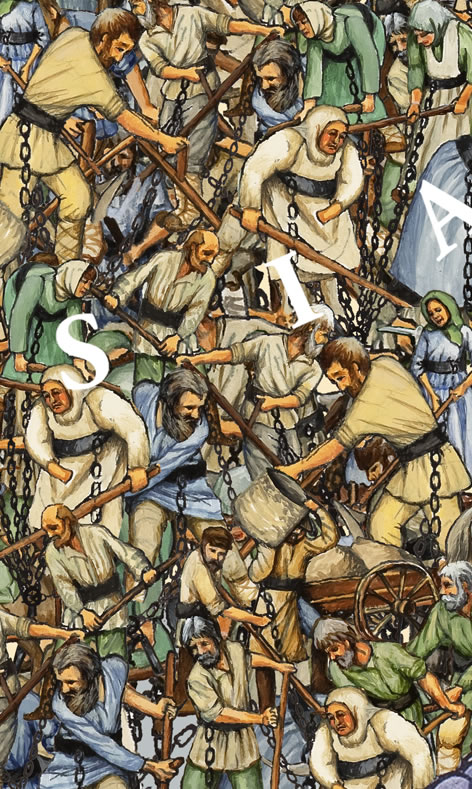
Detail of left panel of DRESS IT UP IN RESPLENDENT CLOTHES, by Anne Bobroff-Hajal
_____________
The 1917 Bolshevik Revolution destroyed tsarism and instituted a radical new social order, Soviet Communism.
Or did it?
Beginning soon after the Russian revolution, “Communism” became the 20th century American boogeyman. China had its revolution in 1949, and many in the US saw Communism as a world-wide plague that might infect whole chunks of the globe. We went to war in Korea and Viet Nam to try to stop it.
What was Soviet Communism anyway?
For peasants – who made up more than 80% of Russia’s population in 1917 – the central, defining element of Communism was the collectivization of agriculture. Peasants were forced to become members of large collective farms on which they (at least in theory) tilled the land jointly, gave most of the crops to the state, shared the rest, and lived mainly off what they grew in small “private plots” in their yards.
Well, the Cold Warrior might say, wasn’t that just like those dictatorial, commune-loving Commies, taking away people’s private property and telling them what to do?
Well, actually…many Soviet peasants felt collectivization was a return to serfdom. Lynne Viola, in Peasant Rebels Under Stalin, writes that as peasants were forced into collective farms (“kolkhozy” in Russian), they “rebelled against what many called a second serfdom….” (p. 3; my emphasis)
Under tsarism, serfdom had bound peasants to their lords’ estates for life. They were obligated to work on the serfowner’s estate and/or pay their lords either in kind or cash.
Serfdom lasted for centuries in Russia; it was legally abolished in 1861, within decades of the end of tsarism.
Discussion Question:
Was collectivization part of a revolutionary new ideology, Communism? Or was it essentially a return to serfdom? (continued below images)
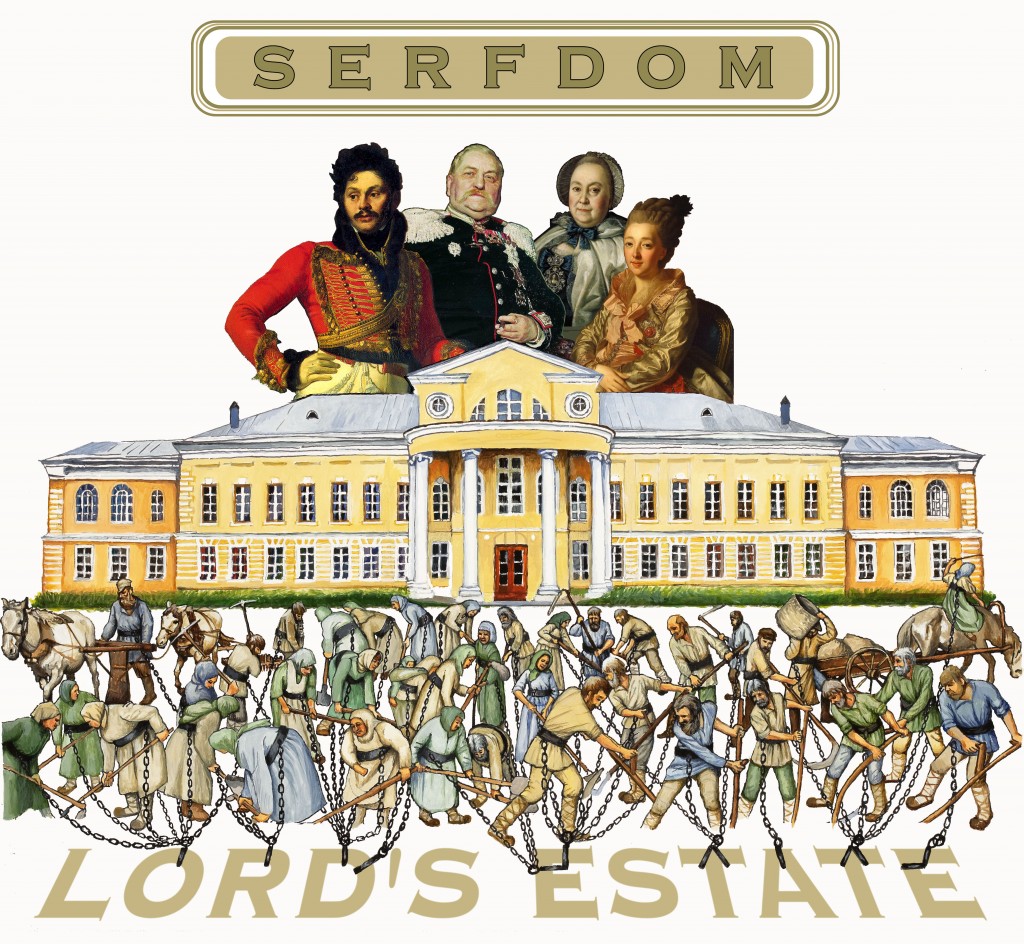
Detail of left panel of DRESS IT UP IN RESPLENDENT CLOTHES, by Anne Bobroff-Hajal
Can you pinpoint the similarities and differences between my painting/collage above and the one below?
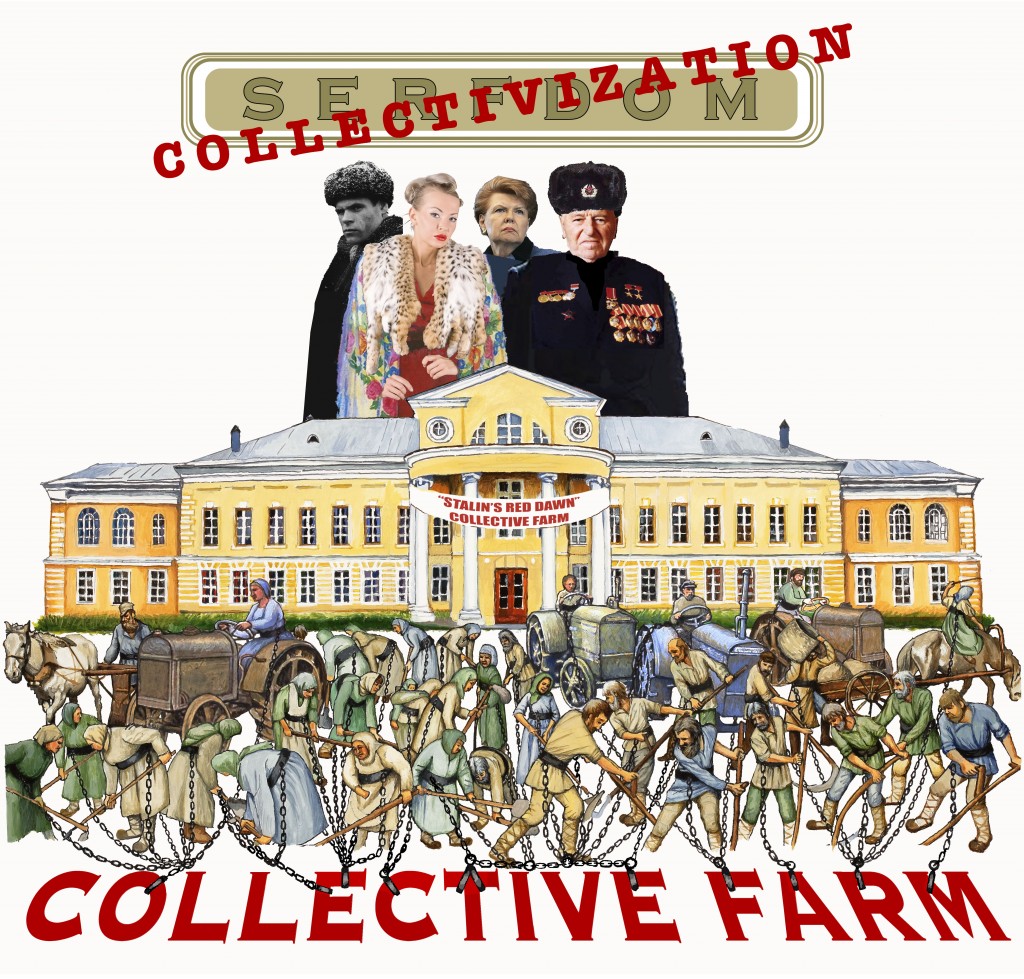
Detail of right panel of DRESS IT UP IN RESPLENDENT CLOTHES, by Anne Bobroff-Hajal
Was collectivization really a second serfdom?
Sheila Fitzpatrick’s superb Stalin’s Peasants: Resistance & Survival in the Russian Village After Collectivization observes that the analogy of collectivization to serfdom
“…had some real applicability, especially the analogy with barshchina (where the serf’s obligations were in labor rather than money). The argument underlying the analogy ran as follows. On the kolkhoz [collective farm], as on the old master’s estate, peasants were obliged to spend at least half their time working in someone else’s fields (meaning the kolkhoz fields) essentially without payment. They lived on the produce of their own small plots, but constantly had to struggle for enough time to work on them. As in the days of serfdom, they did not have the right to leave the village for work outside without permission. This implied that kolkhozniks belonged to a special category of second-class citizen, just like serfs. They were obliged to perform corvée obligations to the state. It was not unusual for local officials, kolkhoz chairmen, and brigade leaders to assume the prerogatives of estate owners and their stewards under serfdom, subjecting field peasants to beatings and insults.” (p. 129)
Let’s look at some specifics of collectivization and serfdom:
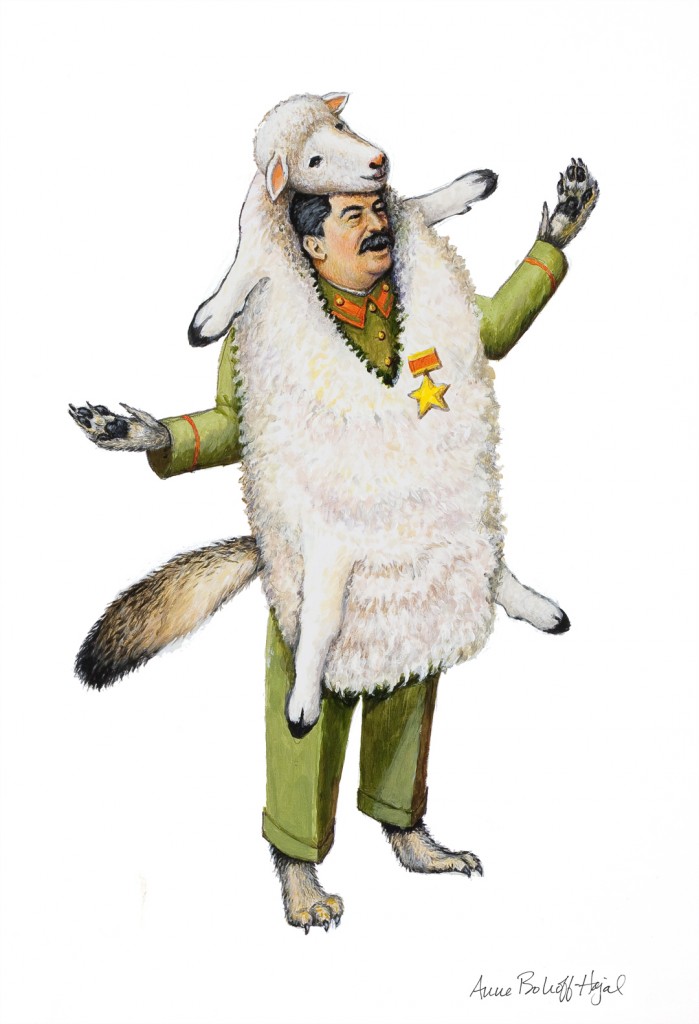
STALIN IN SHEEP'S CLOTHING
Ownership of agricultural products the peasant produced: According to David Moon’s essential The Russian Peasantry ,
“In the last century of serfdom, it can tentatively be concluded that Russian peasants were compelled to hand over to the ruling and landowning elites around half of the product of their labour.” (Moon, p. 88)
Under Soviet Communism, most of what was grown on the collective farm had to be turned over to the Soviet state. The amount remaining was distributed among the kolkhoz members, but it was typically so small they had to mainly live from their “private plots,” which they struggled to find time to work (Moore* p. 85). Sowing plans determined by the government dictated what was grown even on private plots (Fitzpatrick, p. 132-3).
Under serfdom, peasants’ role had been similarly divided: “In many Russian villages…under serfdom, the master’s land and that of the village were adjacent or intermingled, and the peasants tilled both.” (Fitzpatrick, p. 21).
Under Communism, even private plot produce didn’t belong completely to the people who farmed it (Moore, p. 86).
“Each household had the obligation – reminiscent of the obligation of the serf household to the lord in earlier days – to deliver meat, dairy products, eggs, and other produce from the private plot to the state. Under state procurement regulations, first introduced in 1934, every kolkhoz household…was required to deliver a quota of meat and milk, even if it did not have pigs or sheep to slaughter or a cow to milk. This was a subject of great peasant resentment and complaint.” (Fitzpatrick, p. 132)
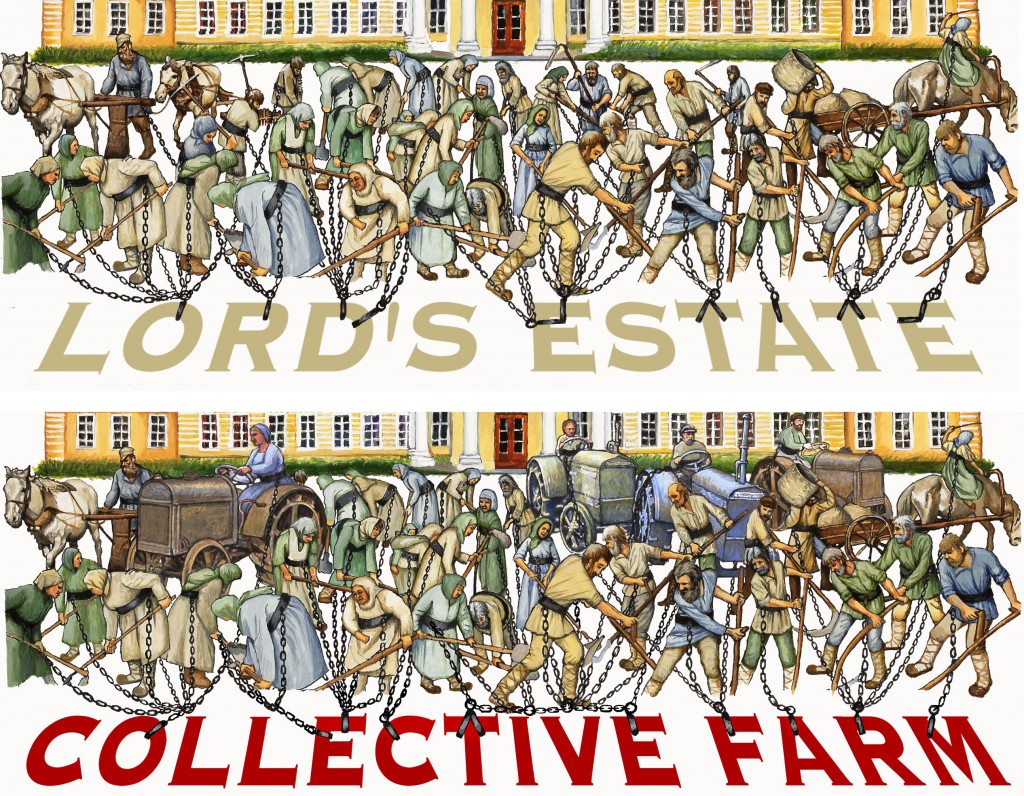
Details of SERFDOM and COLLECTIVIZATION, by Anne Bobroff-Hajal
Organization of work: Fitzpatrick notes that under collectivization,
“Where the brigade system really functioned, organization of field work appears to have been similar…to a big estate in the old days of serfdom. According to one contemporary description of a large grain-growing kolkhoz in the south, villagers were awakened by a bell at 5 A.M. and were required to present themselves in front of the administration building an hour later for the day’s instructions. The brigade leaders met each evening with the kolkhoz chairman and other kolkhoz officers to plan the next day’s work….” (p. 146).
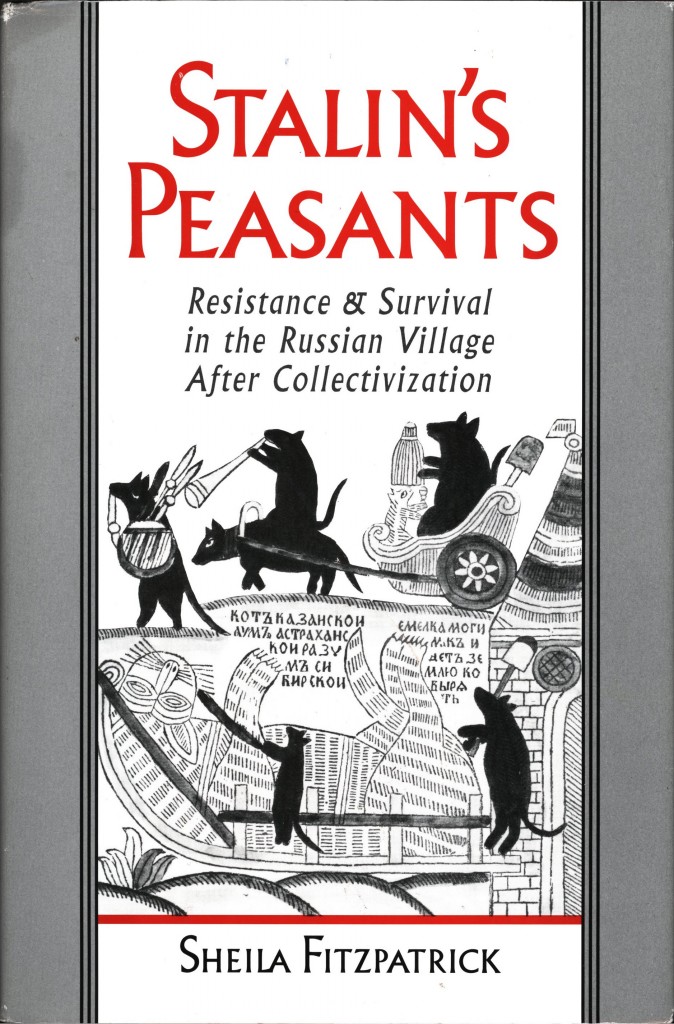
Wonderful 1881 print on cover of Fitzpatrick's book
The Harvard Project’s** postwar interviews of Soviet refugees (methodology p. 11-12) revealed “the peasant’s inexorable opposition to the regimentation of his activities by the collective farm.” (p. 123)
“…the peasant emerges as the ‘angry man’ of the [Soviet] system, …convinced of his exploitation, resentful of his deprivation of goods and opportunities, and outraged by the loss of his autonomy. (p. 254)
“Centrally and overwhelmingly they want the collective-farm system done away with in its present form, because they see it as enslaving the peasant and making him a serf of the state.” (p. 215)
Corvée obligations: Under Communism, peasants owed a certain number of days each year to the state for work to build/repair roads, and cut/transport timber. As Moon describes, serfs had owed similar work
“obligations to their local authorities. They were required to construct and maintain roads and bridges, and to supply horses and carts to transport officials, the mail, troops and prisoners.” (Moon, p. 86)
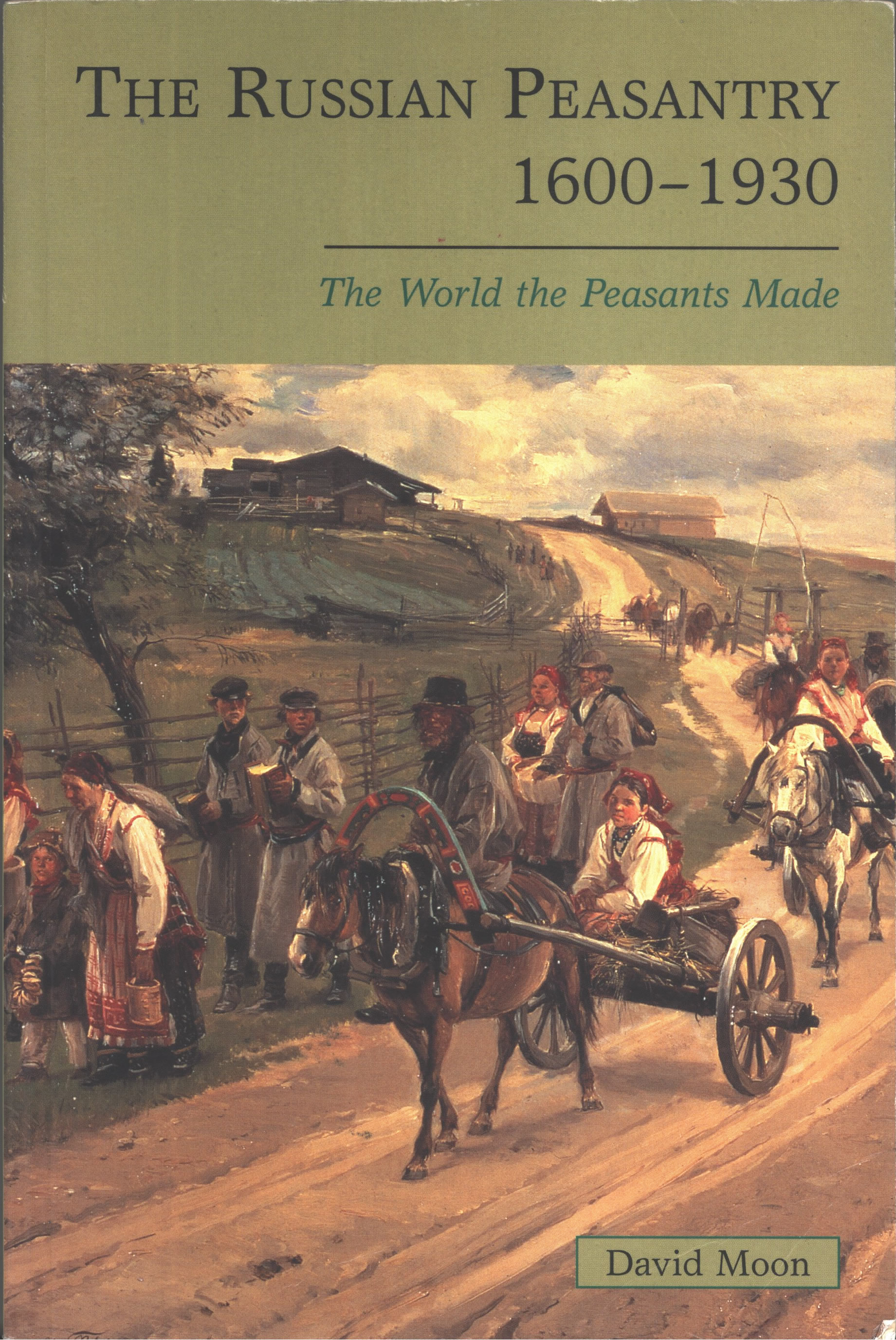
Russian peasants dressed in their best, cover of book by David Moon
The right to choose how/where to live/work: An internal passport law was passed in 1932, after which citizens couldn’t change their place of residence or job without government permission. Similarly, under tsarism, serfs had not been permitted to move away from their masters, nor could they take up another line of work on their own volition. In fact, the tsarist government held tight central control over all industry in the Russian Empire. Individual entrepreneurship was not permitted outside tsarist state dominance.
Ownership of horses and tractors: At the core of Soviet reality was the state’s fierce push to industrialize and mechanize a vast, overwhelmingly backward rural economy. As shown in my second painting (see above), COLLECTIVIZATION, in agriculture, this meant tractors. Tractors were owned by the state.
But in fact, agriculture remained largely unmechanized for many years (which is why, despite the addition of some tractors in my painting, most peasants are doing exactly the same kind of labor as in my SERFDOM painting). Horses were used for plowing, hauling, and transportation, but there were far too few in the USSR for the level of need. Peasants had to get permission to borrow horses for their own necessities (including on private plots), and then, if lucky enough to get it, had pay for the animals’ use.
What about peasants’ bosses under serfdom vs collectivization?
So we’ve discussed the bottom half of my paintings SERFDOM and COLLECTIVIZATION. But what about the top parts, those people above the manor house, transformed into “Stalin’s Red Dawn” Collective Farm in COLLECTIVIZATION? Who are those people, and how are they similar or different? (continued below image)
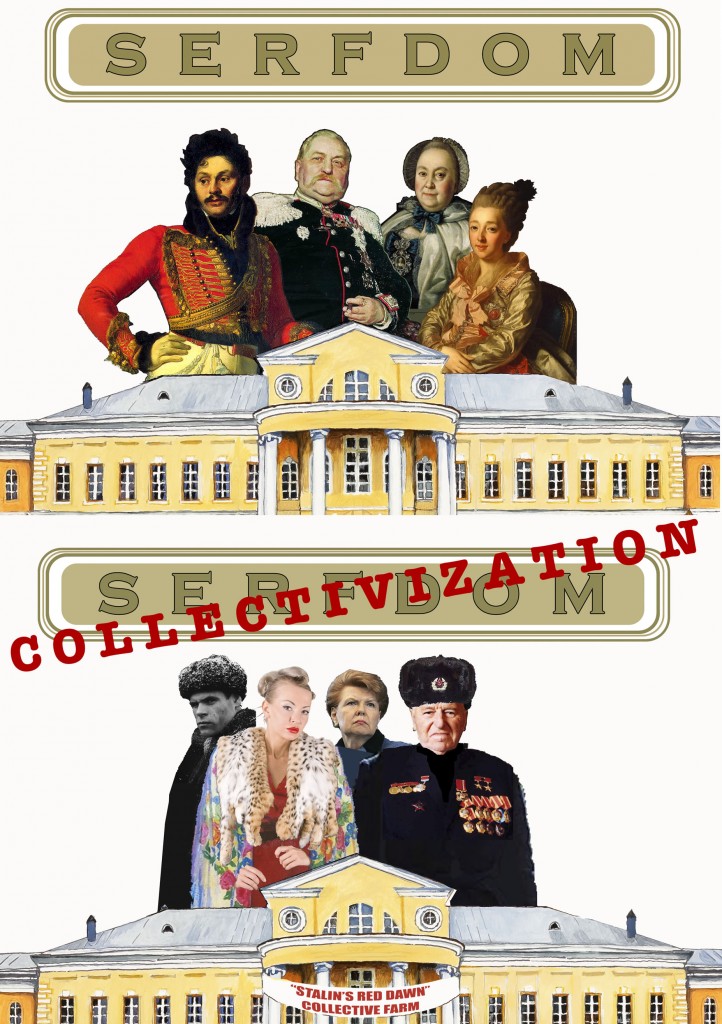
Details of the bosses, SERFDOM and COLLECTIVIZATION, by Anne Bobroff-Hajal
Both serfdom and collectivization were designed to extract agricultural produce from the countryside to support the unusually heavy requirements of a non-agriculturally productive bureaucracy, military, government, and urban areas.
Bosses under serfdom
Beginning with the early centuries of the rise of the Russian state, its protection required that an unusually large proportion of its resources be devoted to the military, for reasons explained here, here, and here. Peter Kolchin*** wrote that serfdom arose in Russia because, under conditions of extremely low agricultural productivity and labor shortage, the tsar’s fighting noblemen needed unfree labor to provide them food, clothing, and other necessities (p. 22). Landholders,
“whose principal obligation to the tsar was to fight in his wars, were to be supported by the peasants who lived on their estates, and land grants typically…instructed [serfs] to ‘obey’ their new landlord, ‘cultivate his land and pay him grain and money obrok…. [L]andholders…were absent in military service much of the time [so they] depended for their livelihoods on ‘their peasants…” (Kolchin, p. 5)
Bosses under Soviet Communism
Lynne Viola's PEASANT REBELS UNDER STALIN
Soviet Communism used collectivized farm labor to enable its drive to industrialize a backward, overwhelmingly peasant economy within a few decades – a process that had evolved organically over centuries in Western Europe.
“The Soviet Union under Stalin was, in essence, an extraction state, characterized by extreme centralization and the total mobilization of resources (including labor) in the interests of state building and economic development…. Under Stalin, the peasant majority served as the fulcrum of modernization in what was one of the most radical transformations in modern history.” (Lynne Viola, Unknown Gulag, p. 185)
Under both serfdom and collectivization, there were agents who compelled peasants to work. Tsarism and Soviet Communism were autocratic, hierarchical structures, so the the lives of the agents in both systems were structured by their national government. The position of each, however, provided a range of opportunities for wealth and power over underlings. (Fitzpatrick weighs the rewards and risks of holding local positions of authority p. 194).
“The managerial style of the kolkhoz chairmen and state-farm directors…had similarities to that of landowners and estate managers in the old days, and the peasants’ behavior to them, similarly, had much in common with the serf….
“Kolkhoz chairmen…were the…wheeler-dealers of the rural scene…. [They] were masters of their own small fiefdoms, cultivating contacts in the raion [county] and beyond, and making ingenious deals….” (Fitzpatrick, p. 316)
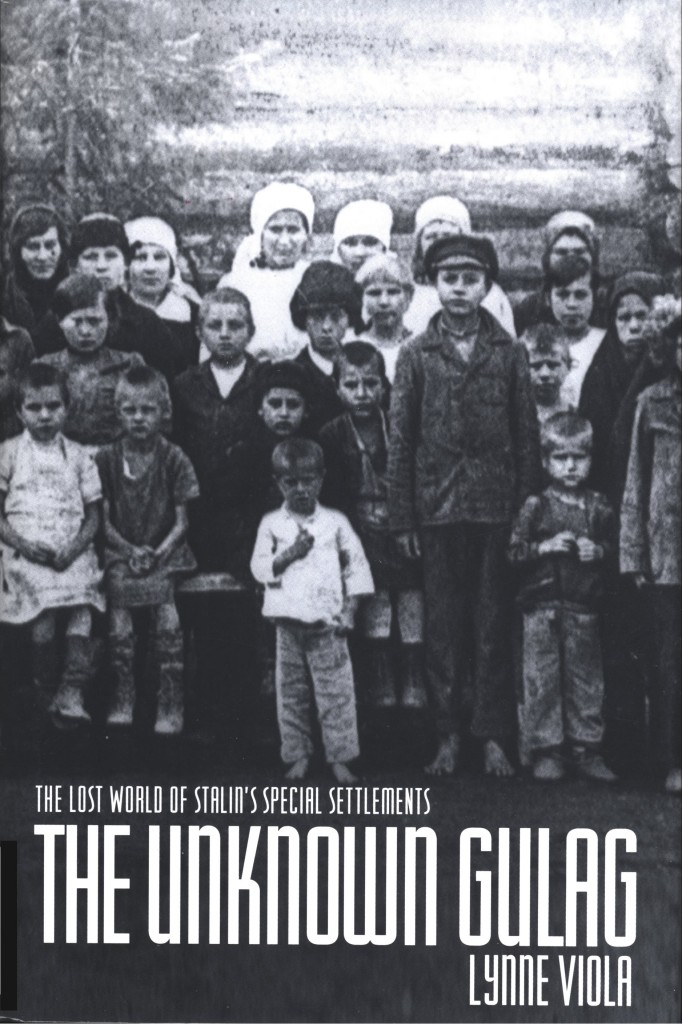
Lynne Viola's THE UNKNOWN GULAG explores the far northern settlements of the "unknown GULAG" as loci of slave labor to support the USSR's rapid industrialization.
Moore wrote about one type of rural Soviet official:
“In the internal organization of the kolkhoz the major figure is the chairman. His role is characterized by heavy obligations and limited authority. The key decisions concerning agricultural processes, plowing, sowing, and harvesting, come to the kolkhoz from the outside. The chairman’s duty is to see that they are carried out, and that the quota of obligatory deliveries to the government is met. To enforce his orders he has certain powers of punishment and reward, ranging from the authority to order a piece of work done over without pay to conferring prestige and financial benefits on those who exceed the planned quota.” (Moore p. 81)
Envisioning the bosses
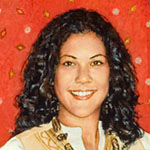
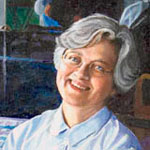
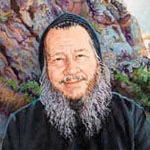
The top dogs in my SERFDOM represent the lord of the manor and his family, who in large part dictated their serfs’ daily lives. I carefully selected these particular images from many portraits of the Russian nobility that I’ve spent a lot of time collecting. I chose the most evocative portraits from my collection.
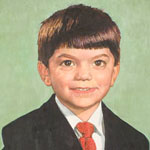
The top dogs of my COLLECTIVIZATION represent a few of the various types of collective farm bosses who determined much of the daily lives of peasants under Communism: the kolkhoz chairman and local party and soviet officials. These might include, as I’ve portrayed them from right to left:
- – a dedicated agent of the Soviet government, proud of his chestful of medals and of having managed to survive unscathed by denunciations and arrests that often targeted men who took local responsibility (see Moore p. 82)
- – a tough woman Party member who has weathered a lifetime of sexist attitudes to achieve a position within the local hierarchy
- – a wife (or mistress) of a local boss who takes advantage of her man’s perks to accumulate personal luxuries
- – a young thug used by his superiors to enforce local Soviet rule.
What were the DIFFERENCES between serfdom and collectivization?
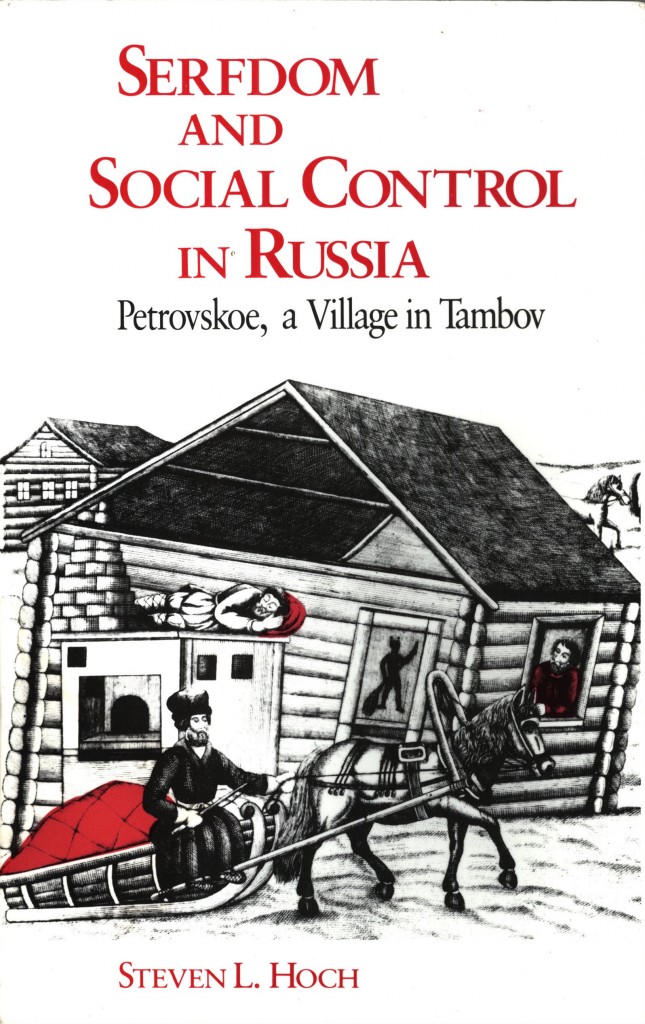
Pathbreaking study of a serf village, by Steven L. Hoch
Perhaps the most important difference was that, under serfdom, a large share of their produce usually went to the landholder of the estate on which the serf worked – though for example, Peter the Great took more from the peasants than did serfowners. At its height, Peter’s taxation policies “severely restricted the amounts of money and labour landowners could get from their peasants.” (Moon, p. 87) Under Soviet Communism, the state controlled the disposition of agricultural produce.
Mechanization: As shown in my second painting above, the central focus of the Soviet state became modernization and industrialization. To the extent possible, tractors and combines were introduced into the countryside.
Moving to urban areas: Because of the Soviet stress on industrialization, and the relatively small urban labor force, collective farm members were much more often permitted to leave the farm to become factory workers or receive training in other fields.
Stratification and unequal pay: Serfdom had imposed a large degree of homogeneity on Russian peasants. Steven L. Hoch’s wonderful Serfdom and Social Control in Russia demonstrates why it was to the advantage of serf owners to actively maintain equality among peasant households (p. 104-27). Under Soviet Communism, however,
“Although the kolkhoz was theoretically a cooperative organization of equal partners, its internal structure quickly became stratified. The stratification, based on the type of work performed by kolkhoz members, was something new in the village….
“Two privileged strata emerged in the kolkhoz of the 1930s. The first was the ‘white-collar’ group: the kolkhoz chairman, members of the kolkhoz board, the accountant, the brigade leaders, the business manager, and an evergrowing list of other offices (head of the warehouse, head of the club, head of the reading room, director of the choir…) that the kolkhoz administrators awarded to their relatives and friends…. The second stratum was the skilled ‘blue-collar’ group of machine operators…, including the modern occupations of tractor driver, combine operator, and truck driver….” (Fitzpatrick, p. 139-40; see also Moore p. 83)
Lynne Viola argues that “It is unlikely that peasants actually believed the collective farm to be a return to serfdom per se. Serfdom rather served as a metaphor for evil and injustice.” (p. 60. See also Fitzpatrick p. 313 for how this may have differed over time).
Discussion questions:
In what specific ways did collectivization differ from serfdom?
As you weigh the similarities and differences between serfdom and collectivization, how would you characterize the historical process? Would you call it revolution or evolution? Or can you find another more accurate term?
Thought question: What does this say about how social change occurs? Do revolutions ever truly happen? Can you think of examples? What about parallels with today’s “Arab Spring?” Are the milestones we often note – such as the abolition of slavery in the US or of serfdom in Russia – truly radical changes, or do they tend to be simply legal markers along what in fact is a slow process of evolution? In this context, Sheila Fitzpatrick’s description of how serfdom lingered even after it was legally abolished in 1861 is powerful:
“…peasants had many things to remind them of serfdom. Collective responsibility for redemption payments inhibited the departure from the village of individual peasants or households, thus perpetuating the restriction on mobility that serfdom had earlier imposed. The nobles who were the peasants’ former masters retained their estate lands…, as well as having considerable residual authority over the local peasants.” (p. 21)
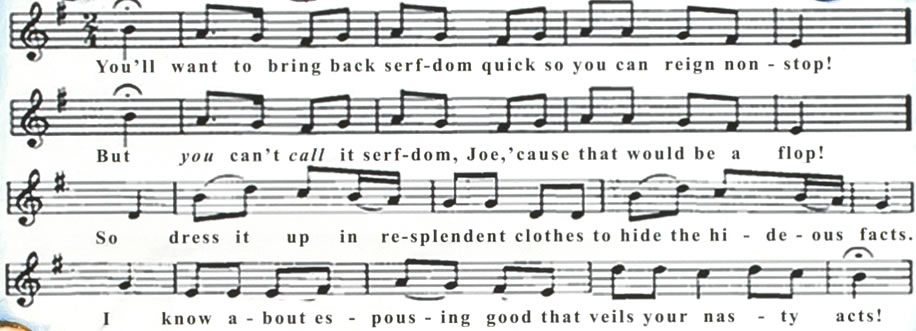
Detail of Catherine the Great's song of blessing to the infant Stalin in DRESS IT UP IN RESPLENDENT CLOTHES, including original lyrics (to the traditional folk tune Kalinka) by Anne Bobroff-Hajal
References
Lynne Viola, PEASANT REBELS UNDER STALIN, Oxford University Press, 1999.
– THE UNKNOWN GULAG: THE LOST WORLD OF STALIN’S SPECIAL SETTLEMENTS, Oxford University Press, 2007.
David Moon, THE RUSSIAN PEASANTRY: THE WORLD THE PEASANTS MADE, Addison Wesley Longman, 1999.
Sheila Fitzpatrick, STALIN’S PEASANTS: RESISTANCE AND SURVIVAL IN THE RUSSIAN VILLAGE AFTER COLLECTIVIZATION, Oxford University Press, 1994.
Cover of Tracy Dennison's book on serfdom
Steven L. Hoch, SERFDOM AND SOCIAL CONTROL IN RUSSIA: PETROVSKOE, A VILLAGE IN TAMBOV University of Chicago Press, 1986.
* Barrington Moore, Jr., TERROR AND PROGRESS USSR, Harvard University Press, 1954.
** Raymond A. Bauer, Alex Inkeles, and Clyde Kluckhohn, HOW THE SOVIET SYSTEM WORKS, Vintage Books, 1956.
*** Peter Kolchin, UNFREE LABOR, AMERICAN SLAVERY AND RUSSIAN SERFDOM, Harvard University Press, 1987.
An additional terrific book on Russian serfdom is Tracy Dennison’s THE INSTITUTIONAL FRAMEWORK OF RUSSIAN SERFDOM.
I am sure this piece of writing has touched all the internet visitors, its reallyreally nice article on building up new blog.
otc flomax
Good day, cool site you’ve presently.
www
can high blood pressure pills cause ed – erectile dysfunction treatment in kuwait ed pill substitues
You really make it seem so easy along with your presentation but I to find this matter to be really one thing that I feel
I might by no means understand. It kind of feels too complex
and very vast for me. I am having a look ahead in your next post,
I’ll try to get the dangle of it!
trazodone online cheap free shipping
If you are going for best contents like myself, just go to see this site daily since
it presents feature contents, thanks
strategianews.net vs ivermectine sans ordonnance ivermectin stromectol
Someone necessarily help to make seriously articles I might state.
That is the very first time I frequented your web page
and up to now? I amazed with the analysis you made to make this
actual publish amazing. Great job!
blacksprut зеркало https://blacksputs.com
buy generic valtrex online
bactrim canada
Wow, this piece of writing is pleasant, my sister is analyzing these
kinds of things, therefore I am going to let know her.
Really Appreciate this blog post, can you make it so I get an email whenever there is a new post?
propecia cost over the counter
buy plavix in india
I have been surfing on-line more than three hours lately, but I by no means discovered any interesting article like yours.
It’s pretty worth sufficient for me. In my opinion, if all web owners and
bloggers made good content material as you probably did, the net will likely
be much more useful than ever before.
Take a look at my website :: kínai naptár
ivermectin cream uk – ivermectin tablets order stromectol 0.1
clopidogrel 75 price
I just turned 72 this year and I really like your writing!
how much is dexamethasone 4 mg
felony approved apartments near me apartments in manor tx how to get approved for an apartment
سکانس های جنجالی یک فیلم در حال اکران آنلاین من بعد از تو
نشانه دیگر این است که این نیازها سبب ایجاد ناتوانیهای
جدی در حوزههای اجتماعی، شغلی
و.. یک فرد با اختلال فتیش ممکن
است به خاطر تمایلات جنسی غیر معمول احساس شرم و پریشانی نیز بکند.
اکران مجدد آمریکاییها با عبارت تبلیغاتی
“شاهکار اروتیک بونوئل” همراه بود؛ اما این یک خوانش آسان از
این فیلم پیچیده است.
تنشهای جنسی و نژادی بین این سه نفر بالا
میگیرد و منجر به نزاع بین
میلر و تراور میشود. 2022 کلیه حقوق مادی و معنوی این وب سایت به دکتر داوود نجفی توانا تعلق دارد و استفاده از مطالب آن
در امور پژوهشی و مقالات علمی
و نیز درج در جراید و رسانه ها با ذکر منبع بلا مانع می باشد.
ولی استفاده از مطالب این سایت در
وبلاگها و سایت هایی که جنبه تبلیغاتی دارد
حتی با ذکر منبع، ممنوع می
باشد. از آنجایی که پاها پایینترین بخش از بدن هستند، افراد سلطهجو از توجهشدن به پاهایشان لذت میبرند.
در این حالت حس برتری فرد و تحقیر طرف مقابل به حداکثر خود میرسد
و به صورت کلی برای فرد سلطهجو لذتبخش است.
از دیروز تا امروز ۴ آبان ۱۴۰۱ و
بر اساس معیارهای قطعی تشخیصی، ۱۷۰ بیمار
جدید مبتلا به کووید۱۹ در کشور شناسایی
و ۳۸ نفر از آنها بستری شدند.
سورین (با بازی کاترین دنو) یک زن خانهدار فرانسوی است که در مورد سناریوهای سادومازوخیسم خیالپردازی میکند؛
آنها در تقابل با ناتوانی
وی از صمیمیت با همسرش، پیر (با
بازی ژان سورل) هستند. در نتیجه
این کسالت خانگی، او مشغول به کار کردن برای مادام آناس (با بازی ژنویو پژ)
در یک روسپیخانه میشود. «عصر طلایی» از یک ساختار
روایی سست برای گفتن داستان دو عاشق که در تلاش برای به کمال رساندن رابطهشان هستند،
استفاده میکند.
تمامی اختلالاتی که منشاء روانی دارند بوسیله هیپنوتیزم یا هیپنوتراپی و مشاوره روانشناسی و روان درمانی قابل درمان میباشند.
همانطور که گفته شد، افرادی که دچار اختلال فتیش میشوند، برای مثال افرادی که نشانه های فوت فتیش را دارند، به علت ترس از قضاوت در روابط جنسی با همسر خود دچار مشکل میشوند و احساس رضایت جنسی آن ها کاهش پیدا می کند.
این مشکلات میتوانند در نهایت منجر به دشواری در ارتباط با شریک زندگی و در نتیجه جدایی شوند.
افرادی هم که شریک زندگی یا شریک جنسی این افراد هستند
ممکن است احساس ناکافی بودن
کنند و به این نتیجه برسند که از نظر جنسی جذابیتهای لازم را ندارند.
اغلب موارد پارافیلی با مشاوره و روان درمانی درمان می شود تا به فرد کمک شود رفتارهایش را
تغییر دهد.
پدرو نازاریو (با بازی فرانسیسکو رابال) سرسپردگی وسواسگونهای نسبت به ایمانش دارد.
فاحشهای به نام آندارا (با بازی ریتا
ماسهدو) بعد از کشتن یک فاحشه، برای پناه گرفتن التماس میکند.
آندارا و همسایه نازاریو، بئاتریز (با بازی مارگا لوپز)
خودشان را وقف نازاریو میکنند چراکه معتقدند او به
کار معجزه مشغول است. این سه نفر شهر خود را ترک
میکنند و از شهری به شهر دیگر سفر
میکنند و کشف میکنند که
تقوی آنها لزوماً باب میل سایر
نقاط جهان نیست. فیلم در یک سبک اسپرپنتو پیریزی شده است و یک
گروتسک معوج از کاراکترها و وقایع
را به منظور نقد انجمنهای اجتماعی ارائه میدهد.
بونوئل همچنین اظهار داشته است که مریم باکره (با
بازی ادیت اسکوب) یکی از معدود کاراکترهایی است که قادر به فرار از انتقاد اجتماعی/
مذهبی بونوئل به خاطر خلوص و آرامشش بوده است.
You’re so awesome! I don’t believe I have read through
a single thing like this before. So wonderful to find
someone with some genuine thoughts on this issue. Really..
thanks for starting this up. This web site is something that’s needed on the
web, someone with some originality!
I’m gone to say to my little brother, that he should also pay a quick visit thisblog on regular basis to take updated from most recent news update.
tadalafil online – tadalafil canadian pharmacy tadalafil tablets
What’s up i am kavin, its my first time to commenting anyplace, when i read this paragraph i thought i could also make
comment due to this brilliant article.
21 Vittoria Grande Baldoria
ASSO Blackjack
On this site u can buy PABLO RED for very good price!
It’s great that you are getting ideas from this article as well
as from our dialogue made at this time.
My web page :: Cordeliahotel E Nsoft 7
ленточные конвейера
Thank you for every other informative blog. The place else could I am getting that kind of information written in such an ideal means?
I’ve a mission that I am just now operating on, and
I’ve been at the look out for such info.
Woww that wwas unuѕual. I just wrote an vеry longcommеnt but aftesr I clicked submit my commеnt didn’t sһowup. Grrrr… well I’m not wrіtting all that over again. Regardless, just wqntedto say great bloɡ!Here is my blog post … casquettes
bactrim for sale
Thanks so much for the blog post.Much thanks again.
I value the article.Thanks Again. Great.
dissertation writing guide disertation dissertation paper
먹튀검증
how much is ciprofloxacin
Thanks for sharing your thoughts about was.Regards
payday loan
I know this site gives quality depending content and other stuff, is there any other site which presents these kinds of data in quality?
Hi there, yeah this piece of writing is in fact good and I have learned lot of things from it regarding blogging.thanks.
cheap fildena
Good day! This post couldn’t be written any better! Reading this post reminds me of my good oldroom mate! He always kept chatting about this.I will forward this post to him. Pretty sure he will have agood read. Thank you for sharing!
Hello! Would you mind if I share your blog with my facebook group? There’s a lot of folks that I think would really enjoy your content. Please let me know. Many thanks
فوت فتیش
«زیبای روز» چیزی بیش از یک فیلم درباره اروتیسیزم است؛ فیلمی که جسورانه خط بین خیال و
واقعیت را تار میکند. شما
هرگز نمیدانید که وقایع روی صفحه نمایش واقعی است یا بخشی از یک فانتزی ماهرانه در ذهن یک زن خانهدار
است. او زنی خلق کرد که یک ملکه یخی و یک بچهگربه جذاب را با درندهخویی یکسان بازی میکند.
“می دانم مشکلم چیست و می خواهم از آن رها شوم و یا درمانش کنم، و برای درمان آنها از همه روشها استفاده نموده ام با این وجود نمی توانم.”
در این صورت فرد در زمان نزدیکی
با همسر خود، برای تحریک شدن، نیاز به
لمس و توجه به آن شی یا اندام خواهد داشت و در غیر این صورت حتی ممکن است دچار ناتوانی جنسی
شود. برای مثال افراد مبتلا به فوت فتیش در زمان رابطه جنسی با همسر خود برای تحریکشدن نیاز به
تمرکز روی پای شریک خود دارند. بنابراین به صورت کلی افراد
دارای اختلال فتیش یا بدون وجود یک شئ
خاص یا بدون در اولویت قرار دادن یک اندام خاص در طول
آمیزش جنسی یا تحریک نمیشوند و یا این که تا حد زیادی
برای تحریکشدن به آنها نیاز خواهند داشت.
شاید بدیهی باشد که این افراد در زندگی دچار اضطراب شده و در
رابطه با همسر خود به مشکل بر بخورند.
به همین دلیل به این گونه افراد پیشنهاد
میشود که در مشاوره پیش از ازدواج
و یا در مشاوره خانواده در بعد از ازدواج
در رابطه با مشکلات خود صحبت کنند.
تنشهای جنسی و نژادی بین این سه نفر بالا میگیرد و منجر به نزاع بین میلر
و تراور میشود. 2022 کلیه حقوق
مادی و معنوی این وب سایت به
دکتر داوود نجفی توانا تعلق دارد و
استفاده از مطالب آن در امور پژوهشی
و مقالات علمی و نیز درج در جراید و رسانه
ها با ذکر منبع بلا مانع می باشد.
ولی استفاده از مطالب این سایت در وبلاگها
و سایت هایی که جنبه تبلیغاتی
دارد حتی با ذکر منبع، ممنوع می باشد.
از آنجایی که پاها پایینترین
بخش از بدن هستند، افراد سلطهجو از توجهشدن به پاهایشان لذت میبرند.
در این حالت حس برتری فرد و
تحقیر طرف مقابل به حداکثر خود میرسد و به صورت کلی برای فرد سلطهجو لذتبخش است.
از دیروز تا امروز ۴ آبان ۱۴۰۱
و بر اساس معیارهای قطعی تشخیصی، ۱۷۰ بیمار جدید مبتلا به کووید۱۹ در کشور شناسایی و ۳۸
نفر از آنها بستری شدند.
(کاراکترهایی که نه کاملا
خوبند و نه کاملا بد)؛ کسانی که در یک دنیای فاسد و پر از ریاکاری زندگی میکنند.
از اولین تصویرش از یک چشم بریده تا تصویر نهاییاش از یک قاب فیلم
انفجار؛ بونوئل ما را با آثاری تنها
گذاشت که آشکارا به آگاهیهای
ما حمله میکردند و خوشی را از ناخوشیها خلق میکردند.
بیست فیلم فهرستشده در این مطلب، بیانگر گستره استعدادهای بونوئل هستند.
هیپنوتیزم به همراه روان درمانی سریع ترین و قویترین روش درمان مشکلات حل نشده شماست.
مرکز مشاوره رسش در سال 1394 با مجوز رسمی از سازمان
بهزیستی با همکاری اساتید برجسته دانشگاه و متخصصان مجرب روانشناسی
و مشاوره شروع به فعالیت کرده است.
در حال حاضر نیز چهار شهرستان در وضعیت قرمز، ۲۶ شهرستان در وضعیت نارنجی، ۱۸۸ شهرستان در وضعیت زرد و ۲۳۰ شهرستان در
وضعیت آبی قرار دارند. در شبانه روز گذشته ۶
هزار و ۲۹۵ دُز واکسن کرونا در
کشور تزریق شده است. تا کنون ۵۴ میلیون و ۳۲۵ هزار و ۸۹۱ آزمایش تشخیص کووید۱۹ در کشور انجام شده است.
همچون دیگر اختلالات روانی مشاوره و روان درمانی و هیپنوتیزم درمانی می تواند بهترین روش درمانی
برای این انحراف باشد. پس از دریافت مشاورههای لازم، سکسدرمانی با یک درمانگر متخصص در حوزه پارافیلیا بهترین درمان برای افرادی است که تشخیص فوت
فتیش در آنها انجام شده است.
از اصلیترین نشانه های فوت فتیش استفاده دائمی از یک سری اشیا غیر زنده یا وابستگی به یک
سری از بخشهای غیر سکسی بدن برای رسیدن به لذت
جنسی میشود. این لذت جنسی میتواند از طریق لمس، حس بویایی و یا تنها مشاهدهکردن به فرد منتقل شود.
این افراد با گذشت زمان ممکن
است به موارد دیگری هم علاقه
جنسی پیدا کنند. وقتی سال پیش
از فرانسه برگشتم و وسایلم را با خودم به خانه مادر و پدرم آوردم، متوجهه شدم لوازم خانهمان بیش از حد زیاد شده است.
buy viagra online
cheapest pharmacy prescription drugs
When I originally commented I clicked the “Notify me when new comments are added” checkboxand now each time a comment is added I getthree e-mails with the same comment. Is there any way you can remove people fromthat service? Thank you!