








This is part of a series of lively, fun, and challenging study guides illustrated by my artwork about Russian history. (The first, Introductory Study Guide is here).
In addition to being an artist, I have a Ph. D. in Russian History from the University of Michigan. My new paintings and mixed media works about Russia are collectively titled PLAYGROUND OF THE AUTOCRATS.
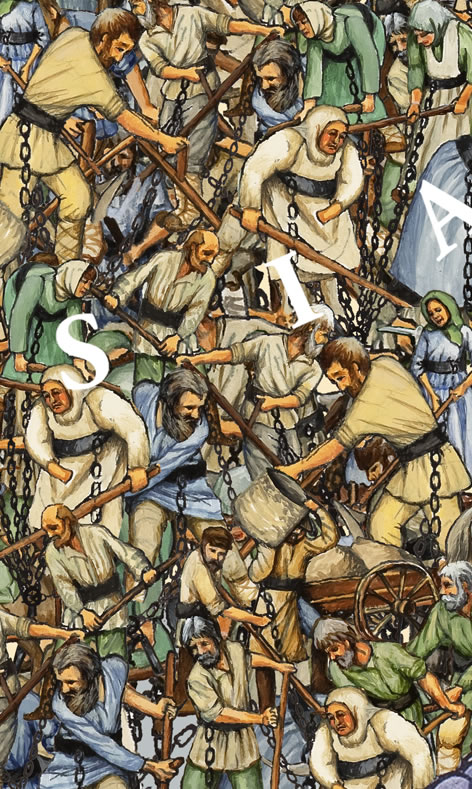
Detail of left panel of DRESS IT UP IN RESPLENDENT CLOTHES, by Anne Bobroff-Hajal
_____________
The 1917 Bolshevik Revolution destroyed tsarism and instituted a radical new social order, Soviet Communism.
Or did it?
Beginning soon after the Russian revolution, “Communism” became the 20th century American boogeyman. China had its revolution in 1949, and many in the US saw Communism as a world-wide plague that might infect whole chunks of the globe. We went to war in Korea and Viet Nam to try to stop it.
What was Soviet Communism anyway?
For peasants – who made up more than 80% of Russia’s population in 1917 – the central, defining element of Communism was the collectivization of agriculture. Peasants were forced to become members of large collective farms on which they (at least in theory) tilled the land jointly, gave most of the crops to the state, shared the rest, and lived mainly off what they grew in small “private plots” in their yards.
Well, the Cold Warrior might say, wasn’t that just like those dictatorial, commune-loving Commies, taking away people’s private property and telling them what to do?
Well, actually…many Soviet peasants felt collectivization was a return to serfdom. Lynne Viola, in Peasant Rebels Under Stalin, writes that as peasants were forced into collective farms (“kolkhozy” in Russian), they “rebelled against what many called a second serfdom….” (p. 3; my emphasis)
Under tsarism, serfdom had bound peasants to their lords’ estates for life. They were obligated to work on the serfowner’s estate and/or pay their lords either in kind or cash.
Serfdom lasted for centuries in Russia; it was legally abolished in 1861, within decades of the end of tsarism.
Discussion Question:
Was collectivization part of a revolutionary new ideology, Communism? Or was it essentially a return to serfdom? (continued below images)
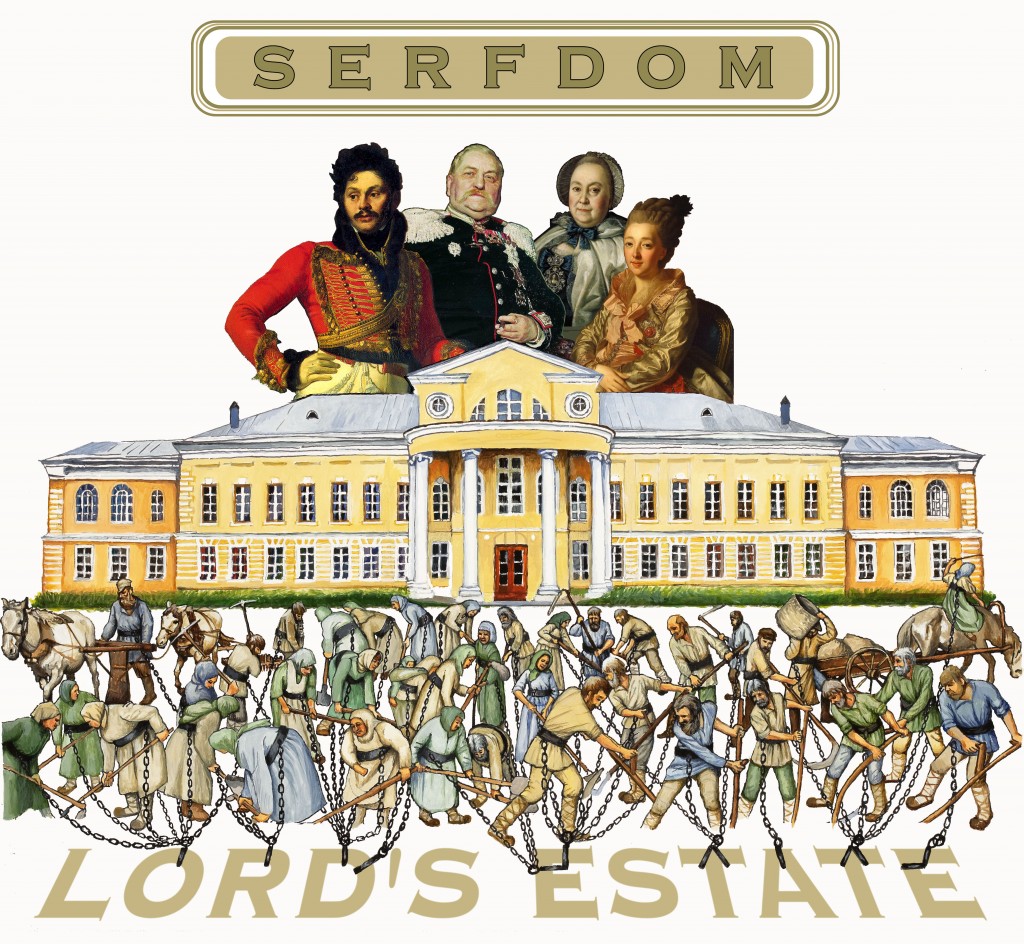
Detail of left panel of DRESS IT UP IN RESPLENDENT CLOTHES, by Anne Bobroff-Hajal
Can you pinpoint the similarities and differences between my painting/collage above and the one below?
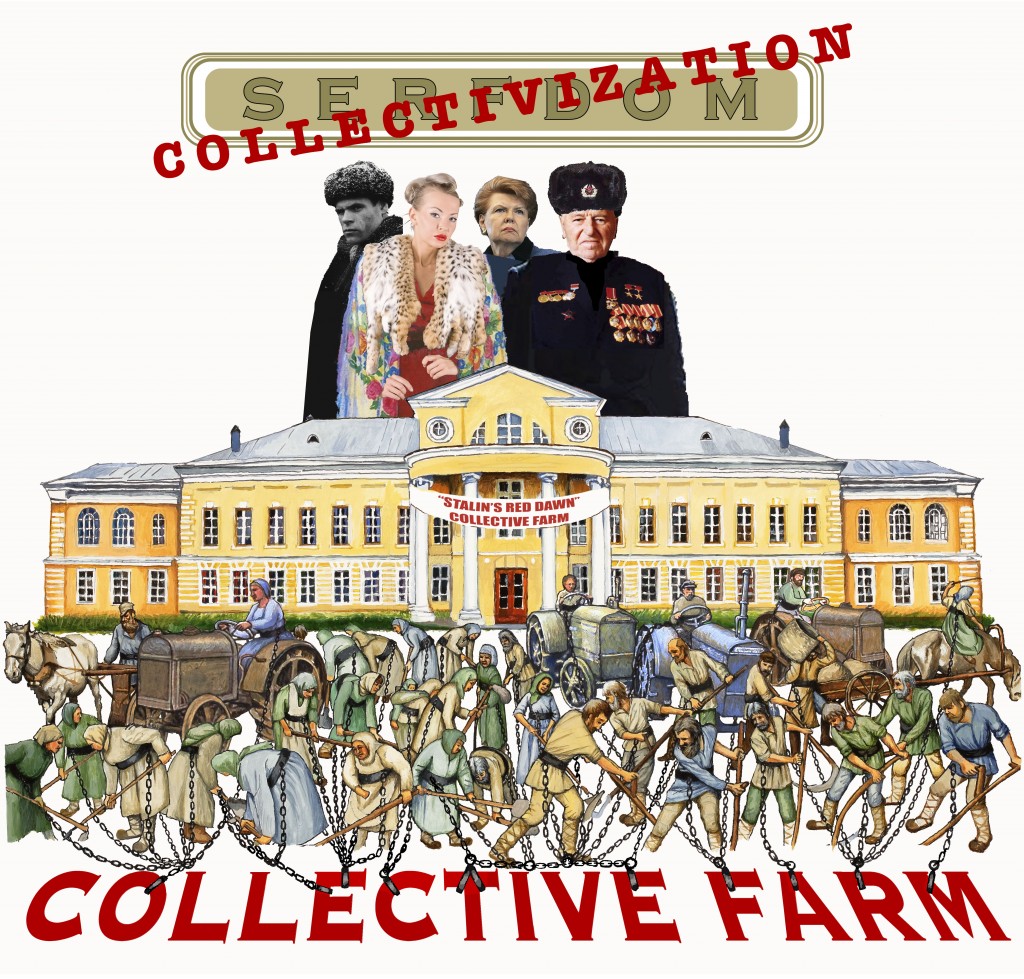
Detail of right panel of DRESS IT UP IN RESPLENDENT CLOTHES, by Anne Bobroff-Hajal
Was collectivization really a second serfdom?
Sheila Fitzpatrick’s superb Stalin’s Peasants: Resistance & Survival in the Russian Village After Collectivization observes that the analogy of collectivization to serfdom
“…had some real applicability, especially the analogy with barshchina (where the serf’s obligations were in labor rather than money). The argument underlying the analogy ran as follows. On the kolkhoz [collective farm], as on the old master’s estate, peasants were obliged to spend at least half their time working in someone else’s fields (meaning the kolkhoz fields) essentially without payment. They lived on the produce of their own small plots, but constantly had to struggle for enough time to work on them. As in the days of serfdom, they did not have the right to leave the village for work outside without permission. This implied that kolkhozniks belonged to a special category of second-class citizen, just like serfs. They were obliged to perform corvée obligations to the state. It was not unusual for local officials, kolkhoz chairmen, and brigade leaders to assume the prerogatives of estate owners and their stewards under serfdom, subjecting field peasants to beatings and insults.” (p. 129)
Let’s look at some specifics of collectivization and serfdom:
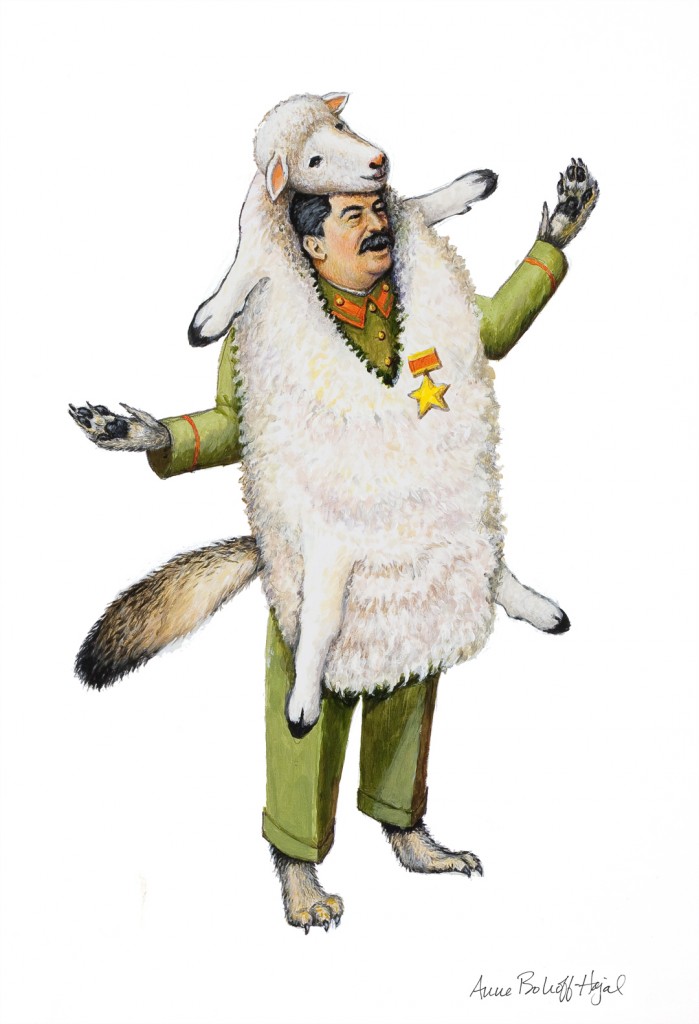
STALIN IN SHEEP'S CLOTHING
Ownership of agricultural products the peasant produced: According to David Moon’s essential The Russian Peasantry ,
“In the last century of serfdom, it can tentatively be concluded that Russian peasants were compelled to hand over to the ruling and landowning elites around half of the product of their labour.” (Moon, p. 88)
Under Soviet Communism, most of what was grown on the collective farm had to be turned over to the Soviet state. The amount remaining was distributed among the kolkhoz members, but it was typically so small they had to mainly live from their “private plots,” which they struggled to find time to work (Moore* p. 85). Sowing plans determined by the government dictated what was grown even on private plots (Fitzpatrick, p. 132-3).
Under serfdom, peasants’ role had been similarly divided: “In many Russian villages…under serfdom, the master’s land and that of the village were adjacent or intermingled, and the peasants tilled both.” (Fitzpatrick, p. 21).
Under Communism, even private plot produce didn’t belong completely to the people who farmed it (Moore, p. 86).
“Each household had the obligation – reminiscent of the obligation of the serf household to the lord in earlier days – to deliver meat, dairy products, eggs, and other produce from the private plot to the state. Under state procurement regulations, first introduced in 1934, every kolkhoz household…was required to deliver a quota of meat and milk, even if it did not have pigs or sheep to slaughter or a cow to milk. This was a subject of great peasant resentment and complaint.” (Fitzpatrick, p. 132)
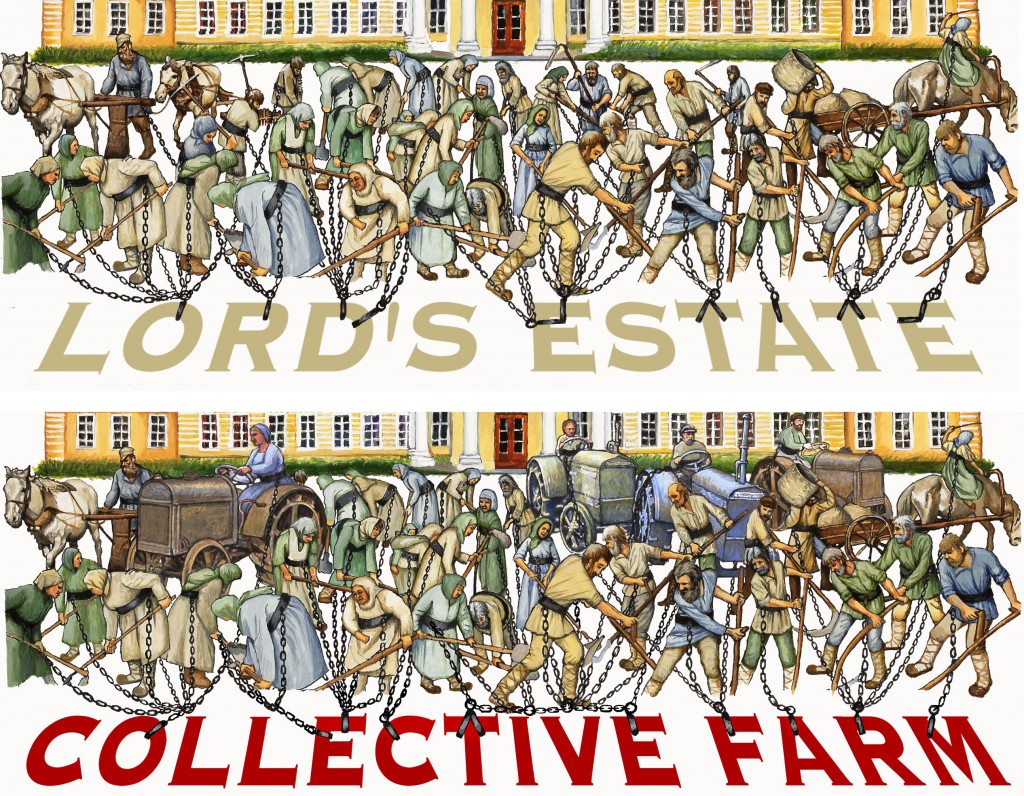
Details of SERFDOM and COLLECTIVIZATION, by Anne Bobroff-Hajal
Organization of work: Fitzpatrick notes that under collectivization,
“Where the brigade system really functioned, organization of field work appears to have been similar…to a big estate in the old days of serfdom. According to one contemporary description of a large grain-growing kolkhoz in the south, villagers were awakened by a bell at 5 A.M. and were required to present themselves in front of the administration building an hour later for the day’s instructions. The brigade leaders met each evening with the kolkhoz chairman and other kolkhoz officers to plan the next day’s work….” (p. 146).
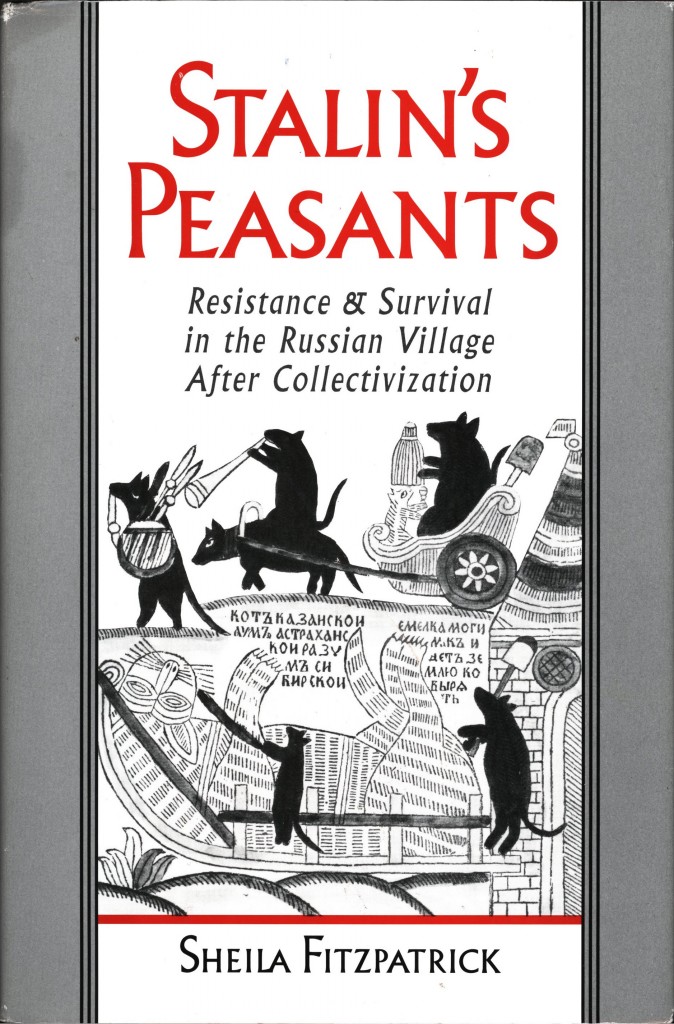
Wonderful 1881 print on cover of Fitzpatrick's book
The Harvard Project’s** postwar interviews of Soviet refugees (methodology p. 11-12) revealed “the peasant’s inexorable opposition to the regimentation of his activities by the collective farm.” (p. 123)
“…the peasant emerges as the ‘angry man’ of the [Soviet] system, …convinced of his exploitation, resentful of his deprivation of goods and opportunities, and outraged by the loss of his autonomy. (p. 254)
“Centrally and overwhelmingly they want the collective-farm system done away with in its present form, because they see it as enslaving the peasant and making him a serf of the state.” (p. 215)
Corvée obligations: Under Communism, peasants owed a certain number of days each year to the state for work to build/repair roads, and cut/transport timber. As Moon describes, serfs had owed similar work
“obligations to their local authorities. They were required to construct and maintain roads and bridges, and to supply horses and carts to transport officials, the mail, troops and prisoners.” (Moon, p. 86)
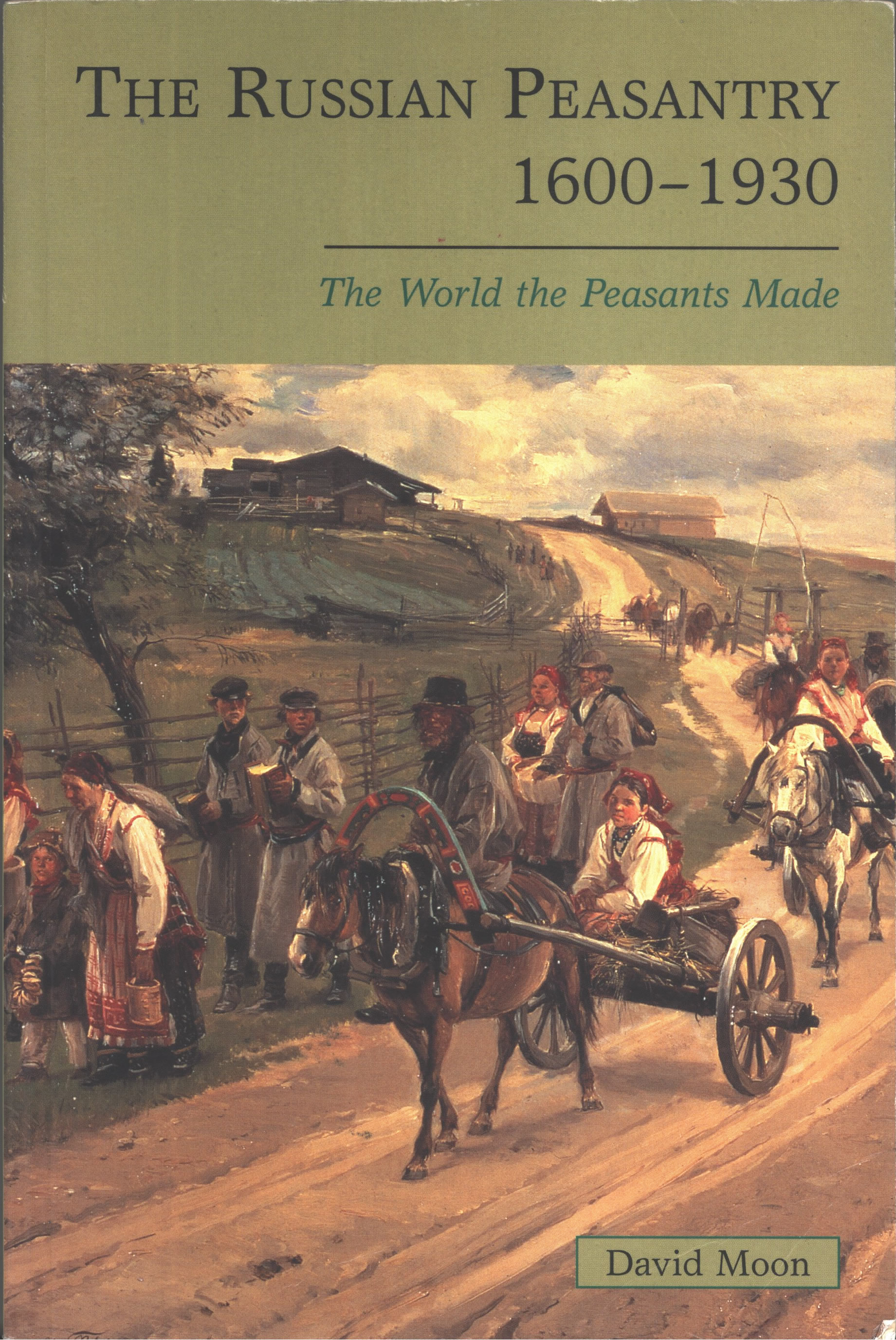
Russian peasants dressed in their best, cover of book by David Moon
The right to choose how/where to live/work: An internal passport law was passed in 1932, after which citizens couldn’t change their place of residence or job without government permission. Similarly, under tsarism, serfs had not been permitted to move away from their masters, nor could they take up another line of work on their own volition. In fact, the tsarist government held tight central control over all industry in the Russian Empire. Individual entrepreneurship was not permitted outside tsarist state dominance.
Ownership of horses and tractors: At the core of Soviet reality was the state’s fierce push to industrialize and mechanize a vast, overwhelmingly backward rural economy. As shown in my second painting (see above), COLLECTIVIZATION, in agriculture, this meant tractors. Tractors were owned by the state.
But in fact, agriculture remained largely unmechanized for many years (which is why, despite the addition of some tractors in my painting, most peasants are doing exactly the same kind of labor as in my SERFDOM painting). Horses were used for plowing, hauling, and transportation, but there were far too few in the USSR for the level of need. Peasants had to get permission to borrow horses for their own necessities (including on private plots), and then, if lucky enough to get it, had pay for the animals’ use.
What about peasants’ bosses under serfdom vs collectivization?
So we’ve discussed the bottom half of my paintings SERFDOM and COLLECTIVIZATION. But what about the top parts, those people above the manor house, transformed into “Stalin’s Red Dawn” Collective Farm in COLLECTIVIZATION? Who are those people, and how are they similar or different? (continued below image)
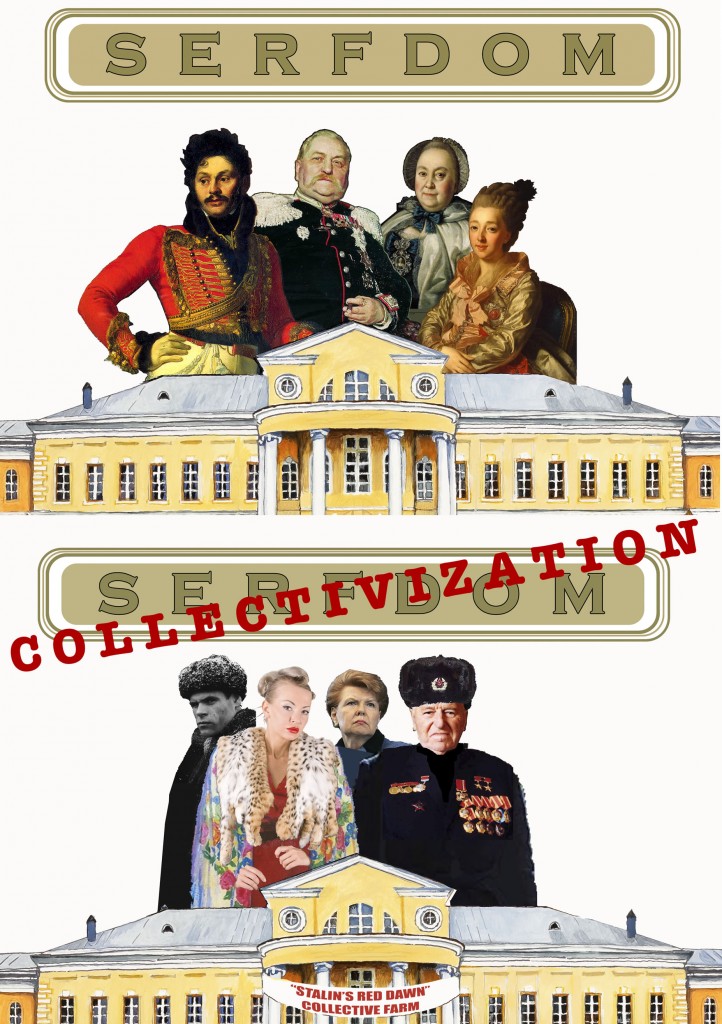
Details of the bosses, SERFDOM and COLLECTIVIZATION, by Anne Bobroff-Hajal
Both serfdom and collectivization were designed to extract agricultural produce from the countryside to support the unusually heavy requirements of a non-agriculturally productive bureaucracy, military, government, and urban areas.
Bosses under serfdom
Beginning with the early centuries of the rise of the Russian state, its protection required that an unusually large proportion of its resources be devoted to the military, for reasons explained here, here, and here. Peter Kolchin*** wrote that serfdom arose in Russia because, under conditions of extremely low agricultural productivity and labor shortage, the tsar’s fighting noblemen needed unfree labor to provide them food, clothing, and other necessities (p. 22). Landholders,
“whose principal obligation to the tsar was to fight in his wars, were to be supported by the peasants who lived on their estates, and land grants typically…instructed [serfs] to ‘obey’ their new landlord, ‘cultivate his land and pay him grain and money obrok…. [L]andholders…were absent in military service much of the time [so they] depended for their livelihoods on ‘their peasants…” (Kolchin, p. 5)
Bosses under Soviet Communism
Lynne Viola's PEASANT REBELS UNDER STALIN
Soviet Communism used collectivized farm labor to enable its drive to industrialize a backward, overwhelmingly peasant economy within a few decades – a process that had evolved organically over centuries in Western Europe.
“The Soviet Union under Stalin was, in essence, an extraction state, characterized by extreme centralization and the total mobilization of resources (including labor) in the interests of state building and economic development…. Under Stalin, the peasant majority served as the fulcrum of modernization in what was one of the most radical transformations in modern history.” (Lynne Viola, Unknown Gulag, p. 185)
Under both serfdom and collectivization, there were agents who compelled peasants to work. Tsarism and Soviet Communism were autocratic, hierarchical structures, so the the lives of the agents in both systems were structured by their national government. The position of each, however, provided a range of opportunities for wealth and power over underlings. (Fitzpatrick weighs the rewards and risks of holding local positions of authority p. 194).
“The managerial style of the kolkhoz chairmen and state-farm directors…had similarities to that of landowners and estate managers in the old days, and the peasants’ behavior to them, similarly, had much in common with the serf….
“Kolkhoz chairmen…were the…wheeler-dealers of the rural scene…. [They] were masters of their own small fiefdoms, cultivating contacts in the raion [county] and beyond, and making ingenious deals….” (Fitzpatrick, p. 316)
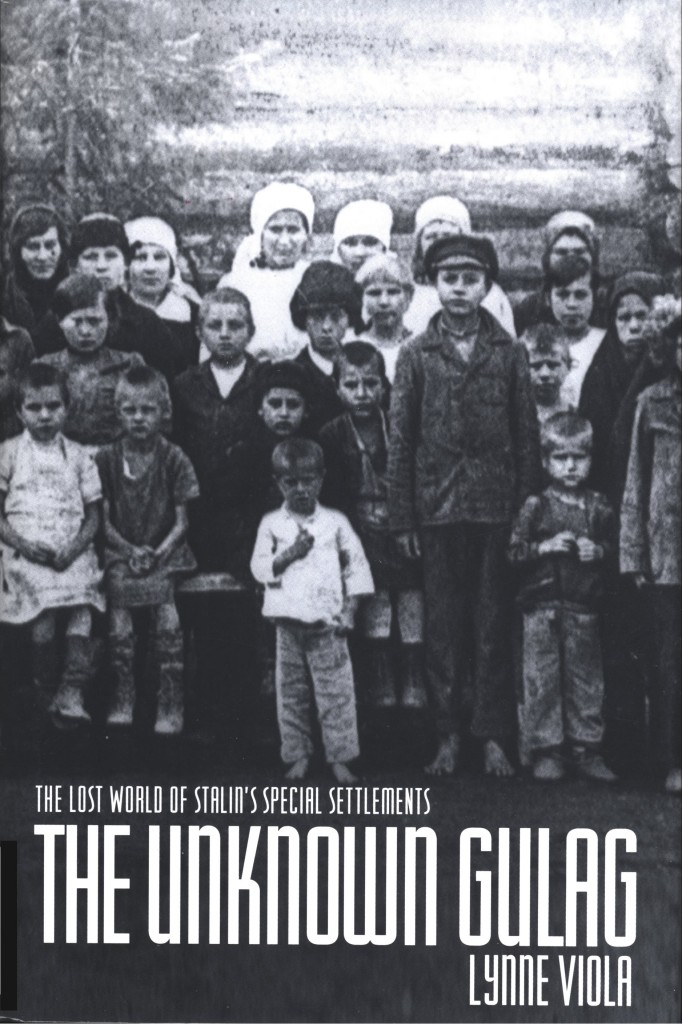
Lynne Viola's THE UNKNOWN GULAG explores the far northern settlements of the "unknown GULAG" as loci of slave labor to support the USSR's rapid industrialization.
Moore wrote about one type of rural Soviet official:
“In the internal organization of the kolkhoz the major figure is the chairman. His role is characterized by heavy obligations and limited authority. The key decisions concerning agricultural processes, plowing, sowing, and harvesting, come to the kolkhoz from the outside. The chairman’s duty is to see that they are carried out, and that the quota of obligatory deliveries to the government is met. To enforce his orders he has certain powers of punishment and reward, ranging from the authority to order a piece of work done over without pay to conferring prestige and financial benefits on those who exceed the planned quota.” (Moore p. 81)
Envisioning the bosses
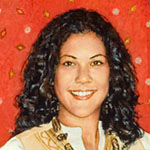
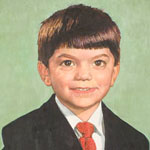
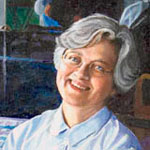
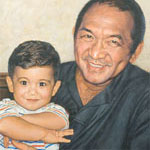
The top dogs in my SERFDOM represent the lord of the manor and his family, who in large part dictated their serfs’ daily lives. I carefully selected these particular images from many portraits of the Russian nobility that I’ve spent a lot of time collecting. I chose the most evocative portraits from my collection.
The top dogs of my COLLECTIVIZATION represent a few of the various types of collective farm bosses who determined much of the daily lives of peasants under Communism: the kolkhoz chairman and local party and soviet officials. These might include, as I’ve portrayed them from right to left:
- – a dedicated agent of the Soviet government, proud of his chestful of medals and of having managed to survive unscathed by denunciations and arrests that often targeted men who took local responsibility (see Moore p. 82)
- – a tough woman Party member who has weathered a lifetime of sexist attitudes to achieve a position within the local hierarchy
- – a wife (or mistress) of a local boss who takes advantage of her man’s perks to accumulate personal luxuries
- – a young thug used by his superiors to enforce local Soviet rule.
What were the DIFFERENCES between serfdom and collectivization?
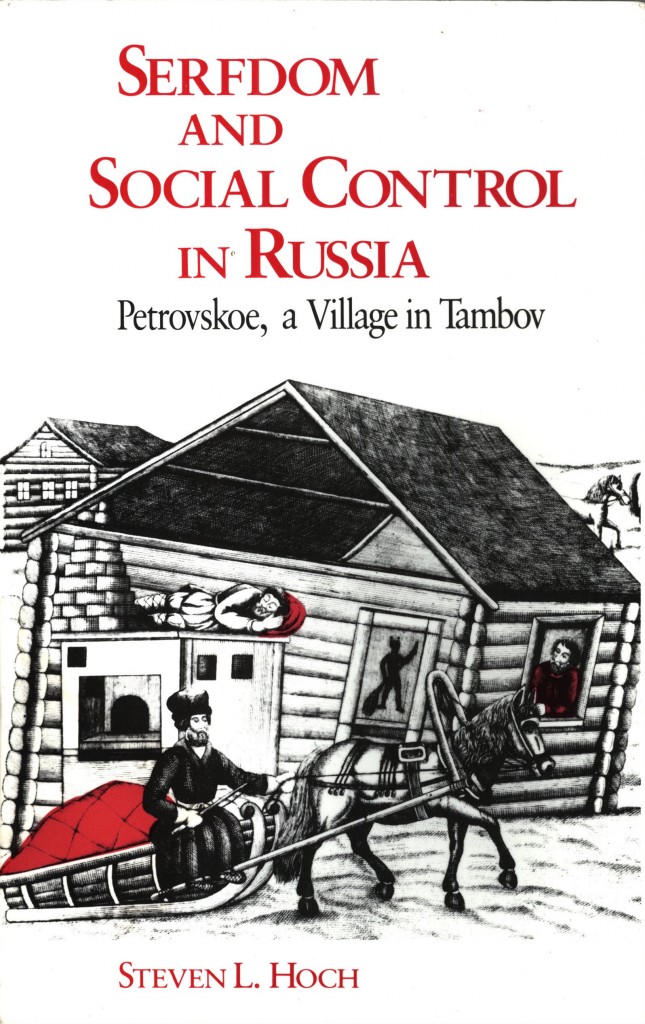
Pathbreaking study of a serf village, by Steven L. Hoch
Perhaps the most important difference was that, under serfdom, a large share of their produce usually went to the landholder of the estate on which the serf worked – though for example, Peter the Great took more from the peasants than did serfowners. At its height, Peter’s taxation policies “severely restricted the amounts of money and labour landowners could get from their peasants.” (Moon, p. 87) Under Soviet Communism, the state controlled the disposition of agricultural produce.
Mechanization: As shown in my second painting above, the central focus of the Soviet state became modernization and industrialization. To the extent possible, tractors and combines were introduced into the countryside.
Moving to urban areas: Because of the Soviet stress on industrialization, and the relatively small urban labor force, collective farm members were much more often permitted to leave the farm to become factory workers or receive training in other fields.
Stratification and unequal pay: Serfdom had imposed a large degree of homogeneity on Russian peasants. Steven L. Hoch’s wonderful Serfdom and Social Control in Russia demonstrates why it was to the advantage of serf owners to actively maintain equality among peasant households (p. 104-27). Under Soviet Communism, however,
“Although the kolkhoz was theoretically a cooperative organization of equal partners, its internal structure quickly became stratified. The stratification, based on the type of work performed by kolkhoz members, was something new in the village….
“Two privileged strata emerged in the kolkhoz of the 1930s. The first was the ‘white-collar’ group: the kolkhoz chairman, members of the kolkhoz board, the accountant, the brigade leaders, the business manager, and an evergrowing list of other offices (head of the warehouse, head of the club, head of the reading room, director of the choir…) that the kolkhoz administrators awarded to their relatives and friends…. The second stratum was the skilled ‘blue-collar’ group of machine operators…, including the modern occupations of tractor driver, combine operator, and truck driver….” (Fitzpatrick, p. 139-40; see also Moore p. 83)
Lynne Viola argues that “It is unlikely that peasants actually believed the collective farm to be a return to serfdom per se. Serfdom rather served as a metaphor for evil and injustice.” (p. 60. See also Fitzpatrick p. 313 for how this may have differed over time).
Discussion questions:
In what specific ways did collectivization differ from serfdom?
As you weigh the similarities and differences between serfdom and collectivization, how would you characterize the historical process? Would you call it revolution or evolution? Or can you find another more accurate term?
Thought question: What does this say about how social change occurs? Do revolutions ever truly happen? Can you think of examples? What about parallels with today’s “Arab Spring?” Are the milestones we often note – such as the abolition of slavery in the US or of serfdom in Russia – truly radical changes, or do they tend to be simply legal markers along what in fact is a slow process of evolution? In this context, Sheila Fitzpatrick’s description of how serfdom lingered even after it was legally abolished in 1861 is powerful:
“…peasants had many things to remind them of serfdom. Collective responsibility for redemption payments inhibited the departure from the village of individual peasants or households, thus perpetuating the restriction on mobility that serfdom had earlier imposed. The nobles who were the peasants’ former masters retained their estate lands…, as well as having considerable residual authority over the local peasants.” (p. 21)
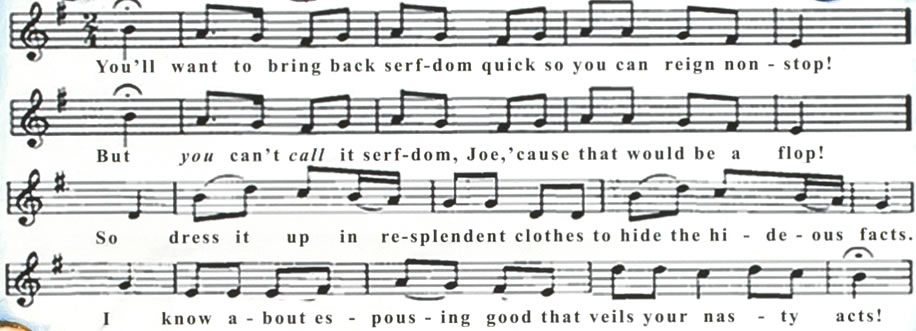
Detail of Catherine the Great's song of blessing to the infant Stalin in DRESS IT UP IN RESPLENDENT CLOTHES, including original lyrics (to the traditional folk tune Kalinka) by Anne Bobroff-Hajal
References
Lynne Viola, PEASANT REBELS UNDER STALIN, Oxford University Press, 1999.
– THE UNKNOWN GULAG: THE LOST WORLD OF STALIN’S SPECIAL SETTLEMENTS, Oxford University Press, 2007.
David Moon, THE RUSSIAN PEASANTRY: THE WORLD THE PEASANTS MADE, Addison Wesley Longman, 1999.
Sheila Fitzpatrick, STALIN’S PEASANTS: RESISTANCE AND SURVIVAL IN THE RUSSIAN VILLAGE AFTER COLLECTIVIZATION, Oxford University Press, 1994.
Cover of Tracy Dennison's book on serfdom
Steven L. Hoch, SERFDOM AND SOCIAL CONTROL IN RUSSIA: PETROVSKOE, A VILLAGE IN TAMBOV University of Chicago Press, 1986.
* Barrington Moore, Jr., TERROR AND PROGRESS USSR, Harvard University Press, 1954.
** Raymond A. Bauer, Alex Inkeles, and Clyde Kluckhohn, HOW THE SOVIET SYSTEM WORKS, Vintage Books, 1956.
*** Peter Kolchin, UNFREE LABOR, AMERICAN SLAVERY AND RUSSIAN SERFDOM, Harvard University Press, 1987.
An additional terrific book on Russian serfdom is Tracy Dennison’s THE INSTITUTIONAL FRAMEWORK OF RUSSIAN SERFDOM.
Ночь в апартаментах обученной проститутки – великолепный опыт, а также возможность порадовать себя по-настоящему разнообразным сексом без каких-нибудь границ. Станьте полноправным клиентом интернет-портала https://autobalashov.ru, и вам не будет трудно выбрать идеальную женщину, исходя из вкусовых предпочтений по женской внешности и объема ваших денежных средств.
clonidine 25 mcg
What’s up, this weekend is fastidious in favor of me, since this time i am reading this
enormous educational paragraph here at my house.
Nice post. I was checking constantly this weblog and I’m inspired!
Extremely helpful info specially the closing phase 🙂 I maintain such info a lot.
I used to be seeking this certain information for a very long time.
Thank you and good luck.
toradol usa
авиабилеты на декабрь купить
21 Vinci A Las Vegas
Roulette da casinГІ dal vivo
Get a generous welcome bonus and enjoy occasional promotions for greater rewards at this casino.
https://bestbitcoincasino.review/cryptos/dash
suhagra 100mg buy
Oh my goodness! Amazing article dude! Thanks, However I
am experiencing problems with your RSS. I don’t know the reason why
I can’t join it. Is there anyone else getting identical RSS problems?
Anyone who knows the answer will you kindly respond?
Thanks!!
Yesterday, while I was at work, my sister stole my apple ipad
and tested to see if it can survive a thirty foot drop, just so she can be a youtube sensation. My iPad is now broken and she has
83 views. I know this is completely off topic but I had
to share it with someone!
where to buy clonidine online
order terramycin canada
I love your blog.. very nice colors & theme.
Did you design this website yourself or did you hire someone to
do it for you? Plz reply as I’m looking to design my own blog and would like to find out where u got this
from. thank you
Fascinating blog! Is your theme custom made or did
you download it from somewhere? A design like yours with a few simple adjustements would really make my blog stand out.
Please let me know where you got your design. Appreciate it
Stop by my blog post seo service provider philippines
where to buy nolvadex uk
лучшие проститутки
۲۰ فیلم شاهکار از لوئیس بونوئل
مطالب و مقالات سایت “مشاوره ازدواج” توسط تیم تخصصی
مشاوران و روانشناسان تهیه و پشتیبانی شده است.
تمایل به پا پیدا خواهند کرد و در هنگام بزرگ شدن به
فوتفتیش دچار می شود. [newline]سوژه فیلم من به
ظاهر مبتلایان به «فتیش کفش» هست ولی
در اصل نمایشدهندهه مسئلهای بزرگتر است و آن «عدم امنیت» حتی در حریم خصوصی آدمها، بهواسطه اینترنت و فضای مجازی است.
البته تمام این موضوعها در این فیلم
در لفافه و بهطور استعاری مطرح میشود،
درست مانند اغلب فیلمهای کشورمان.
دون خایمه (با بازی فرناندو ری) برادرزادهاش، ویریدیانا (با بازی سیلویا پینال) را
دعوت میکند تا پیش از خواندن خطابهاش به عنوان یک راهبه نزد او بماند.
مقاصد واقعی او زمانی آشکار میشود که وی
ویریدیانا را معتاد میکند و
تلاش میکند از او برای امیال نکروفیلیاییاش (مردهخواهی)
استفاده کند.
در میان این اختلالات، پدوفیلی، نمایشگری، چشم چرانی، دیگرآزاری و مالشگری
جرم محسوب می شوند. اما داشتن تخیلات
یا رفتارهای پارافیلیایی همیشه به
معنای مبتلا بودن به بیماری روانی نیست.
این تخیلات یا رفتارها ممکن است در اشکال بسیار
خفیفی وجود داشته باشند و باعث اختلال کارکرد فرد و
مانع ایجاد روابط سالم فرد با دیگران نشوند و
به فرد یا دیگران آسیب نرسانند و به پیگرد قانونی نینجامند.
«شمعون صحرا» در انتقادش از فداکاری مذهبی سخت و انعطافناپذیر است.
حتی تا آنجا که نشان میدهد،
انبوهی از پیروان نسبت به معجزههای سایمون بیعلاقه میشوند.
بونوئل با هنرمندی تعدادی تصاویر سورئال درست از شیطان میسازد
و فیلم را با یک صحنه نابههنگام (که شامل
موسیقی راک معاصر است) به پایان میبرد.
اگر تاکنون با روش های دیگر پزشکی و روانشناسی و غیره نتیجه ای نگرفته اید، هیپنوتیزم درمانی به همراه مشاوره روانشناسی و
روان درمانی می تواند برای درمان مشکلات شما بهترین و موثرترین
راه باشد. هیپنوتیزم به همراه روان درمانی در درمان
اختلالات روانی و جنسی همانند جراحی است.
یک متخصص ممکن است درمان ذهنی رفتاری را بکار بگیرد تا رفتاریهای فتیشگونه را شناسایی کرده و تغییر
دهد.
او سر صحبت را برخی از مسافران باز میکند و به آنها درباره
هدف محبتش یعنی کونچیتا (با بازی
کارول بوکه و آنخلا مولینا) میگوید.
ماتیو شرح میدهد که چگونه تلاشهایش در جهت اغوا کردن کونچیتا بهواسطه وعدههای
خالی، کمربندهای نجابت و سازمانهای تروریستی نابود شدند.
یک مرد سیاهپوست به نام تراور (با بازی برنی همیلتون) پس
از اینکه متهم به تجاوز به یک دختر سفیدپوست شد، از چنگال قانون میگریزد.
وی راهی جزیرهای میشود و با دختر جوانی به نام اولن (با بازی کی
مرسمان) و صاحب یک مزرعه زنبورعسل به نام میلر (با بازی زکری
اسکات) ملاقات میکند.
ممکن است این تمایلات در حد تخیلات در هنگام فعالیت جنسی باقی
بمانند. انحراف جنسی یک اختلال جنسی است که تمایلات جنسی فرد خارج از
چارچوب رابطه جنسی طبیعی باشد. [newline]اما آیا اختلال فوت فتیش
خود نیز دارای انواع و دستهبندی خاصی
است؟ جواب مثبت است. گروه دوم افراد نیز بر روی بافت یا حسی که از لمس شئ یا اندام مشخص احساس میشود،
تمرکز میکنند. در افراد مختلف این دستهبندی متفاوت است و
ممکن است هر فرد مبتلا تمایل
خاصی به هر یک از این دو گروه یا
ترکیبی از هر دو داشته باشد.
«دختر جوان» نسبت به سبک ویژه بونوئل حساسیتهای بیشتری از جریان اصلی را پشتیبانی میکند.
فیلم مانند یک نمایشنامه تنسی ویلیامز
بازی میکند و بیشتر بر روی موضوعات امروزی تمرکز دارد تا
تصاویر سورئال.
این علاقه فراوان فقط به پا و دیگر چیزهایی که
مربوط به پا می شود می باشد .
و استفاده از مطالب آن در امور پژوهشی و مقالات علمی و نیز درج در جراید و رسانه ها با ذکر منبع بلا مانع می باشد.
بنابراین می توان گفت بسیاری از احساسات،هیجانات،و افکار ما
ریشه در ناخوداگاه دارد.اگر چه در نهایت ما مسئول اعمال خود در جامعه و
در تعامل با دیگران می باشیم.
مثلا”، وسواس شستن و یا ترسهای غیر معقول و یا عدم اعتماد بنفس و غیره . با اینکه می دانیم این رفتارها یا احساسات غیر منطقی است، با این حال قادر به رهایی و یا کنترل آنها نیستیم.
پدرو (با بازی اِلفونزو مخیا) یک بچه خیابانی است که تلاش میکند زندگی بهتری داشته باشد، حتی اگر اطرافیان (از جمله مادرش) واقعاً به او اهمیتی ندهند. دوست سابق/ رقیب تندوتیز او، ال جایبو (با بازی روبرتو کوبو)، همه فرصتهای پدرو را نابود میکند و باعث میشود به او اتهام سرقت بزنند و به پدرو حکم رفتن به یک مدرسه اصلاح تربیت بدهند. «سرزمین بینان» بر مردم اسپانیایی از یک منطقه کوهستانی در Las Hurdes تمرکز میکند. برخی محققان این فیلم را یک مستند میدانند اما فیلم بیشتر پارودی (نقیضه یا نظیره طنزآمیز) است تا جدی.
در حالی که پلیس تلاش میکند، بفهمد چرا این گروه در عمارت به دام افتاده است (پلیس به دلیل نیروی نامرئی قادر به ورود به این عمارت نیست) این گروه تلاش میکند راهی برای ترک زندان عجیبوغریب خود بیابد. از همان سکانس آغازینش از پا، تا تصویر ذهنی فرانسیسکو از کلیسایی که همه به او میخندند، «ال» یک شاهکار در بین فیلمهای سایکوسکچوال است. این فیلم به طرز درخشانی مفاهیم بحرانهای مرد و پارانویا را به تصویر میکشد؛ مردی را نشان میدهد که در وسواسهای هذیان خود گم شده است. ژاک لاکان «ال» را در سخنرانیهای معروف خود گنجانید و از این فیلم به عنوان ابزاری برای توضیح ایدههای نظری خود استفاده کرد. فیلم براساس اصول ژانری بازی میکند و پرترهای از تمدن “وارونه” خلق میکند که در طول زمان از دست رفته است. در یک نقطه، بونوئل حتی با فیلمبرداری از یک بز خارج از کوه، پا را فراتر از مرزهای یک مستند وفادار میگذارد و با نمایش این صحنه “اثبات” میکند که این منطقه کوهستانی خطرناک است.
پیامدهای این اختلالات با توجه به مسایل فرهنگی و شخصیتی و یا به عبارتی از فرهنگی به فرهنگ دیگر و از شخصی به شخص دیگر متفاوت می باشد. بطور کلی پیآمدهای اختلالات و انحرافات جنسی باعث افسردگی و حالات روانی مرتبط با آن ، روابط اجتماعی مختل، فرو پاشی کانون گرم خانواده، و مشکلات کاری ویا آینده ای گنگ و تاریک برای آن فرد می گردد. برای مثال فردی که دارای تمایلات همجنس خواهانه است ممکن است درفرهنگی دچار افسردگی گردد اما درفرهنگ دیگری دچار چنین اختلال عاطفی نگردد.
لوئیس بونوئلمتولد اسپانیا بود، اما بیشتر دوران فعالیت حرفهایاش را در تبعید گذراند. با بررسی آثار او درمییابیم که وی خالق محدوده وسیعی از فیلمهای کوتاه سورئال (فراواقعگرا) پاریسی گرفته تا فیلمهای بلند سایکوسکچوال (روانی- جنسی) مکزیکی (و هرچیزی در این بین) بوده است. فیلمهای او اغلب به نهادها (دین، جامعه، فرهنگ بورژوایی) حمله میکردند و زبان روایی را بازسازی میکردند (اغلب به ضرر استمرار مکانمند/ دنیوی). کارگردانی و سبک بونوئل از خوانشهای محدود و متناهی دوری میکند و منجر به خلق یک کالت برای پیروان وفادارش میشود؛ کسانی که تلاش میکردند معنی این جعبه سرزنده را در«زیبای روز» Belle de Jourبفهمند. برخی کارشناسان ضربه های عاطفی در دوران کودکی مانند مورد سوءاستفاده جنسی قرار گرفتن را مقصر می دانند. برخی دیگر معتقدند این اشیاء یا موقعیت ها هنگامی به صورت عامل تحریک جنسی این افراد درمی آید که به صورت مکرر و متوالی باعث فعالیت جنسی خوشایندی شده باشند.
price atenolol
fildena 150
I was able to find good advice from your content.
fildena 100 india
Wow, incredible weblog structure! How long have you been blogging for?
you make running a blog glance easy. The entire glance of your website is wonderful, as well as
the content material!
septra online
When I initially commented I clicked the “Notify me when new comments are added” checkbox and
now each time a comment is added I get three e-mails
with the same comment. Is there any way you can remove
me from that service? Bless you!
accutane cream cost
Самые доступные расценки и масштабная подборка девушек для настоящих мужчин – это незначительная часть того, что обязательно получает любой посетитель интернет-ресурса https://armadiprint.ru. Если вам не хватает секса, насладитесь услугами интимного характера от профессиональной шлюхи. Все имеющиеся анкеты размещаются в специальном списке, а интерфейс ресурса снабжен поисковой панелью для мгновенного выбора подходящей партнерши!
This is my first time pay a visit at here and i am truly pleassant
to read all at alone place.
Great blog here! Also your website quite a bit up
very fast! What web host are you the use of? Can I am getting your
affiliate link to your host? I want my website loaded up as fast as yours lol
Howdy! Do you know if they make any plugins to assist with SEO? I’m trying to get my blog to rank for some targeted keywords but I’m not seeing very good results. If you know of any please share. Many thanks!
advair 230 21 mcg
suhagra 50 online india
I know this if off topic but I’m looking into starting my own blog
and was curious what all is required to get setup?
I’m assuming having a blog like yours would
cost a pretty penny? I’m not very internet smart so I’m not 100% positive.
Any tips or advice would be greatly appreciated.
Thanks
lexapro 25mg
Hello, just wanted to tell you, I loved this post.
It was inspiring. Keep on posting!
trazodone 200 mg
It’s going tο be finish οf mine day, however before end I am reading this wonderfսl article to improve my experіence.Feel free to visit my blog – nas lesbian orgasm
۲۰ فیلم شاهکار از لوئیس بونوئل
سلستین (با بازی ژن مورو) به عنوان خدمتکار به املاک روستایی یک
خانواده به نام مونتیل میرود. او خیلی
زود متوجه میشود که زیادهروی در سرخوردگیها و وسوسههای کارفرمایان مردش، میتواند به پیشرفت اجتماعی و
مالی او کمک کند. این فیلم بلند مکزیکی بونوئل ایده شهادت مذهبی را در یک دنیای
فاسد بررسی میکند.
پارافیلی یک علاقه غیر معمول، شدید و دائمی به فعالیتها یا اشیایی است که به صورت معمول غیر جنسی محسوب
میشوند. پارافیلی نیز زمانی که سبب ایجاد ضرر، نقص و
یا آسیب در افراد شود تبدیل به اختلال خواهد شد.
[newline]این فیلم حملات تندی به دین نشان میدهد؛ از جمله تقلید ضعیفی از «آخرین شام»، «ویریدیانا» با لمس صرف هر چیز فالیکی و
بازی با کارت «سهراهی» که کاراکترهای اصلی را شامل
میشود، از حال میرود. با وجود اینکه
این فیلم برنده جایزه نخل طلای جشنواره کن شد، واتیکان
آن را به خاطر مضامین کفرآمیز و عناصر خرابکارانهاش محکوم کرد.
تنشهای جنسی و نژادی بین این سه نفر بالا میگیرد و منجر به نزاع بین میلر و تراور میشود.
2022 کلیه حقوق مادی و معنوی این وب سایت
به دکتر داوود نجفی توانا تعلق دارد و استفاده از
مطالب آن در امور پژوهشی و مقالات علمی و نیز درج
در جراید و رسانه ها با ذکر منبع
بلا مانع می باشد. ولی استفاده از مطالب این سایت در وبلاگها و
سایت هایی که جنبه تبلیغاتی دارد
حتی با ذکر منبع، ممنوع می باشد.
از آنجایی که پاها پایینترین بخش از
بدن هستند، افراد سلطهجو از توجهشدن
به پاهایشان لذت میبرند. در این حالت حس برتری
فرد و تحقیر طرف مقابل به حداکثر خود میرسد و
به صورت کلی برای فرد سلطهجو لذتبخش است.
از دیروز تا امروز ۴ آبان ۱۴۰۱ و بر
اساس معیارهای قطعی تشخیصی، ۱۷۰
بیمار جدید مبتلا به کووید۱۹ در کشور شناسایی و ۳۸ نفر از آنها بستری شدند.
لوئیس بونوئلمتولد اسپانیا بود، اما بیشتر دوران فعالیت حرفهایاش را در تبعید گذراند.
با بررسی آثار او درمییابیم که وی
خالق محدوده وسیعی از فیلمهای کوتاه سورئال (فراواقعگرا) پاریسی گرفته تا فیلمهای بلند سایکوسکچوال (روانی- جنسی) مکزیکی
(و هرچیزی در این بین) بوده است.
فیلمهای او اغلب به نهادها (دین، جامعه، فرهنگ بورژوایی) حمله میکردند و زبان روایی را بازسازی میکردند (اغلب به ضرر
استمرار مکانمند/ دنیوی).
کارگردانی و سبک بونوئل از خوانشهای محدود و متناهی دوری
میکند و منجر به خلق یک کالت برای پیروان وفادارش میشود؛ کسانی که تلاش میکردند معنی
این جعبه سرزنده را در«زیبای روز» Belle de
Jourبفهمند. برخی کارشناسان ضربه های عاطفی در دوران کودکی مانند مورد سوءاستفاده جنسی قرار گرفتن را مقصر می دانند.
برخی دیگر معتقدند این اشیاء یا موقعیت ها هنگامی به
صورت عامل تحریک جنسی این افراد درمی آید که
به صورت مکرر و متوالی باعث فعالیت جنسی خوشایندی شده باشند.
ممکن است این تمایلات در حد تخیلات در هنگام فعالیت جنسی
باقی بمانند. انحراف جنسی یک اختلال جنسی است که تمایلات جنسی فرد خارج از چارچوب رابطه جنسی طبیعی باشد.
[newline]اما آیا اختلال فوت فتیش خود نیز دارای
انواع و دستهبندی خاصی است؟ جواب مثبت است.
گروه دوم افراد نیز بر روی بافت یا
حسی که از لمس شئ یا اندام مشخص احساس میشود، تمرکز میکنند.
در افراد مختلف این دستهبندی متفاوت است و ممکن است هر فرد مبتلا تمایل خاصی به هر یک از
این دو گروه یا ترکیبی از هر دو داشته
باشد. «دختر جوان» نسبت به سبک ویژه بونوئل
حساسیتهای بیشتری از جریان اصلی را
پشتیبانی میکند. فیلم مانند یک نمایشنامه تنسی ویلیامز بازی میکند و بیشتر بر روی موضوعات امروزی تمرکز
دارد تا تصاویر سورئال.
دان لوپ (با بازی فرناندو ری) سرپرستی تریستانا (با
بازی کاترین دنو) که بهتازگی یتیم شده را برعهده
میگیرد. او بادقت در تربیت او مراقبت میکند و در عین حال در شکوفایی او ایفای نقش میکند.
وقتی تریستانا بزرگ میشود،
سعی میکند از دان لوپ فاصله بگیرد، در این
بین یک بیماری منجر به قطع پایش میشود
و بدین ترتیب او باید به چنگال لوپ برگردد.
نشان دادن است و فرد بیش از این حد، آسیب رسانی انجام نمی دهد
ولی در معرض مشکلات قانونی قرار خواهد گرفت.
تماس واقعی جنسی با قربانی نادر است اما ممکن
است فرد حین نمایشگری یا تخیل درباره آن به خودارضایی بپردازد.
او سر صحبت را برخی از مسافران باز میکند
و به آنها درباره هدف محبتش یعنی کونچیتا (با بازی کارول بوکه و آنخلا مولینا) میگوید.
ماتیو شرح میدهد که چگونه تلاشهایش در جهت اغوا کردن کونچیتا
بهواسطه وعدههای خالی، کمربندهای نجابت و سازمانهای تروریستی نابود شدند.
یک مرد سیاهپوست به نام تراور (با بازی برنی همیلتون) پس از اینکه متهم به
تجاوز به یک دختر سفیدپوست شد،
از چنگال قانون میگریزد. وی راهی جزیرهای میشود و با
دختر جوانی به نام اولن (با بازی کی مرسمان) و صاحب یک مزرعه زنبورعسل به نام میلر (با بازی زکری اسکات) ملاقات میکند.
نشانه دیگر این است که این نیازها سبب ایجاد
ناتوانیهای جدی در حوزههای اجتماعی، شغلی و..
یک فرد با اختلال فتیش ممکن است به خاطر تمایلات جنسی غیر
معمول احساس شرم و پریشانی
نیز بکند. اکران مجدد آمریکاییها با عبارت تبلیغاتی “شاهکار اروتیک بونوئل” همراه بود؛ اما این یک خوانش آسان از این فیلم پیچیده است.
We are a group of volunteers and starting a brand new scheme in our community.
Your web site offered us with helpful information to work on.
You’ve performed a formidable job and our entire neighborhood
shall be grateful to you.
how many milligrams of cbd oil for pain relief
seroquel 2.5 mg
zofran drug
avodart pharmacy
dapoxetine hcl
Вас интересует место, которое позволяет отбирать красивых дам, опираясь на ваши вкусовые предпочтения? Желаете провести время с индивидуалкой и побаловать себя насыщенным сексом? Посетите этот сайт https://almat-info.ru, и вы обязательно добьетесь нужных результатов, ведь именно там выставлены страницы наиболее сногсшибательных шлюх, способных похвастать серьезными навыками удовлетворения мужчин!
Excellent site. Lots of helpful information here. I am sending it to
some buddies ans also sharing in delicious. And obviously,
thanks for your sweat!
Peculiar article, exactly what I wanted to find.
It’s actually a great and useful piece of information. I am satisfied that you
simply shared this helpful information with us. Please keep us up to date
like this. Thanks for sharing.
my homepage: tracfone
What i don’t realize is if truth be told how you are no longer really a lot more well-appreciated than you might be now.
You are so intelligent. You understand thus significantly on the subject of this matter, produced
me in my view believe it from numerous varied angles. Its like women and
men aren’t involved unless it is something to accomplish with Girl gaga!
Your individual stuffs nice. At all times deal with it up!
Good post. I learn something new and challenging on websites I stumbleupon on a daily basis.
It’s always useful to read content from other authors and use a little
something from other sites.