










One of the biggest challenges in much of my personal artwork – and that of many artists – is that I’m painting things that exist in my imagination rather than in the outside world. So I invent “models” from which I draw the imagined scene.
Do you paint from the real…
When I paint a portrait, I’m painting a person who exists (or existed). When I do life drawings (the most fun drawing of all), I sketch live models who pose.
When I was a kid, I used to set up still lifes and draw them. In school (I don’t mean art class), I used to alleviate boredom by sketching classmates. When I painted landscapes, I’d go out in the country, find an appealing scene, and paint what I saw. I might make artistic changes in the scene, but it actually existed.
You may be the kind of artist who always paints real objects from the world around you.
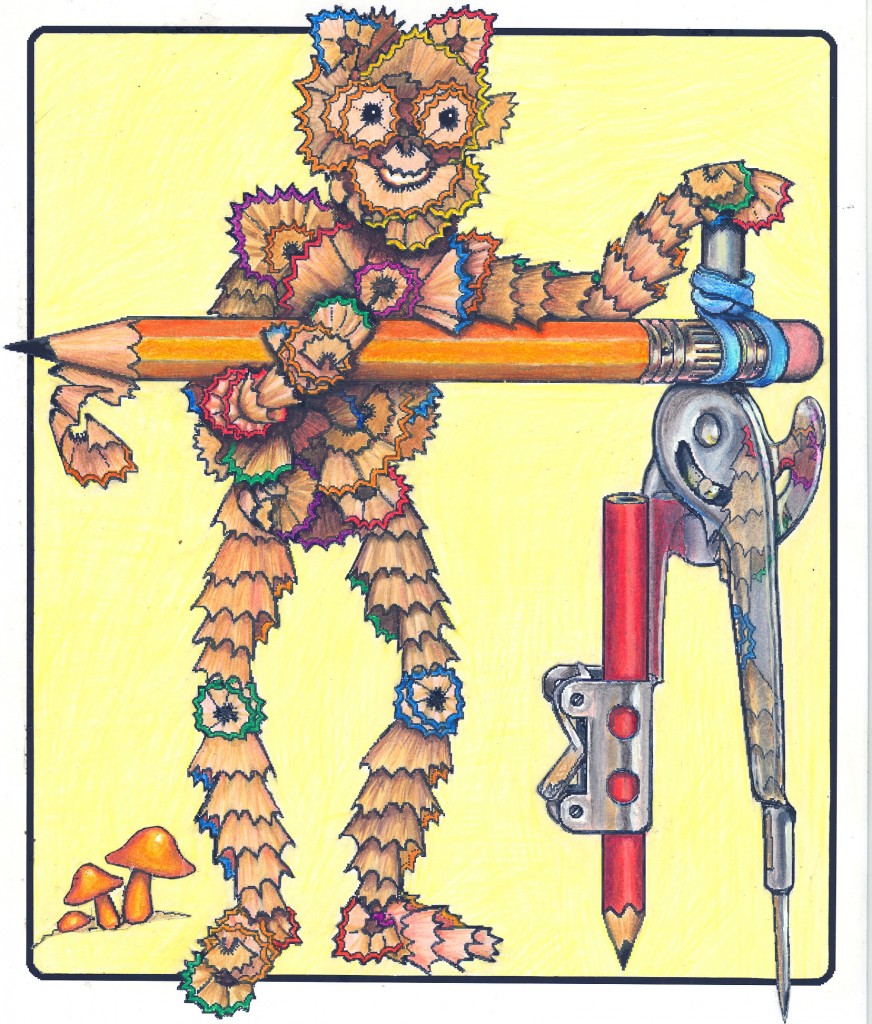
Mr. Pencil Shavings, by Anne Bobroff-Hajal (from ABBIE AND THE DESK DWELLERS)
… or from the imaginary?
Or you may want to paint images from your imagination. If so, you may want to learn to invent “models” from which you can create the imagined scene.
An example of this is animated character designs I created for a screenplay I wrote, called ABBIE AND THE DESK DWELLERS. These characters were made of detritus from kids’ school desks – pencil shavings; dirty broken crayons; gum and candy wrappers and scraps of paper; grungy old erasers and eraser dust.
How would you approach drawing these characters?
Here’s my technique, which you might have fun trying: I did things like grinding out pencil shavings using an old-fashioned pencil sharpener. Then I shaped the pencil shavings – or the worn crayon stubs or the battered erasers – as closely as I could to the character I imagined.
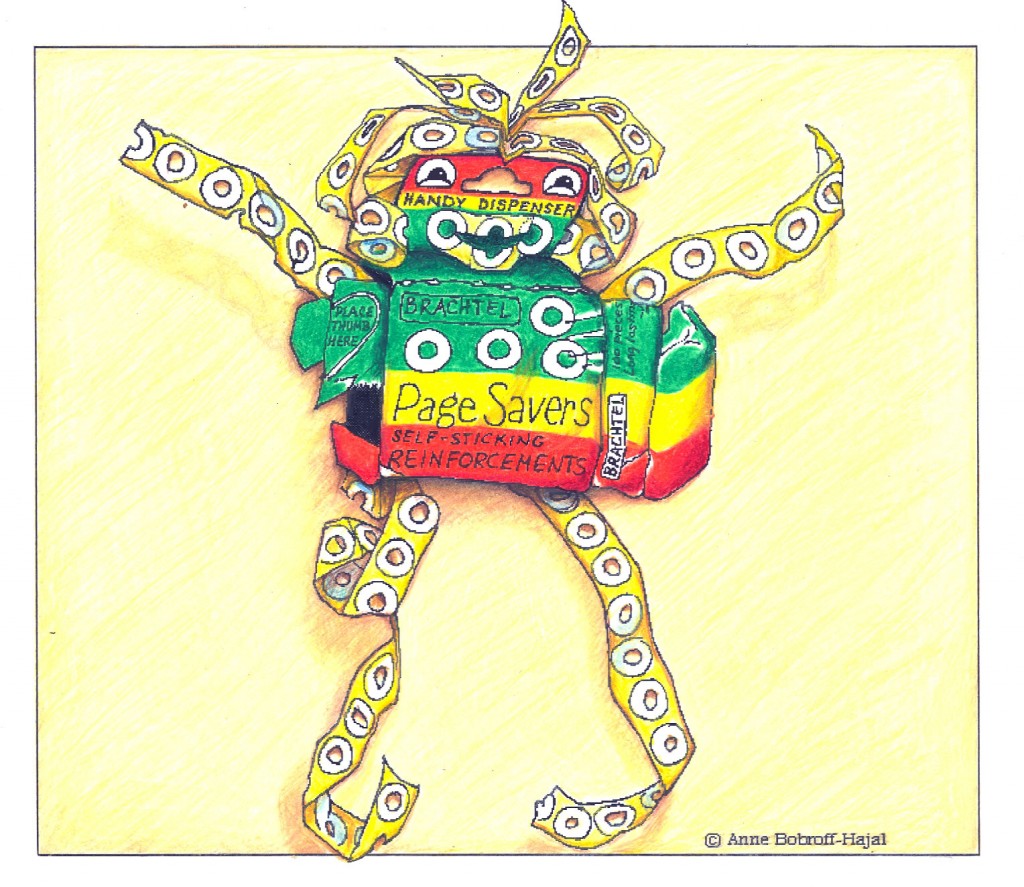
Slo Page Reinforcements, by Anne Bobroff-Hajal (from ABBIE AND THE DESK DWELLERS)
It can be hard because in the real world, things like shavings can’t hold their shape standing up as they can in your imagination. Yet to make the character look real, you need to draw the shavings (or whatever you’re using) from the proper angles even if in actuality they couldn’t hold those positions for more than a split second. So it involves a lot of adjusting the objects as you continue to draw.
Have you ever created models from real world materials to draw your own vision? If so, leave a comment about your method and how it worked. If not, give it a try! It’s challenging and fun to experiment with.
Reflective surfaces
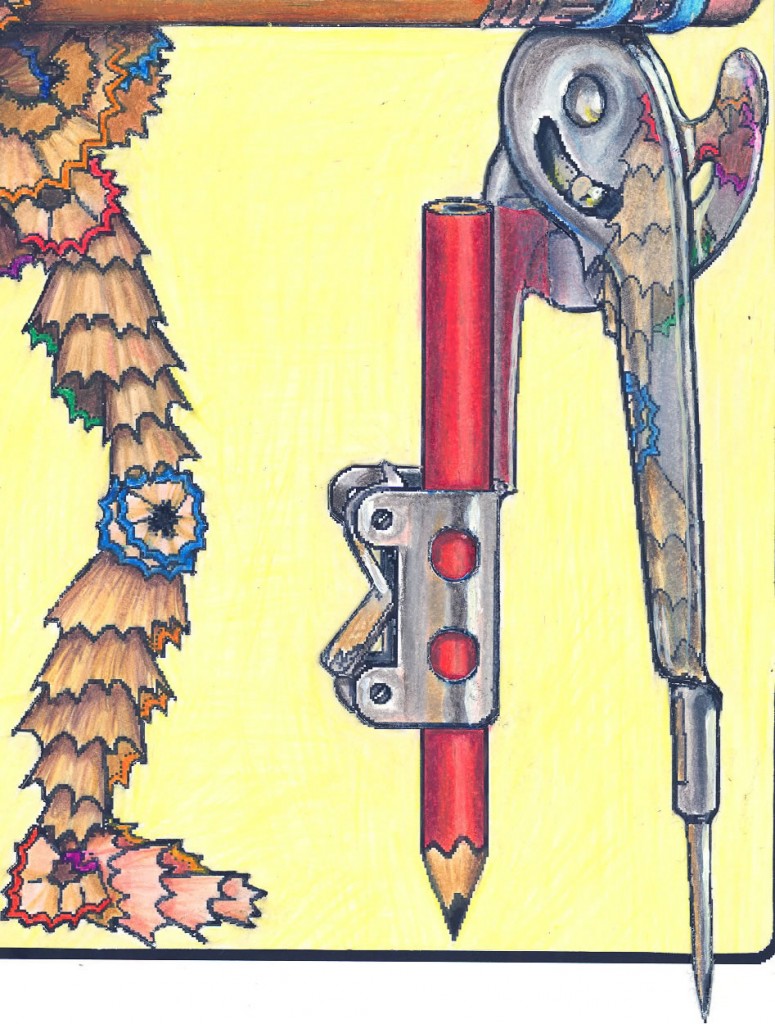
Detail of reflections in protractor (from Anne Bobroff-Hajal's ABBIE AND THE DESK DWELLERS)
Notice the reflection of pencil shavings in the shiny metal of the protractor. What makes any reflective surface look real is that images of nearby objects appear on their surfaces – but not just anywhere.
I carefully set up a pencil shaving “leg” at the distance and angle from the protractor that my character’s leg was positioned.
Notice that the reflections appear in both the upright metal support of the protractor, and the curly metal extension that almost reaches the pencil eraser. Capturing that detail is what makes the protractor look real next to a little man made of pencil shavings.
You might enjoy practicing setting up some objects next to simple reflective surfaces. Look at them really carefully and try to replicate in your drawing exactly what you see.
Don’t bring in preconceived notions of what you think a reflection should look like – its color or shape. Any reflective shape – like the protractor’s – distorts the appearance of the object reflected in it. So just draw exactly the oddities you see, and you will find you’ve drawn a realistic-looking reflection in an object that looks three-dimensional.
But why bother with models? Why not just draw from memory?
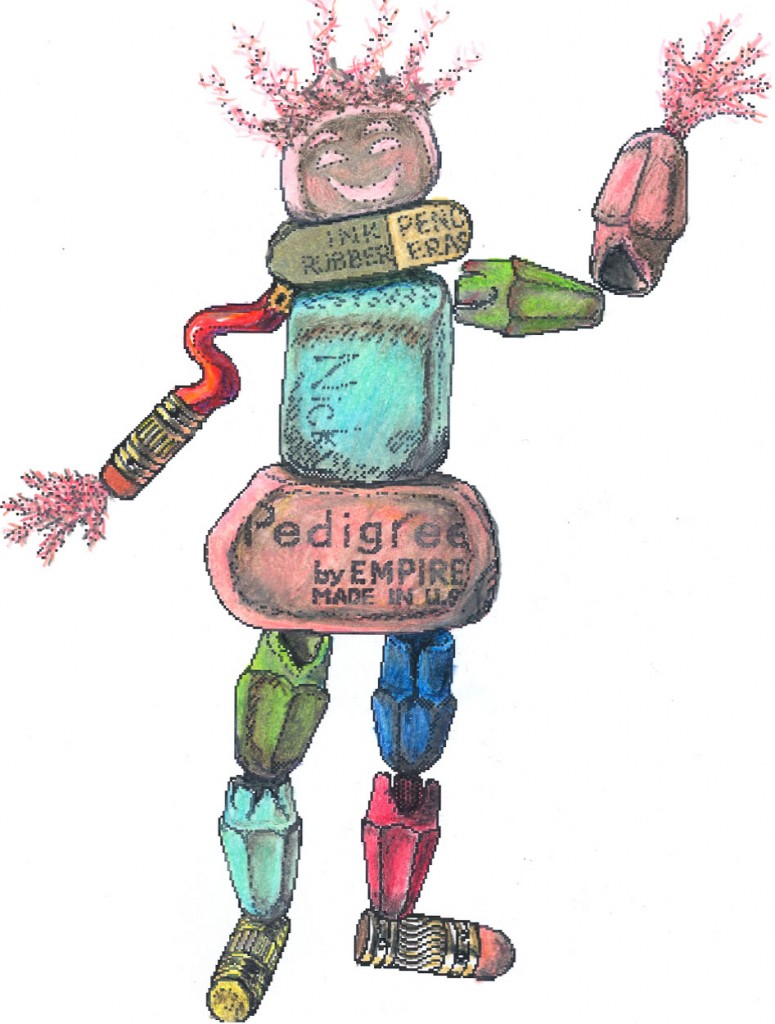
Brenda Eraser Crumbs, by Anne Bobroff-Hajal (from ABBIE AND THE DESK DWELLERS)
Why bother with the hassle of setting up models? Don’t a lot of artists draw purely from memory? The answer is yes, many do.
For me, though, the everyday visual world is full of such surprises that I don’t want to just repeat from memory something I’ve drawn or seen in the past. Drawing from my memory of “what an X looks like,” by definition means I’ve developed a somewhat standardized way of seeing and drawing X. For me – and maybe for you – there’s nothing like the magical pleasure of discovering what’s unique about the particular “X” I’m drawing at that moment, and capturing that uniqueness on paper.
Reality is infinitely variable. If I hadn’t set up my shavings next to the protractor, for example, I might not have guessed that the reflection would appear in the very particular way it does over several surfaces of it. Scroll back up to the protractor closeup image above. Note how the reflection of the shavings continues down the point at the bottom of the protractor as simply a beige stripe. Notice also how the shading of the protractor itself – the grooves down its length, the white highlight at the top of its curve, the indentation around the grommet – all these intermingle with the shavings’ reflections. This interplay is what makes the protractor appear reflective and three-dimensional.
What if your subject is too large to set up a model?
I wish I had human models on retainer who I could call on at any time to dress up in the appropriate costumes and assume the emotions and positions I need to draw! I have a lot of books of models in hundreds of different positions, but I don’t recommend you spend much money on these books. It’s rare to find the exact position you need to simulate a particular activity you want to draw.
And the books don’t include the variations that come from the emotional intent of an action. Any action – say swinging an axe – shapes the human body differently if it’s taken, for example, in anger than if it’s taken in pleasure.
Before the web existed, I used to prowl libraries and magazines for photos that could serve as my models. The internet has provided a new wealth of relatively easily-found photos of people doing all kinds of activities, from shooting arrows on horseback to singing arias. Of course I’d prefer to draw from a three-dimensional reenactment. But I’ll never have a peasant chasing a soldier on horseback with a pitchfork in front of me – or an entire Mongol battle played out before me.
Next post, I’ll provide some tips on how to find images on the web that you can use as models for drawing scenes from your imagination.
Meanwhile, for Jonathan Linton’s popular video drawing demo and commentary, go here.
For a 2-part life drawing lesson, start Part 1 here.
phenergan gel over the counter
synthroid 0.050 mg
I was suggested this blog through my cousin. I am not sure whether or not this post is written by way of him as no one else recognise such targeted
about my problem. You’re amazing! Thanks!
viagra 25 mg tablet price
I don’t know whether it’s just me or if perhaps everybody else encountering
problems with your site. It seems like some of the written text
within your content are running off the screen. Can somebody
else please provide feedback and let me know if this is happening to them too?
This may be a problem with my browser because I’ve had
this happen previously. Thanks
cialis price south africa
tadalafil generic where to buy
drug finasteride
buy citalopram 20mg tablets
buy cialis from canada
how to buy provigil online
phenergan price
Pretty! This was an extremely wonderful article. Many thanks for
supplying this info.
viagra prescription uk
cafergot tablets in india
A dysbiosis diet should correct your gut issues for good, as long as you stick to those dietary changes. is doxycycline an antibiotic
I read this paragraph fully regarding the difference
of hottest and previous technologies, it’s remarkable article.
sumycin cost
where can i get trazodone
sildenafil 20 mg tablet brand name
Hello there, I do think your web site could possibly be having web browser
compatibility issues. Whenever I look at your site in Safari,
it looks fine however, when opening in IE, it’s got some overlapping issues.
I simply wanted to give you a quick heads
up! Besides that, wonderful site!
tadalafil canada generic over the counter
phenergan 50 mg
medication allopurinol
fluoxetine singapore
albendazole tablets in india
provigil prescription online
tadalafil 20 mg over the counter
generic for synthroid
modafinil 100mg
cialis 5mg best price
buy generic viagra online without prescription
cialis 40mg india
darkweb sites reddit dark web directory
It’s remarkable to visit this site and reading the views of all colleagues
regarding this paragraph, while I am also eager of getting experience.
I think everything published was actually very logical. But, what about this?
suppose you typed a catchier post title? I am not suggesting
your content isn’t good, however what if you
added a title to possibly get people’s attention? I mean How to create models for drawing the imaginary « Portrait Artist
from Westchester, NY – Anne Bobroff-Hajal is a little vanilla.
You ought to look at Yahoo’s home page and see how
they write post headlines to grab people to click. You might try adding a video or a pic or
two to grab readers interested about everything’ve got to say.
Just my opinion, it could bring your blog a little bit more interesting.
prednisone online no prescription
You’re so cool! I don’t suppose I’ve truly read
anything like this before. So good to discover someone with some original thoughts on this issue.
Really.. many thanks for starting this up. This web site is something that’s needed on the web,
someone with a little originality!
can you buy zithromax online
where can i buy generic cialis
inderal uk buy
tadalafil us
Great info. Lucky me I discovered your website by accident (stumbleupon).
I’ve saved as a favorite for later!
cheap pet meds without vet prescription canadian online drugs
cafergot usa
https://24hr-pharmacy.top/# prescription drugs from canada online
clomid 25
Ridiculous quest there. What occurred after? Good luck!
brand name allopurinol
buy generic viagra online fast shipping